Best Flooring for Basements: Types, Benefits & How to Choose
Choosing the right basement flooring requires more consideration than selecting flooring for an ordinary bedroom or living room. Because basements are located below ground level, they can experience moisture, condensation, temperature changes, and humidity that affect flooring performance.
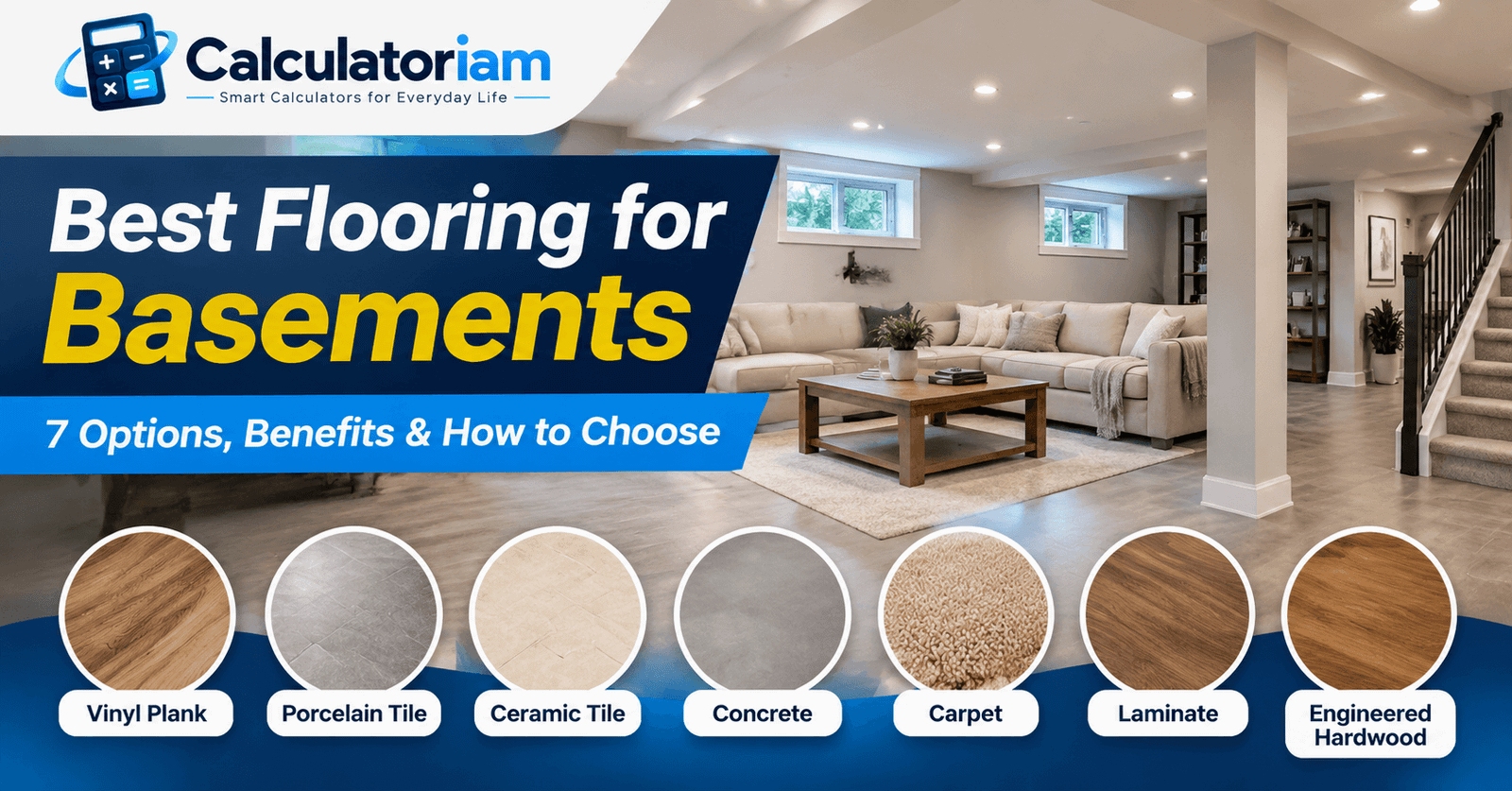
The best flooring for basements depends on several factors, including concrete slab conditions, water resistance, durability, comfort, appearance, and budget. Popular choices include luxury vinyl plank (LVP), porcelain tile, ceramic tile, sealed concrete, carpet, laminate, and engineered hardwood.
In this guide, we compare seven basement flooring options, explain their advantages and disadvantages, and help you choose a suitable material for your space.
What Is the Best Basement Flooring?
The best basement flooring depends primarily on moisture conditions and how you plan to use the space.
For many finished basements, luxury vinyl plank (LVP) is a practical choice because many products offer waterproof surface construction and attractive designs.
However, porcelain tile and sealed concrete may be better choices for spaces that require a durable, moisture-tolerant surface.
Here is a quick comparison:
| Flooring Type | Best For | Main Advantage | Main Limitation |
|---|---|---|---|
| Luxury Vinyl Plank (LVP) | Finished basements | Waterproof product options and attractive designs | Requires a suitable, properly prepared subfloor |
| Porcelain Tile | Bathrooms and moisture-prone areas | Low water absorption and durability | Hard and cold underfoot |
| Ceramic Tile | Utility rooms and finished spaces | Easy maintenance and moisture resistance | Can crack if the substrate moves |
| Sealed Concrete | Workshops and modern basements | Uses the existing concrete surface | Hard and potentially cold |
| Carpet | Dry basement living rooms | Softness and warmth | Can retain moisture |
| Laminate | Dry, properly prepared basements | Wood-like appearance | Many products are unsuitable for below-grade moisture conditions |
| Engineered Hardwood | Controlled, dry basement environments | Natural wood appearance | Requires careful moisture management |
Importantly, no flooring product can correct water intrusion or an unsuitable concrete slab. Therefore, investigate moisture conditions before purchasing materials.
Why Does Choosing the Right Basement Flooring Matter?
Basements have different environmental conditions from other areas of a house. Because the floor is generally constructed over concrete below ground level, moisture management becomes particularly important.
1. Moisture From Concrete Slabs
Concrete is porous and can allow moisture vapor to move through it.
Even when a basement floor looks dry, moisture may still be present within the slab.
Consequently, installing an unsuitable flooring material can lead to adhesive failure, swelling, discoloration, or mold-related problems.
2. Temperature Differences
Basement floors often remain cooler than floors in upper levels.
This can make ceramic tile and concrete uncomfortable during colder months. Therefore, homeowners may prefer materials that provide a warmer underfoot experience, such as carpet or certain vinyl flooring products.
3. Condensation
Condensation can develop when warm, humid air comes into contact with cooler basement surfaces.
For example, this may occur during humid weather when indoor air reaches a cool concrete floor.
As a result, controlling basement humidity is important before installing a new flooring system.
4. Water Intrusion and Flooding
Basements may experience water entry through foundation cracks, plumbing leaks, drainage problems, or groundwater pressure.
If flooding has occurred previously, consider how easily the selected material can be cleaned, dried, or replaced.
For this reason, moisture history should influence your flooring decision.
7 Best Basement Flooring Options Compared
Different materials offer different combinations of durability, appearance, comfort, and moisture resistance.
Let’s examine the most common options.
1. Best Luxury Vinyl Plank Flooring for Basements
Luxury vinyl plank is one of the most versatile choices for finished basements.
It is available in different colors, textures, and wood-look designs. Additionally, many products have waterproof wear layers and rigid cores.
These features make LVP attractive for basement bedrooms, family rooms, offices, and entertainment areas.
Benefits of LVP Flooring
- Many products have waterproof construction.
- Available in realistic wood and stone designs.
- Relatively easy to clean.
- Available in floating click-lock systems.
- Suitable for many residential basement applications.
- Multiple thicknesses and wear-layer options.
Disadvantages of LVP Flooring
- Some products can be damaged by heavy impacts.
- Concrete must meet manufacturer flatness and moisture requirements.
- Installation over an unsuitable slab can cause problems.
- Product quality varies between manufacturers.
- Waterproof planks do not make the entire floor assembly waterproof.
Best Applications
LVP works well in many finished basement environments, including:
- Family rooms.
- Home offices.
- Basement bedrooms.
- Entertainment areas.
- General living spaces.
Verdict: LVP is a strong all-around option for many finished basements, provided the concrete slab is properly evaluated and prepared.
2. Best Porcelain Tile Flooring for Basements
Porcelain tile is another excellent option for basement flooring, especially where moisture resistance and durability are priorities.
It is manufactured using refined clay materials fired at high temperatures. This process produces a dense tile with low water absorption.
Therefore, porcelain tile is commonly considered for basement bathrooms, laundry rooms, and other areas where water exposure is possible.
Benefits of Porcelain Tile
- Low water absorption.
- Durable surface.
- Resistant to many common stains.
- Available in numerous designs and finishes.
- Suitable for many moisture-prone spaces.
- Easy to clean with compatible products.
Disadvantages of Porcelain Tile
- Hard and cold underfoot.
- Installation can require professional expertise.
- Tiles may crack if the substrate moves.
- Grout joints require cleaning and maintenance.
- Initial installation costs may be higher than some alternatives.
Best Applications
Porcelain tile is suitable for:
- Basement bathrooms.
- Laundry areas.
- Utility rooms.
- Basement kitchens.
- Spaces requiring a hard-wearing surface.
Verdict: Porcelain tile is an excellent choice when durability and water tolerance are more important than softness or warmth.
3. Best Ceramic Tile Flooring for Basements
Ceramic tile offers another practical solution for basement floors.
Although ceramic and porcelain tiles are both made from clay-based materials, porcelain is generally denser and has lower water absorption.
Ceramic tile is available in a wide range of colors, patterns, and finishes. Consequently, it can suit different basement designs.
Benefits of Ceramic Tile
- Easy to maintain.
- Available in many styles.
- Suitable for compatible basement concrete slabs.
- Resistant to everyday surface stains.
- Offers a durable finished surface.
Disadvantages of Ceramic Tile
- Can feel cold underfoot.
- Hard surface provides limited cushioning.
- Some products absorb more water than porcelain.
- Grout requires regular maintenance.
- Cracking may occur if the substrate moves.
Best Applications
Ceramic tile can work well in:
- Basement utility rooms.
- Laundry areas.
- Finished living spaces.
- Storage areas.
- Areas with controlled moisture conditions.
Verdict: Ceramic tile is a practical option when you want a hard, easy-to-clean surface without necessarily choosing porcelain.
4. Best Sealed Concrete Basement Flooring
If your basement already has a concrete slab, you may not need to install another flooring material.
Instead, the existing surface can be prepared, polished, stained, or sealed to create a finished appearance.
This approach is particularly suitable for modern, industrial-style basements and functional spaces.
Benefits of Concrete Flooring
- Uses the existing concrete surface.
- Provides a durable floor.
- Offers a simple, modern appearance.
- Requires relatively little surface maintenance when properly finished.
- Can avoid the need for a separate floor covering.
Disadvantages of Concrete Flooring
- Hard and cold underfoot.
- Surface cracks may remain visible.
- Some coatings require periodic maintenance.
- Preparation can be necessary before finishing.
- Moisture conditions may affect coating performance.
Best Applications
Sealed or polished concrete works well for:
- Home gyms.
- Workshops.
- Storage rooms.
- Utility spaces.
- Industrial-style basement interiors.
Verdict: Concrete is a practical choice when durability and simplicity matter more than softness or insulation.
5. Best Carpet Flooring for Dry Basements
Carpet provides a softer and warmer surface than tile or concrete.
For this reason, it is often considered for basement bedrooms, family rooms, and entertainment spaces.
However, carpet requires particular attention to moisture because its fibers, backing, and padding can retain water.
Benefits of Basement Carpet
- Soft and comfortable underfoot.
- Provides a warmer feeling.
- Helps reduce impact noise.
- Available in many colors and textures.
- Suitable for comfortable living spaces.
Disadvantages of Basement Carpet
- Can absorb water.
- Padding may retain moisture.
- Can develop unpleasant odors if it stays damp.
- Cleaning and drying may be difficult after flooding.
- Requires suitable moisture management beneath the installation.
Best Applications
Carpet may be appropriate for:
- Dry basement bedrooms.
- Family rooms.
- Entertainment rooms.
- Home theaters.
- Comfortable recreation areas.
Verdict: Carpet can make a dry basement more comfortable, but it is not a good choice where water intrusion or persistent moisture is present.
6. Best Laminate Flooring for Dry Basements
Laminate flooring offers the appearance of natural wood at a generally accessible price.
It is made from multiple layers, typically including a decorative surface and a fiberboard-based core.
However, standard laminate products can swell when moisture reaches the core.
Therefore, basement installation requires particular care.
Benefits of Laminate Flooring
- Attractive wood-like appearance.
- Available in numerous designs.
- Easy-to-clean surface.
- Often available at competitive prices.
- Some products offer water-resistant or waterproof features.
Disadvantages of Laminate Flooring
- Standard products may swell after moisture exposure.
- Concrete moisture must be evaluated.
- Installation requirements vary by manufacturer.
- Damaged sections may require replacement.
- Not every laminate product is approved for below-grade installation.
Best Applications
Laminate may be considered for:
- Dry finished basements.
- Basement offices.
- Dry recreation rooms.
- Spaces with properly controlled moisture conditions.
Verdict: Laminate can be considered only when the specific product is approved for below-grade installation and the concrete assembly meets its requirements.
7. Best Engineered Hardwood Flooring for Basements
Engineered hardwood offers a natural wood appearance with a layered construction.
Unlike solid hardwood, it consists of a real wood surface layer attached to a multi-layer core.
This construction can provide greater dimensional stability than solid hardwood. Nevertheless, it does not make engineered hardwood waterproof.
Benefits of Engineered Hardwood
- Natural wood appearance.
- Available in different finishes and species.
- Generally more dimensionally stable than solid hardwood.
- Offers an attractive residential finish.
- Can complement premium basement interiors.
Disadvantages of Engineered Hardwood
- Moisture can still damage the material.
- Requires suitable concrete moisture conditions.
- Product installation restrictions vary.
- Repairs may be more complicated.
- Usually requires careful subfloor preparation.
Best Applications
Engineered hardwood may be appropriate for:
- Dry finished basements.
- Controlled indoor environments.
- Premium basement living spaces.
- Areas where a natural wood appearance is important.
Verdict: Engineered hardwood can be an option in suitable dry basements, but manufacturer approval and moisture testing are essential.
Basement Flooring Comparison: Which Material Should You Choose?
Comparing flooring materials side by side makes the selection process easier.
| Flooring Material | Moisture Suitability | Comfort | Maintenance | Best Use |
|---|---|---|---|---|
| Luxury Vinyl Plank | Good with suitable slab conditions | Moderate | Low | Finished living spaces |
| Porcelain Tile | Very high surface water resistance | Low | Low to moderate | Bathrooms and utility areas |
| Ceramic Tile | High surface water resistance | Low | Moderate | General basement areas |
| Sealed Concrete | Depends on slab and coating system | Low | Low to moderate | Workshops and gyms |
| Carpet | Low where moisture is present | High | Moderate to high | Dry bedrooms and family rooms |
| Laminate | Product-dependent; moisture-sensitive | Moderate | Moderate | Dry, approved basement spaces |
| Engineered Hardwood | Requires controlled moisture | High | Moderate | Dry premium interiors |
Remember that moisture suitability is not determined by the surface material alone. The concrete slab, installation system, adhesive, underlayment, and manufacturer requirements also matter.
How to Choose the Best Basement Flooring
Selecting basement flooring becomes easier when you evaluate the space before purchasing materials.
Step 1: Check for Moisture Problems
Start by examining the basement for signs of water intrusion.
Look for:
- Water stains.
- Damp concrete.
- Musty odors.
- Visible condensation.
- Foundation cracks with moisture.
- Previous flooding.
- Persistent humidity.
If water enters the basement, address the source before installing new flooring.
Step 2: Test the Concrete Slab
Concrete can look dry while still releasing moisture vapor.
Therefore, use an appropriate moisture-testing method before installing flooring.
Common professional methods include:
- ASTM F2170 in-situ relative humidity testing.
- ASTM F1869 calcium chloride moisture vapor emission testing.
Follow the flooring manufacturer’s testing requirements and acceptance limits. A simple plastic-sheet observation may indicate a potential moisture concern, but it does not replace standardized testing.
Step 3: Evaluate the Concrete Surface
Check whether the slab is:
- Cracked.
- Uneven.
- Damaged.
- Contaminated.
- Poorly finished.
- Showing signs of previous repairs.
Additionally, check the flatness requirements of your selected flooring product.
For example, many floating floor products require a relatively flat installation surface.
Step 4: Decide How the Basement Will Be Used
Different basement activities require different flooring characteristics.
| Basement Use | Suitable Flooring Options |
|---|---|
| Family room | LVP, carpet in dry conditions |
| Basement bedroom | LVP, carpet, approved engineered wood |
| Home gym | Rubber flooring, sealed concrete |
| Laundry room | Porcelain tile, suitable vinyl |
| Storage room | Sealed concrete, suitable tile |
| Home office | LVP, carpet in dry conditions |
| Basement bathroom | Porcelain tile, suitable vinyl |
Step 5: Compare Your Budget
Your flooring budget should include more than the price of the visible material.
Consider:
- Flooring material.
- Underlayment.
- Moisture-control products.
- Subfloor preparation.
- Installation labor.
- Adhesives.
- Trims and transitions.
- Waste allowance.
- Removal of existing flooring.
As a result, comparing complete installation estimates is more useful than comparing material prices alone.
Step 6: Review Manufacturer Requirements
Before making a purchase, check the installation instructions.
Confirm whether the flooring is approved for below-grade installation and whether it requires a specific moisture barrier, underlayment, adhesive, or expansion space.
Finally, keep the product documentation and installation requirements for future reference.
Best Basement Flooring for Concrete Floors
Many basements have concrete slabs, making flooring compatibility particularly important.
The most suitable option depends on the condition and moisture characteristics of the concrete.
Luxury Vinyl Plank Over Concrete
LVP can be installed over a properly prepared concrete slab when the product’s requirements are satisfied.
However, check the manufacturer’s moisture limits and underlayment specifications.
Porcelain Tile Over Concrete
Porcelain tile can be installed over a suitable concrete substrate.
The slab must be sound, properly prepared, and appropriate for the tile installation system.
Carpet Over Concrete
Carpet can improve comfort, but the concrete must be suitable for the installation.
A compatible moisture-management system may be required. In addition, avoid installing carpet over a slab with unresolved moisture problems.
Laminate Over Concrete
Laminate installation over concrete requires particular attention to moisture protection.
Use only products approved for the intended below-grade application and follow their specific installation instructions.
Common Basement Flooring Mistakes to Avoid
Several mistakes can lead to flooring damage and unnecessary replacement expenses.
| Mistake | Why to Avoid It | Better Approach |
|---|---|---|
| Installing flooring over damp concrete | Moisture can damage the flooring system | Test the slab first |
| Choosing materials based only on appearance | Attractive products may not suit basement conditions | Compare moisture suitability |
| Ignoring previous flooding | Water may return after installation | Correct water intrusion |
| Using unsuitable underlayment | Can interfere with product performance | Follow manufacturer instructions |
| Installing standard laminate in a damp basement | The core may swell | Choose an approved product |
| Ignoring uneven concrete | Can affect floating flooring installation | Prepare the slab appropriately |
| Forgetting expansion requirements | May cause lifting or buckling | Follow installation specifications |
| Comparing only material prices | Leaves out preparation and labor | Estimate the complete project |
Additionally, remember that waterproof flooring does not mean a basement floor system is protected against every type of water problem.
How Much Basement Flooring Do You Need?
Before purchasing flooring, calculate the total area that needs coverage.
For a rectangular basement room, use this formula:
Floor Area = Length × Width
For example, suppose your basement measures:
- Length = 24 feet
- Width = 18 feet
The calculation is:
24 × 18 = 432 square feet
Therefore, the basement has a total floor area of 432 square feet.
Next, include a suitable waste allowance based on the flooring material and installation layout.
Suppose you choose a 10% waste allowance:
432 × 1.10 = 475.2 square feet
You should plan for approximately 476 square feet of flooring coverage, subject to carton rounding and the manufacturer’s recommendations.
For multiple rooms or irregular spaces, calculate each section separately and combine the results.
You can use the Calculatoriam Flooring Calculator to estimate floor area, flooring boxes, waste allowance, and optional material and labor costs.
The Calculatoriam Square Footage Calculator can also help measure multiple rooms and convert between common area units.
These tools provide quantity and cost estimates. They do not determine concrete moisture conditions or approve a particular flooring product.
Frequently Asked Questions About Basement Flooring
What is the best flooring for basements?
Luxury vinyl plank is a practical choice for many finished basements because it offers attractive designs and waterproof product options. However, porcelain tile and sealed concrete may be better for areas where water exposure is a greater concern.
What is the best flooring for a basement concrete floor?
Luxury vinyl plank, porcelain tile, ceramic tile, and suitable concrete coatings are common options. The best choice depends on moisture testing, slab condition, product specifications, and intended use.
Is vinyl plank flooring good for basements?
Yes. Many vinyl plank products are suitable for basement installations. Nevertheless, the concrete slab must meet the manufacturer’s moisture and flatness requirements.
Can you put laminate flooring in a basement?
Some laminate products are approved for below-grade installation. However, standard laminate can swell when exposed to moisture. Always check the product specifications before purchasing.
Is carpet a good choice for basement flooring?
Carpet can make a dry basement feel warmer and more comfortable. However, it is less suitable for areas with water intrusion, persistent dampness, or previous flooding.
What flooring is best for a damp basement?
The appropriate material depends on the source and severity of moisture. Porcelain tile, suitable vinyl products, and compatible concrete finishes may be considered. However, active water problems must be corrected before installation.
Can you install hardwood flooring in a basement?
Solid hardwood is generally not recommended for below-grade spaces because moisture changes can cause expansion, contraction, and other damage. Engineered hardwood may be suitable in some controlled conditions if the manufacturer approves the installation.
Should basement flooring have an underlayment?
Some flooring systems require or allow specific underlayments, while others have attached padding. The correct choice depends on the product, concrete conditions, and manufacturer requirements.
How do you make basement floors warmer?
Options include selecting a warmer flooring material, using an approved insulated subfloor system, and addressing basement temperature and humidity conditions. However, any insulation or vapor-control assembly must be suitable for below-grade construction.
Is waterproof flooring enough to protect a basement?
No. Waterproof flooring protects the material according to its product rating, but it does not stop water from entering through the foundation or concrete slab. Therefore, drainage, moisture control, and proper installation remain important.
Final Thoughts
Choosing the best flooring for basements starts with understanding the conditions beneath the finished surface.
Luxury vinyl plank, porcelain tile, ceramic tile, sealed concrete, carpet, laminate, and engineered hardwood each offer different advantages. However, their suitability depends on moisture exposure, slab condition, comfort requirements, and manufacturer specifications.
For many finished basements, LVP provides a practical combination of appearance, maintenance, and product-level water resistance. Meanwhile, porcelain tile and suitable concrete finishes can be better choices for utility areas and spaces with greater water exposure.
Before making a final decision, inspect the basement, evaluate the concrete, and review the installation requirements.
Ultimately, the best basement flooring is the material that suits the actual conditions of your space and provides reliable performance over time.