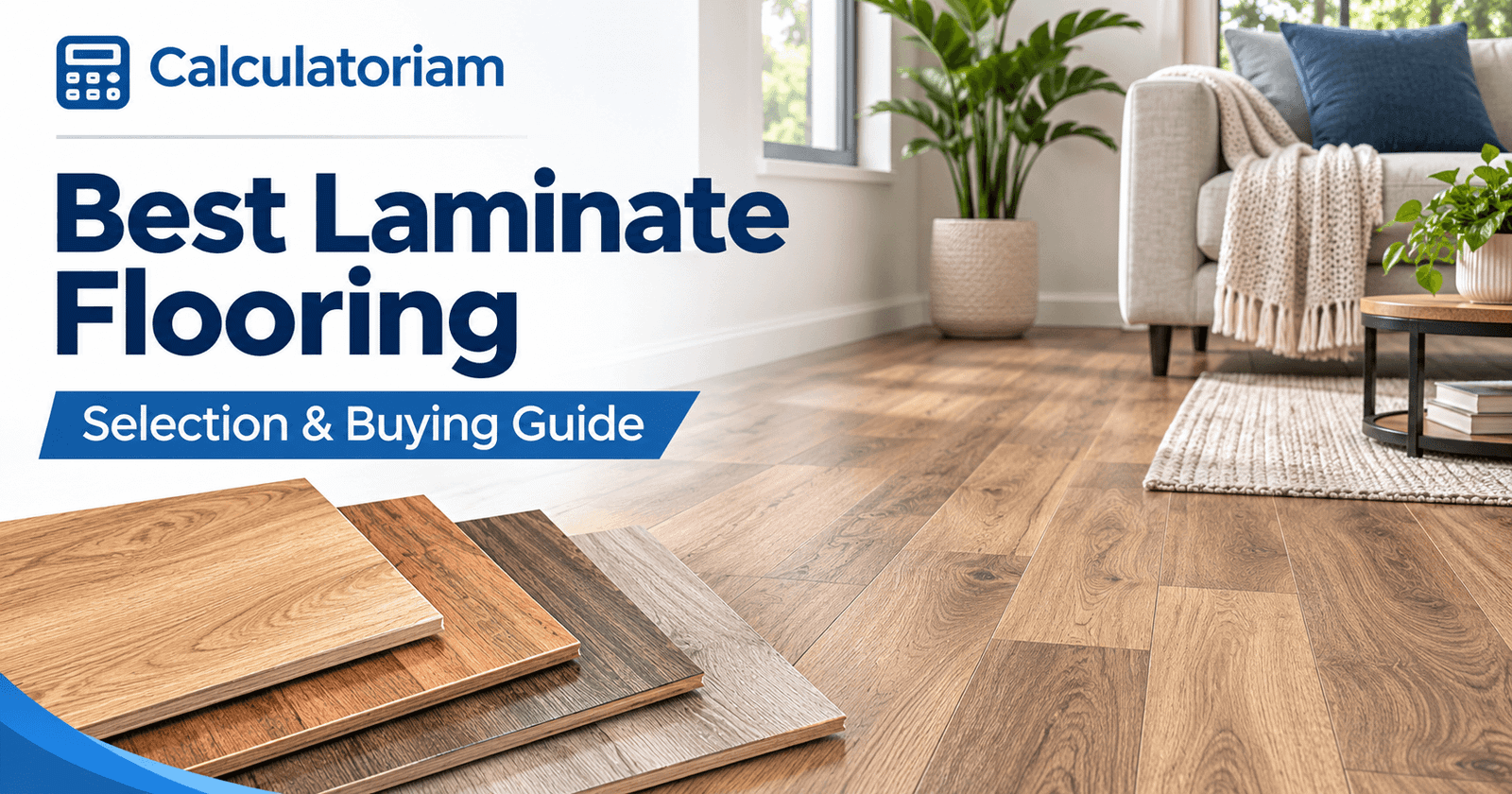
Best Laminate Flooring: How to Choose Quality Floors for Your Home
The best laminate flooring combines a durable wear layer, an appropriate abrasion rating, reliable locking joints, attractive finishes, and moisture protection suited to the room. For most residential spaces, laminate rated AC3 or AC4 is a sensible starting point. However, the right choice depends on foot traffic, subfloor conditions, maintenance needs, and your overall budget.
A busy household with children and pets may benefit from a more abrasion-resistant product. Meanwhile, a quiet bedroom might not need the same specifications. Kitchens and entryways also demand closer attention to water exposure.
Rather than choosing flooring by brand name or plank thickness alone, compare the actual product specifications. This buying guide explains what separates high-quality laminate from basic options, which features matter most, and how to avoid paying extra for benefits you may not need.
What Makes the Best Laminate Flooring?
High-quality laminate flooring must perform well in the conditions where it will be installed. An expensive product is not automatically better for every home.
Most laminate planks contain a decorative image layer protected by a wear-resistant surface, supported by a dense wood-fiber core. The quality of these components affects appearance, performance, and resistance to everyday damage.
When comparing laminate floors, pay attention to these factors:
- Abrasion resistance: Check the published AC rating or applicable product performance certification.
- Core quality: Look for consistent construction and documented resistance to swelling where moisture exposure is possible.
- Plank thickness: Evaluate thickness alongside the flooring’s construction, underlayment, and installation requirements.
- Water protection: Review the manufacturer’s exact spill-resistance conditions and exclusions.
- Locking system: Choose a product with clear installation instructions and joints designed for its intended use.
- Surface appearance: Compare grain patterns, embossing, color variation, and plank-edge details.
- Warranty coverage: Understand which residential uses, conditions, and types of damage the warranty actually covers.
A useful comparison should consider the complete product rather than one advertised feature.
Understanding Laminate Flooring AC Ratings
An abrasion class, or AC rating, helps indicate how well a laminate surface resists wear under standardized testing.
The World Floor Covering Association’s laminate flooring guidance explains the relationship between abrasion classes and intended traffic levels.
| AC Rating | Typical Intended Use | Suitable Setting |
|---|---|---|
| AC1 | Light residential traffic | Low-use bedrooms or guest rooms |
| AC2 | Moderate residential traffic | Dining rooms and moderate-use living spaces |
| AC3 | Heavy residential traffic | Busy family rooms, hallways, and entryways |
| AC4 | Heavy residential and some commercial traffic | Active households and certain offices |
| AC5 | Heavy commercial traffic | High-use commercial environments |
Is AC3 or AC4 Laminate Flooring Better?
AC3 is generally suitable for residential use, including busy areas. AC4 provides a higher abrasion-resistance classification and may be worthwhile for households with heavier traffic.
However, a higher AC rating does not automatically mean better moisture protection, stronger joints, or greater comfort.
For example, an AC4 product with unsuitable moisture limitations could be a poor choice for a kitchen where spills are common. Another laminate with a lower abrasion classification but documented water protection might better match that specific requirement.
Choose the rating based on expected use, then evaluate the remaining specifications separately.
What Thickness of Laminate Flooring Is Best?
Laminate flooring is available in different thicknesses, commonly including 7 mm, 8 mm, 10 mm, and 12 mm.
Thicker planks can offer a different feel underfoot and may affect sound characteristics. Nevertheless, thickness alone does not establish durability or overall quality.
| Thickness | Buying Considerations |
|---|---|
| 7 mm | Evaluate subfloor requirements, locking quality, and suitability for the intended traffic |
| 8 mm | A practical option when product performance and installation specifications match the room |
| 10 mm | Worth comparing when comfort, sound, or plank construction are priorities |
| 12 mm | May provide a more substantial feel, but still requires a properly prepared subfloor |
Is 12 mm Laminate Better Than 8 mm?
Not necessarily. A well-manufactured 8 mm laminate with an appropriate wear rating can be a better purchase than a poorly constructed 12 mm product.
Also, thicker flooring does not eliminate the need to correct uneven surfaces. Every laminate system has specific subfloor flatness requirements.
Compare thickness together with abrasion resistance, joint quality, warranty coverage, and the manufacturer’s installation instructions.
Best Laminate Flooring for Different Rooms
The best type of laminate flooring depends on how each room is used.
Living Rooms and Family Rooms
Living spaces usually need a balance of appearance, scratch resistance, and everyday comfort.
For active family rooms, consider AC3 or AC4 flooring with a surface finish that helps disguise minor dust and everyday marks. A textured wood-look finish can also create a more natural appearance.
Check whether the product requires separate underlayment or already includes an attached pad.
Bedrooms
Bedrooms often experience less concentrated foot traffic than entrances and main hallways.
An AC3 product may provide sufficient abrasion resistance without the need to purchase a heavier commercial-grade option.
Prioritize appearance, comfort, compatible underlayment, and the intended maintenance routine. Flooring samples should be viewed under the room’s actual lighting before making a final color decision.
Kitchens
The best laminate flooring for kitchens should have documented moisture protection appropriate for normal household spills.
Look for a product whose instructions clearly explain:
- How quickly standing water must be removed.
- Whether specific edge or perimeter sealing is required.
- Which kitchen installations are permitted.
- Whether water-related damage is covered by the warranty.
A water-resistant surface does not guarantee protection against plumbing leaks or moisture trapped beneath the floor.
For a detailed explanation, read Is Laminate Flooring Waterproof? Water Resistance Guide.
Hallways and Entryways
Hallways receive repeated foot traffic and may accumulate dirt or moisture from shoes.
AC4 flooring can be worth considering when traffic is particularly demanding. A suitable entrance mat can also help reduce grit reaching the surface.
Check the manufacturer’s cleaning recommendations and avoid relying on the abrasion rating as a measure of slip resistance.
Bathrooms and Laundry Rooms
Bathrooms and laundry areas require special consideration because moisture can reach plank edges, joints, and the underlying substrate.
Only consider laminate products specifically approved by their manufacturers for the intended room and installation conditions.
Even products marketed as waterproof may have limitations concerning standing water, floor drains, leaks, or continuous humidity. When those conditions are likely, another flooring material may be more appropriate.
Best Laminate Flooring Brands: What Should You Compare?
Several established flooring companies offer laminate collections, including Pergo, Mohawk, Quick-Step, and Mannington.
These names can provide a starting point when researching products. However, performance varies across individual collections, and a brand-level ranking cannot replace a comparison of current product specifications.
Instead of asking only which company makes the best laminate flooring, evaluate specific collections using the same criteria.
| Comparison Factor | What to Verify |
|---|---|
| Durability | Published AC rating or documented performance testing |
| Moisture protection | Written water-resistance terms and installation limitations |
| Thickness | Total plank thickness and construction |
| Surface finish | Texture, pattern repeat, and visual realism |
| Installation | Locking method and approved subfloors |
| Warranty | Coverage duration, conditions, and exclusions |
| Availability | Matching transitions, trim, replacement cartons, and accessories |
| Total price | Flooring, underlayment, installation, and preparation expenses |
This method helps identify the strongest product for a particular project without relying on promotional claims or generalized brand rankings.
How to Read Laminate Flooring Reviews
Customer reviews can reveal potential concerns, but they should be evaluated carefully.
Look for detailed comments about joint performance, wear over time, cleaning, and manufacturer support. Pay attention to whether a reported problem involved a specific product defect or an installation issue.
A review describing warped boards after a plumbing leak, for example, does not establish that every product from that brand is defective.
Compare independent feedback with technical documentation and the actual warranty before deciding.
How to Choose Laminate Flooring That Looks Like Real Wood
The best-looking laminate flooring often uses realistic grain patterns, balanced color variation, and surface textures that complement the printed wood design.
Some products use embossed-in-register technology. This technique aligns the surface texture with features in the printed grain, producing a more convincing wood appearance.
When comparing samples, consider three details.
1. Surface Texture
A completely smooth plank may look different from one with subtle grain embossing.
Choose the finish based on the room’s style and your preferred cleaning routine.
2. Plank Color and Variation
Light oak, natural wood, warm brown, and gray-toned finishes create different visual effects.
Examine multiple planks together rather than relying on a single small sample. Repeated grain patterns and abrupt color differences may become more noticeable across a large floor.
3. Plank Size and Edge Design
Wide planks can give a room a different visual character than narrow boards.
Beveled edges may emphasize individual planks, while flatter edge designs can produce a more continuous appearance.
Neither option is universally better. The choice depends on the design and maintenance preferences.
How Much Does Quality Laminate Flooring Cost?
The total cost of laminate flooring depends on the product, floor area, cartons required, accessories, labor, and subfloor preparation.
Comparing only the displayed price per square foot can be misleading because flooring is commonly sold in complete cartons.
Before buying, use the Calculatoriam Flooring Calculator to estimate room area, required boxes, waste-adjusted coverage, and optional material and labor costs.
Example: Calculate the Cost of Laminate Flooring
Suppose you are comparing flooring for a rectangular living room with these hypothetical measurements and purchase details:
- Room length: 18 feet
- Room width: 14 feet
- Waste allowance: 8%
- Coverage per carton: 22 square feet
- Flooring price: $3.25 per square foot
- Installation labor: $2.50 per square foot
Step 1: Calculate the floor area.
Let A represent the floor area, L the length, and W the width.
A=L\times W
Substitute the room dimensions:
A=18\times14=252
The room measures 252 square feet.
Step 2: Include the waste allowance.
Let P represent the waste percentage and A_w the adjusted area.
A_w=A\times\left(1+\frac{P}{100}\right)
Using the hypothetical 8% allowance:
A_w=252\times1.08=272.16
You need at least 272.16 square feet of nominal coverage after applying that allowance.
Step 3: Calculate the number of cartons.
Let B represent the number of cartons and C the coverage per carton.
B=\left\lceil\frac{A_w}{C}\right\rceil
The ceiling symbols mean that the result must be rounded up to a whole carton.
B=\left\lceil\frac{272.16}{22}\right\rceil=13
Answer: Purchase 13 cartons, providing 286 square feet of nominal flooring coverage.
Step 4: Calculate the estimated flooring cost.
Multiply the purchased coverage by the hypothetical material price.
286\times3.25=929.50
The estimated material cost is $929.50.
For labor, multiply the actual floor area by the hypothetical installation rate.
252\times2.50=630.00
Add both estimates:
929.50+630.00=1559.50
Estimated material and installation labor cost: $1,559.50.
These prices are illustrative, not current market quotations. The calculation excludes any additional underlayment, transition strips, removal, subfloor repairs, delivery, and taxes.
The appropriate waste allowance also varies by plank layout and installation requirements.
How to Buy the Best Quality Laminate Flooring Without Overspending
A smart flooring purchase starts with the room’s requirements rather than the highest advertised specification.
Compare Products at the Same Performance Level
First, shortlist laminate products that meet your required traffic rating and moisture conditions.
Then compare installation requirements, appearance, warranty terms, and total material cost.
This prevents a lower-priced but unsuitable product from appearing to be the best deal.
Check the Full Warranty
Warranty periods can look impressive, but the exclusions matter more than the headline number.
Read the conditions covering:
- Residential versus commercial use.
- Surface wear and manufacturing defects.
- Water exposure and moisture damage.
- Subfloor and installation requirements.
- Cleaning products and maintenance.
- Transferability and replacement remedies.
A long warranty does not necessarily cover every type of damage.
Verify Indoor Air Quality Compliance
Many laminate flooring products use composite wood cores. For covered products sold in the United States, formaldehyde emission requirements are relevant.
The U.S. Environmental Protection Agency advises consumers to look for TSCA Title VI compliance labeling on regulated composite wood products and finished goods.
You can review the EPA’s laminate flooring guidance for more information.
Account for Installation Requirements
Check the approved subfloor types, moisture limits, underlayment compatibility, and required expansion space.
A high-quality laminate product may still perform poorly when installed over an unsuitable substrate.
For the complete installation process, see How to Install Laminate Flooring: Step-by-Step DIY Guide.
Common Mistakes When Choosing Laminate Flooring
Even experienced shoppers can focus on the wrong specifications.
Choosing thickness over durability: A thicker plank does not automatically have better abrasion resistance.
Assuming waterproof means unlimited protection: Water-related claims have product-specific conditions.
Ignoring subfloor preparation: Uneven surfaces and moisture problems can affect flooring performance regardless of brand.
Comparing only carton prices: Different cartons contain different coverage areas. Use the actual price per square foot and the required number of full boxes.
Buying without examining samples: Colors and textures may appear different in store lighting than inside the home.
Overlooking accessories: Underlayment, thresholds, trim, and other materials can change the overall purchase cost.
By reviewing these factors early, shoppers can make more practical decisions and reduce the risk of selecting unsuitable flooring.
Best Laminate Flooring: Quick Buying Checklist
Before purchasing, confirm the following:
- The flooring is approved for the intended room.
- The abrasion rating suits expected foot traffic.
- Water-resistance claims match likely exposure.
- Thickness and underlayment meet project requirements.
- The subfloor satisfies the manufacturer’s specifications.
- Samples look appropriate under actual room lighting.
- Warranty conditions and exclusions are understood.
- The product has appropriate compliance documentation.
- Carton coverage, waste, and total material costs are calculated.
- Compatible installation accessories are available.
This checklist is especially useful when comparing several laminate collections with similar designs but different specifications.
Frequently Asked Questions
What is the best laminate flooring for a home?
For many homes, laminate with an AC3 or AC4 rating, suitable moisture protection, reliable joints, and a clear residential warranty is a practical choice. Select the specific product according to room conditions and manufacturer specifications.
What is the most durable laminate flooring?
Higher abrasion classifications indicate greater resistance to surface wear under the relevant testing system. AC4 and AC5 products are designed for more demanding traffic conditions, but durability also depends on moisture resistance, joint performance, installation, and maintenance.
Which laminate flooring brand is best?
No single brand is best for every situation. Compare individual collections from established manufacturers using their published specifications, warranty terms, installation requirements, and availability.
Is expensive laminate flooring worth buying?
A higher price may be worthwhile when it delivers a needed improvement in durability, moisture protection, appearance, or warranty coverage. Paying extra for specifications your room does not require may provide little practical benefit.
What is the best inexpensive laminate flooring?
Look for a competitively priced product with an appropriate residential performance rating, clearly documented installation requirements, and a warranty that covers your intended use. Avoid choosing solely by the lowest price per carton.
Can laminate flooring be installed on uneven floors?
Laminate generally requires a subfloor that meets the manufacturer’s flatness tolerance. Minor variations may be acceptable within those limits, but significant unevenness needs correction before installation. Thicker planks and additional underlayment are not substitutes for proper preparation.
How long does quality laminate flooring last?
There is no single reliable lifespan for every laminate product. Service life depends on construction, traffic, moisture exposure, installation quality, and maintenance. Product-specific warranties and performance documentation provide a better basis for comparing expected use than a universal lifespan claim.
Final Thoughts: Which Laminate Flooring Should You Choose?
The best laminate flooring is the one that meets your room’s actual demands without unnecessary expense.
Start with a suitable abrasion rating and confirmed moisture limitations. Then compare construction quality, realistic finishes, installation requirements, warranty coverage, and total cost.
For many households, a well-specified AC3 or AC4 product offers a reasonable balance of performance and value. However, no single thickness, brand, or rating guarantees the best result in every space.
Once you have selected a product, use the Flooring Calculator to work out how many cartons to purchase and estimate your project budget using the exact coverage and prices of your chosen laminate.