Slope Degrees and Percent Grade Conversion
A 30-degree slope describes a surface that rises or falls at an angle of 30 degrees relative to the horizontal. However, a slope angle of 30 degrees is not the same as a 30% grade. Degrees measure the angle of inclination, while percent grade compares vertical rise with horizontal distance.
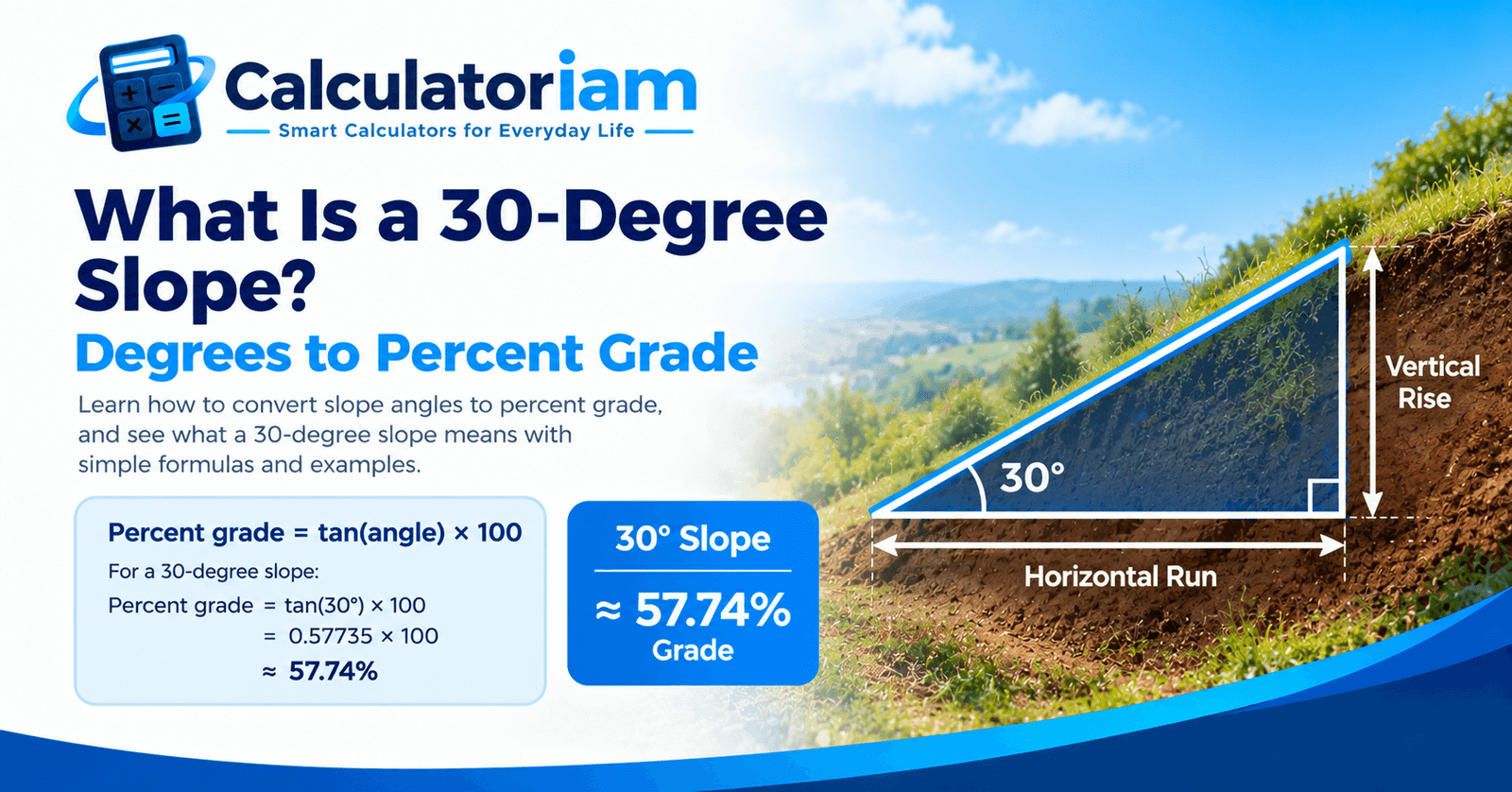
A 30-degree slope is approximately a 57.74% grade. This means the vertical rise is approximately 57.74 units for every 100 units of horizontal distance.
Understanding the difference between degrees and percent grade is useful when interpreting construction plans, measuring terrain, evaluating driveways, planning drainage, and working with slope calculations.
You can use the Calculatoriam Slope Calculator to calculate slope angle, percentage grade, and elevation change from rise and horizontal run.
What Is the Slope of 30 Degrees?
A 30-degree slope forms an angle of 30° with a horizontal reference line.
Imagine a right triangle representing a sloped surface:
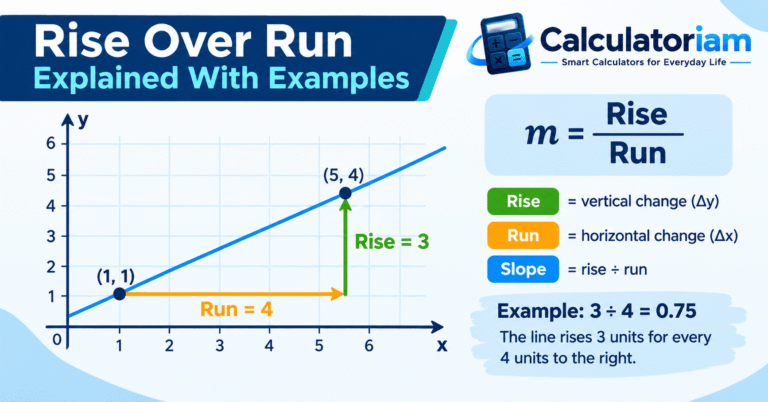
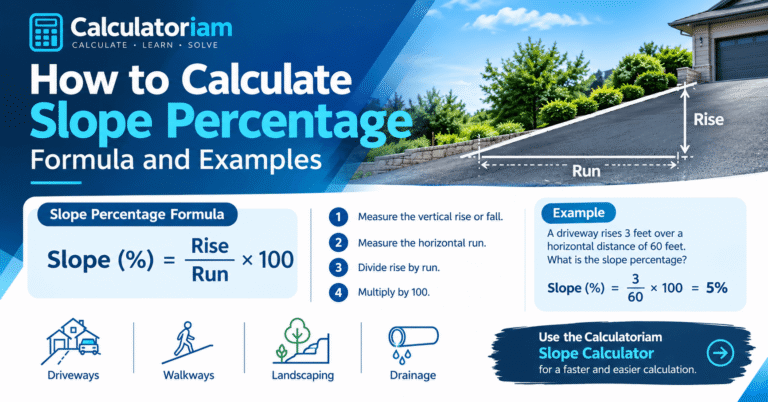
- The horizontal run is the level distance between two points.
- The vertical rise is the elevation difference between those points.
- The slope angle is measured between the horizontal run and the inclined surface.
For a 30-degree angle, the relationship between vertical rise and horizontal run is determined by the tangent function.
The formula is:
Percent grade = tan(angle) × 100
Substitute 30 degrees:
To convert a 30-degree slope into percent grade, use the tangent formula:
Percent grade = tan(30°) × 100
Since tan(30°) ≈ 0.57735, multiply this value by 100.
The result is approximately 57.74% grade.
Therefore, a 30-degree slope corresponds to approximately 57.74% grade.
This percentage describes the geometry of the slope. It does not automatically indicate whether the surface is safe or suitable for a particular construction project.
What Is the Difference Between Slope Degrees and Percent Grade?
Slope degrees and percent grade describe the same general concept—steepness—but use different mathematical measurements.
Slope angle in degrees measures the angle between a surface and the horizontal.
Percent grade measures the vertical change relative to horizontal distance, expressed as a percentage.
For example, a slope with a 30-degree angle has a grade of approximately 57.74%, not 30%.
The distinction matters because degrees and percentages do not increase at the same rate.
A 10-degree slope is approximately a 17.63% grade, while a 45-degree slope is a 100% grade. As the angle approaches 90 degrees, the horizontal run approaches zero and the percent grade increases without a finite upper limit.
How to Convert Slope Degrees to Percent Grade
To convert an angle in degrees to percent grade, use the tangent of the angle and multiply the result by 100.
Formula: Percent grade = tan(angle in degrees) × 100
In this formula:
- Percent grade is the vertical change divided by horizontal run, multiplied by 100.
- Angle is the slope angle measured from the horizontal.
- tan is the tangent trigonometric function.
Most scientific calculators have a tangent function labeled TAN. Make sure the calculator is set to degree mode when entering an angle measured in degrees.
Example: Convert a 30-Degree Slope to Percent Grade
Suppose you need to determine the percent grade of a surface with a 30-degree slope.
Given:
- Slope angle = 30°
- Required result = percent grade
Step 1: Write the formula.
Percent grade = tan(angle) × 100
Step 2: Substitute the angle.
Percent grade = tan(30°) × 100
Step 3: Calculate the tangent.
tan(30°) ≈ 0.577350
Step 4: Multiply by 100.
Percent grade = 0.577350 × 100
Percent grade ≈ 57.74%
Answer: A 30-degree slope is approximately a 57.74% grade.
This conversion works for angles between -90° and 90°, excluding -90° and 90°, where the tangent is undefined.
How to Convert Percent Grade to Degrees
If you know the percent grade and want to find the slope angle, use the inverse tangent function, also called arctangent or atan.
First, divide the percent grade by 100. Then calculate the inverse tangent of that decimal value.
Formula: Angle in degrees = arctan(percent grade / 100) × 180 / π
Here:
- Percent grade is the grade expressed as a percentage.
- arctan is the inverse tangent function.
- π is approximately 3.14159265.
Example: Convert a 30% Grade to Degrees
Suppose a driveway has a grade of 30%. Find its angle in degrees.
Given:
- Percent grade = 30%
- Required result = angle in degrees
Step 1: Convert the percentage to a decimal.
30 / 100 = 0.30
Step 2: Apply the inverse tangent.
Angle = arctan(0.30)
Step 3: Convert the result to degrees.
Angle ≈ 16.70°
Answer: A 30% grade corresponds to an angle of approximately 16.70°.
Notice that a 30% grade is much less steep than a 30-degree slope. This is why you should never treat a percentage and a degree measurement as interchangeable.
Slope Degrees to Percent Grade Conversion Table
The following table shows common slope angles and their approximate percent grades. All angles are measured from the horizontal.
| Slope Angle | Approximate Percent Grade |
|---|---|
| 1° | 1.75% |
| 2° | 3.49% |
| 5° | 8.75% |
| 10° | 17.63% |
| 15° | 26.79% |
| 20° | 36.40% |
| 25° | 46.63% |
| 30° | 57.74% |
| 35° | 70.02% |
| 40° | 83.91% |
| 45° | 100.00% |
| 60° | 173.21% |
| 75° | 373.21% |
Values are rounded to two decimal places. Small differences may occur when using rounded intermediate values.
The table shows that the relationship between angle and percent grade is nonlinear. Increasing the angle by 10 degrees does not produce a constant increase in percent grade.
Percent Grade to Degrees Conversion Table
Use this table when the grade is expressed as a percentage and you need the equivalent angle in degrees.
| Percent Grade | Approximate Slope Angle |
|---|---|
| 1% | 0.57° |
| 2% | 1.15° |
| 3% | 1.72° |
| 5% | 2.86° |
| 10% | 5.71° |
| 15% | 8.53° |
| 20% | 11.31° |
| 25% | 14.04° |
| 30% | 16.70° |
| 40% | 21.80° |
| 50% | 26.57° |
| 75% | 36.87° |
| 100% | 45.00° |
For example, a 2% slope has an angle of approximately 1.15 degrees.
Calculation:
Angle = arctan(2 / 100) × 180 / π
Angle ≈ 1.1458°
This illustrates why a small percentage grade generally corresponds to a relatively small angle.
How to Calculate Slope Degrees From Rise and Run
You can calculate the angle of a slope if you know its vertical rise and horizontal run.
The formula is:
Angle in degrees = arctan(rise / run) × 180 / π
Rise is the vertical elevation change, and run is the horizontal distance between the same two points. Both measurements must use the same unit.
Example: Calculate the Angle From Rise and Run
Suppose a surface rises 6 feet over a horizontal distance of 10.392 feet.
Given:
- Rise = 6 feet
- Horizontal run = 10.392 feet
Step 1: Divide rise by run.
Rise / Run = 6 / 10.392
Rise / Run ≈ 0.5774
Step 2: Calculate the inverse tangent.
Angle = arctan(0.5774)
Angle ≈ 30°
Answer: The slope angle is approximately 30 degrees.
The result is approximate because the horizontal run was rounded. Using the exact relationship for a 30-degree angle gives a horizontal run of approximately 10.3923 feet for a 6-foot rise.
For additional calculations involving rise and run, use the Calculatoriam Slope Calculator.
How to Calculate Rise From Slope Angle and Horizontal Run
If you know the angle and horizontal distance, you can calculate the vertical rise using the tangent function.
Formula: Rise = horizontal run × tan(angle)
For example, suppose a surface has a 30-degree angle and a horizontal run of 20 feet.
Given:
- Angle = 30°
- Horizontal run = 20 feet
Step 1: Write the formula.
Rise = horizontal run × tan(angle)
Step 2: Substitute the values.
Rise = 20 × tan(30°)
Step 3: Calculate the result.
Rise = 20 × 0.577350
Rise ≈ 11.55 feet
Answer: The vertical rise is approximately 11.55 feet.
This calculation estimates the elevation change for a straight, constant-angle slope. It does not establish the suitability of that slope for a real site.
Why a 30% Grade Is Not a 30-Degree Slope
A common mistake is to assume that a 30% grade equals a 30-degree angle. The two values are different because percentage grade is based on a ratio, while degrees describe an angle.
For a 30% grade:
Percent grade = 30%
Convert the percentage to a decimal:
Rise / Run = 30 / 100 = 0.30
Calculate the angle:
Angle = arctan(0.30) × 180 / π
Angle ≈ 16.70°
By contrast, a 30-degree slope has a grade of approximately 57.74%.
The correct relationship is:
- 30% grade ≈ 16.70°
- 30° slope ≈ 57.74% grade
When comparing construction drawings, terrain measurements, or technical specifications, always check whether the value is expressed in degrees, percentage grade, or a slope ratio.
Common Mistakes When Converting Degrees and Percent Grade
Using the Wrong Trigonometric Function
To convert an angle in degrees to percent grade, use tangent.
Percent grade = tan(angle) × 100
To convert percent grade to an angle, use inverse tangent.
Angle = arctan(percent grade / 100)
Using the wrong function can produce an incorrect result.
Forgetting to Multiply by 100
The tangent of 30 degrees is approximately 0.57735. That value is the rise-to-run ratio, not the percentage.
Multiply by 100 to obtain percent grade:
0.57735 × 100 = 57.735%
Using the Wrong Calculator Mode
A scientific calculator may be set to radians instead of degrees. If you enter 30 into a calculator that expects radians, the tangent result will not represent a 30-degree angle.
Check that the calculator is set to degree mode before calculating tangent for an angle specified in degrees.
Confusing Horizontal Run With Sloped Distance
Slope grade calculations use horizontal run, not the diagonal distance measured along the inclined surface.
If you know the sloped distance and the angle, you need a different trigonometric relationship to find the horizontal run before calculating grade.
Assuming the Result Determines Construction Safety
A mathematical conversion describes the geometry of a slope. It does not verify soil stability, drainage performance, accessibility, or compliance with local construction requirements.
For real construction projects, evaluate the relevant site conditions and specifications separately.
Frequently Asked Questions
What is the slope of 30 degrees in percent?
A 30-degree slope is approximately a 57.74% grade.
Formula: Percent grade = tan(30°) × 100
Calculation: 0.577350 × 100 ≈ 57.74%
What angle is a 2% slope?
A 2% grade corresponds to an angle of approximately 1.15 degrees.
Formula: Angle = arctan(2 / 100) × 180 / π
Result: Approximately 1.1458°.
What is a 45-degree slope in percent?
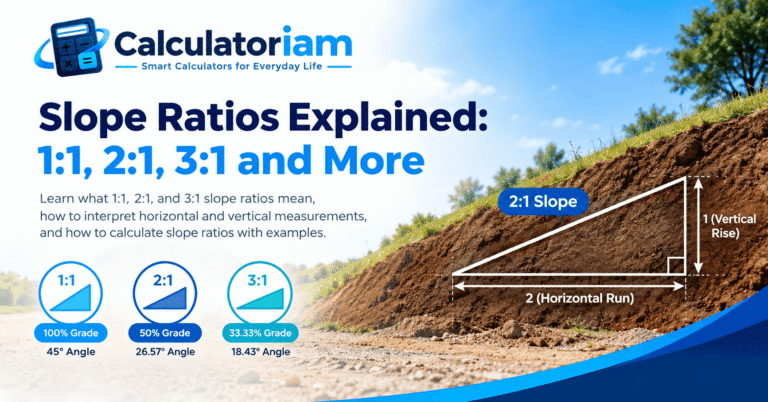
A 45-degree slope corresponds to a 100% grade because the vertical rise equals the horizontal run.
Formula: Percent grade = tan(45°) × 100
Calculation: 1 × 100 = 100%.
Is a 30% slope steeper than a 30-degree slope?
No. A 30% grade corresponds to approximately 16.70 degrees, while a 30-degree slope corresponds to approximately 57.74% grade. Therefore, the 30-degree slope is steeper.
Can percent grade be greater than 100%?
Yes. Percent grade can exceed 100% when the vertical rise is greater than the horizontal run. For example, a 60-degree slope corresponds to approximately 173.21% grade.
How do I convert degrees to slope ratio?
For an angle measured from the horizontal, calculate the rise-to-run ratio using the tangent of the angle.
Rise-to-run ratio = tan(angle)
For a 30-degree angle:
Rise-to-run ratio = tan(30°) ≈ 0.57735
This means approximately 0.57735 units of vertical rise for every 1 unit of horizontal run. If expressing the ratio as horizontal-to-vertical instead, invert the relationship: horizontal-to-vertical ≈ 1.732:1.
Always state which ratio convention you are using.
What is the easiest way to convert slope degrees to percent grade?
Use the tangent formula or enter the rise and horizontal run into a slope calculator that provides both grade percentage and angle. If you know only the angle, calculate tangent of the angle and multiply by 100.
Conclusion
Converting slope degrees to percent grade helps you interpret slope measurements correctly. A 30-degree slope corresponds to approximately 57.74% grade, while a 30% grade corresponds to an angle of approximately 16.70 degrees.
Remember the two main formulas:
Degrees to percent grade: Percent grade = tan(angle) × 100
Percent grade to degrees: Angle = arctan(percent grade / 100) × 180 / π
Use degree mode when calculating angles, keep measurement units consistent when working with rise and run, and distinguish mathematical conversions from project-specific design requirements.
For a quicker calculation, visit the Calculatoriam Slope Calculator to calculate slope angle, percent grade, and elevation change from your measurements.