
How to Calculate Slope Percentage: Formula and Examples
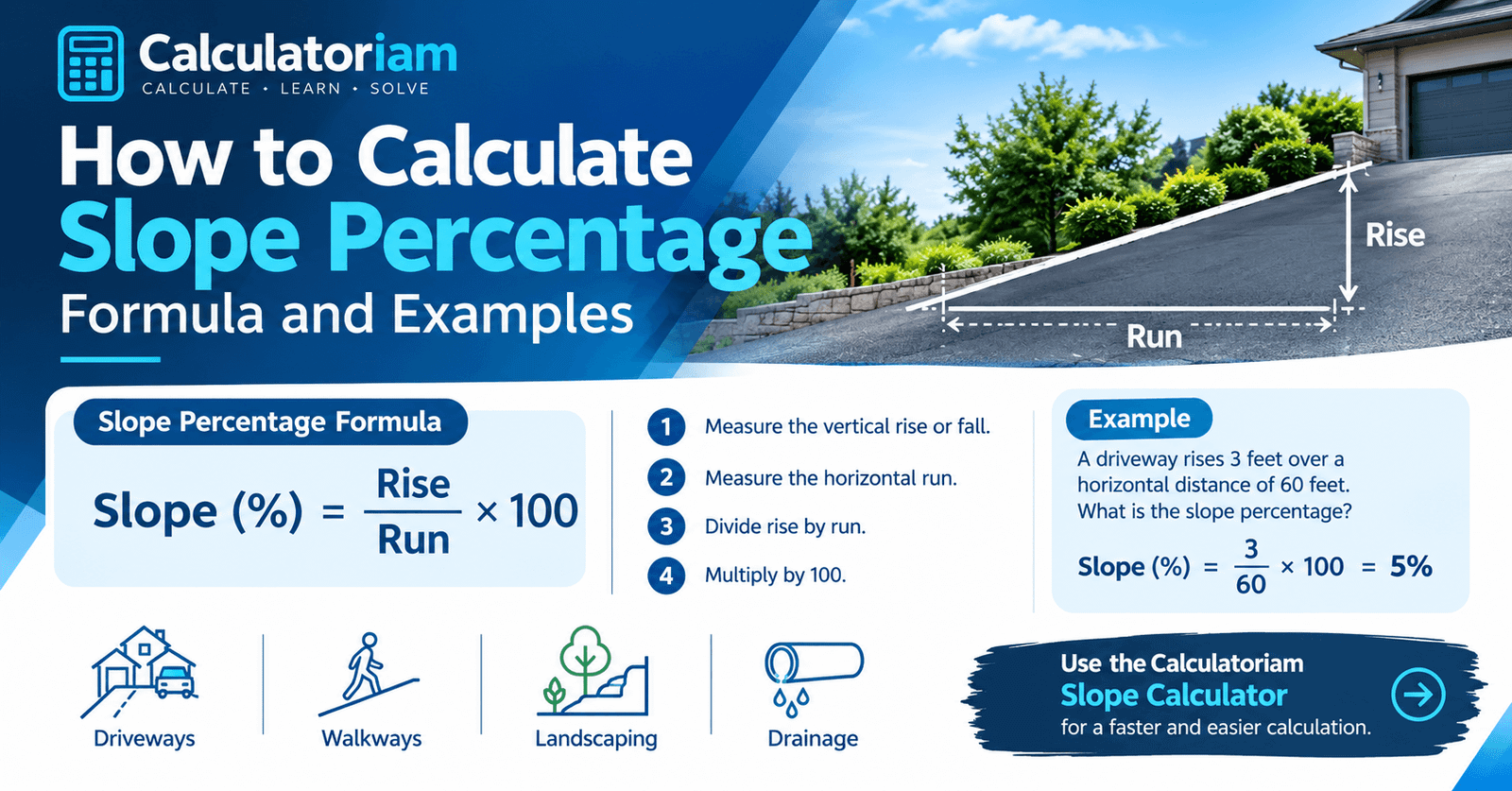
To calculate slope percentage, divide the vertical rise or fall by the horizontal run and multiply the result by 100. The answer expresses how much elevation changes for every 100 units of horizontal distance.
Slope percentage formula:
Slope (%) = (Rise / Run) × 100
For example, if a driveway rises 3 feet over a horizontal distance of 60 feet, its slope is 5%. You can use this calculation to understand grades on driveways, walkways, landscaping, drainage paths, and other sloped surfaces.
For a quicker calculation, use the Calculatoriam Slope Calculator to calculate slope percentage from rise and horizontal run.
What Is Slope Percentage?
Slope percentage, also called percent grade, describes the vertical change of a surface relative to its horizontal distance. It is commonly used to compare how steep or flat a driveway, path, hillside, or other surface is.
A 5% slope means the surface rises or falls 5 units for every 100 units of horizontal distance. The units can be feet, inches, meters, or centimeters, provided the rise and run use the same unit.
For example, a surface with a 5-foot rise over a 100-foot horizontal run has a 5% slope. A surface with a 10-foot rise over the same run has a 10% slope and is steeper.
Slope percentage is not the same as slope angle in degrees. Percentage describes the relationship between vertical change and horizontal distance, while degrees measure the angle between the sloped surface and the horizontal.
Slope Percentage Formula
The formula for calculating slope percentage is:
Formula: Slope (%) = (Rise / Run) × 100
In this formula:
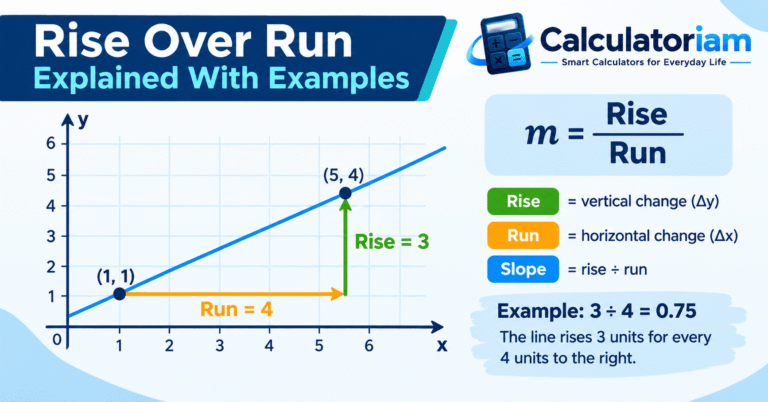
- Rise: The vertical difference in elevation between two points.
- Run: The horizontal distance between those same points.
- 100: The multiplier that converts the rise-to-run ratio into a percentage.
- Slope (%): The resulting grade expressed as a percentage.
Rise and run must be measured using consistent units. For instance, divide feet by feet or inches by inches. If the measurements use different units, convert one measurement before performing the calculation.
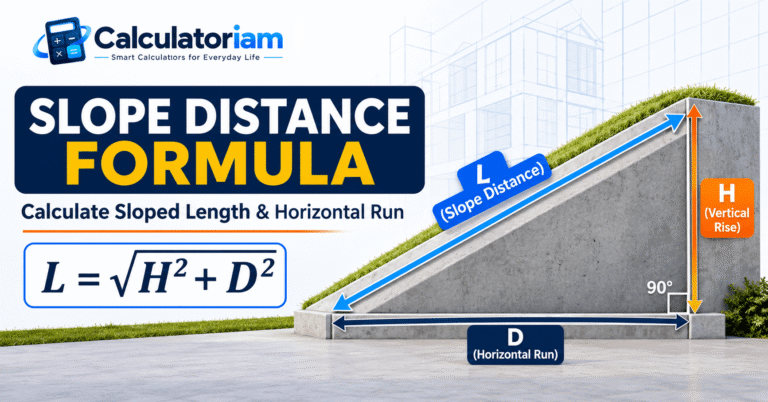
Also, use the horizontal distance rather than the length measured along the inclined surface. The two distances are different whenever the surface has a nonzero elevation change.
How to Calculate Slope Percentage Step by Step
You can calculate percent slope with a basic calculator if you know the vertical rise and horizontal run. Follow these steps to obtain the result.
Step 1: Measure the Vertical Rise or Fall
Determine the elevation difference between the starting point and the ending point. For example, a driveway might rise 2 feet from its entrance to its upper end.
For a downhill surface, measure the amount of vertical fall. If you only need the steepness, you can use the absolute value of the elevation difference. If direction matters, retain the negative sign for a downward change.
Step 2: Measure the Horizontal Run
Measure the level horizontal distance between the same two points. Suppose the driveway has a horizontal run of 40 feet.
Do not substitute the diagonal length of the driveway for the horizontal run. Doing so changes the result and produces an incorrect grade percentage.
Step 3: Divide Rise by Run
Divide the vertical change by the horizontal distance.
Calculation: Rise / Run = 2 / 40 = 0.05
The decimal value represents the ratio of vertical change to horizontal distance.
Step 4: Multiply by 100
Multiply the decimal result by 100 to convert it to a percentage.
Calculation: Slope (%) = 0.05 × 100 = 5%
Therefore, the driveway has a 5% slope. This result describes its geometric grade; whether that grade is suitable depends on the project’s purpose and applicable requirements.
If you already have the rise and run, you can enter them into the Calculatoriam Slope Calculator to calculate the percentage without manually repeating these steps.
Worked Examples of Slope Percentage
The formula stays the same for different projects. However, the result changes according to the relationship between the vertical elevation difference and the horizontal distance.
Example 1: Calculate a Driveway Slope
A driveway rises 3 feet over a horizontal distance of 60 feet. Find its slope percentage.
Given:
- Rise = 3 feet
- Run = 60 feet
Formula: Slope (%) = (Rise / Run) × 100
Substitute: Slope (%) = (3 / 60) × 100
Calculate: Slope (%) = 0.05 × 100 = 5%
Answer: The driveway has a 5% slope.
This means the driveway changes elevation by 5 feet for every 100 feet of horizontal distance at that grade. If the actual rise and run vary along the driveway, the calculated result represents the average grade between the two selected points.
Example 2: Calculate a Walkway Slope in Inches
A walkway falls 4 inches over a horizontal run of 120 inches. Calculate the slope percentage.
Given:
- Rise or fall magnitude = 4 inches
- Run = 120 inches
Formula: Slope (%) = (Rise / Run) × 100
Substitute: Slope (%) = (4 / 120) × 100
Calculate: Slope (%) = 0.033333… × 100 = 3.3333…%
Answer: The walkway has a slope magnitude of approximately 3.33%.
If the walkway falls in the direction of travel, its signed grade is approximately -3.33%. The magnitude describes steepness, while the negative sign indicates the downward direction.
Example 3: Calculate a Patio Slope
A patio has a vertical fall of 3 inches over a horizontal run of 12 feet. Find its slope percentage.
The measurements use different units, so convert the horizontal run to inches first.
Convert the run: 12 feet × 12 inches per foot = 144 inches
Given:
- Rise or fall magnitude = 3 inches
- Run = 144 inches
Formula: Slope (%) = (Rise / Run) × 100
Substitute: Slope (%) = (3 / 144) × 100
Calculate: Slope (%) = 0.0208333… × 100 = 2.0833…%
Answer: The patio has a slope magnitude of approximately 2.08%.
This is a mathematical example, not a universal drainage recommendation. The appropriate slope for a patio depends on the surface design, drainage conditions, and applicable project requirements.
Example 4: Calculate a Steeper Ground Slope
A section of ground rises 12 feet over a horizontal distance of 30 feet. Calculate its slope percentage.
Formula: Slope (%) = (Rise / Run) × 100
Substitute: Slope (%) = (12 / 30) × 100
Calculate: Slope (%) = 0.4 × 100 = 40%
Answer: The ground has a 40% slope.
A 40% slope does not mean the surface forms a 40-degree angle. Percentage grade and angular measurement use different scales, so they should not be interpreted as interchangeable values.
Slope Percentage Reference Table
The following table shows common rise-to-run relationships and their corresponding percentage grades. Each example assumes a horizontal run of 100 feet.
| Rise | Horizontal Run | Slope Percentage |
| 1 foot | 100 feet | 1% |
| 2 feet | 100 feet | 2% |
| 5 feet | 100 feet | 5% |
| 10 feet | 100 feet | 10% |
| 20 feet | 100 feet | 20% |
| 50 feet | 100 feet | 50% |
| 100 feet | 100 feet | 100% |
A larger absolute rise-to-run ratio produces a steeper grade. A zero rise over a positive horizontal run produces a 0% slope, meaning the two endpoints have the same elevation.
A percentage grade can exceed 100%. For example, a 120-foot rise over a 100-foot horizontal run produces a 120% grade. This is mathematically valid because the vertical rise is greater than the horizontal run.
How to Calculate Slope Percentage From Different Measurements
Sometimes, you may know the desired grade rather than the rise and run. In other situations, you may have measurements in different units or need to compare percentage grade with an angle. The following relationships help you handle these cases.
Calculate Slope Percentage From Feet
When both measurements are in feet, divide the rise in feet by the horizontal run in feet and multiply by 100.
Example: A surface rises 6 feet over a 150-foot horizontal run.
Calculation: Slope (%) = (6 / 150) × 100 = 4%
The slope is 4%. You do not need to convert feet into inches when both measurements already use the same unit.
Calculate Slope Percentage From Inches
When rise and run are both measured in inches, use the same formula without converting either value.
Example: A surface rises 2 inches over a horizontal run of 96 inches.
Calculation: Slope (%) = (2 / 96) × 100 = 2.0833…%
The slope is approximately 2.08%. If the horizontal distance were given in feet instead, convert it to inches or convert the rise to feet before dividing.
Calculate the Required Rise From a Percentage Grade
If you know the target grade and horizontal run, you can calculate the required vertical rise or fall by rearranging the slope percentage formula.
Formula: Rise = (Slope (%) / 100) × Run
For example, suppose a surface must have a 3% grade over a horizontal run of 80 feet.
Substitute: Rise = (3 / 100) × 80
Calculate: Rise = 0.03 × 80 = 2.4 feet
Answer: The required elevation change is 2.4 feet, or 28.8 inches.
This calculation determines the geometric elevation difference. It does not establish whether a proposed grade meets building, drainage, roadway, or accessibility requirements.
Calculate Horizontal Run From Rise and Slope Percentage
If the vertical rise and target grade are known, you can calculate the horizontal distance required to achieve that grade.
Formula: Run = Rise / (Slope (%) / 100)
Suppose a surface rises 2 feet and must have a 4% grade.
Substitute: Run = 2 / (4 / 100)
Calculate: Run = 2 / 0.04 = 50 feet
Answer: The required horizontal run is 50 feet.
These inverse calculations are useful when planning dimensions from a known elevation difference or a target grade.
Slope Percentage vs. Slope Angle in Degrees
Slope percentage and slope angle both describe steepness, but they measure it differently. A percentage grade compares rise with horizontal run, while an angle measures the inclination from the horizontal.
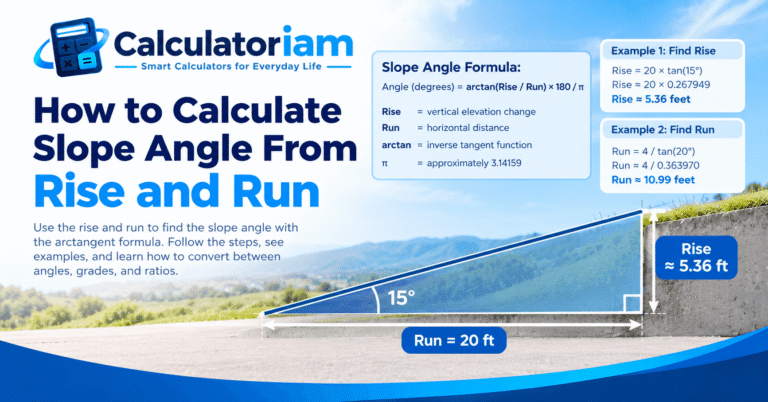
To calculate the angle in degrees from rise and run, use the inverse tangent function.
Formula: Angle (degrees) = arctan(Rise / Run) × 180 / π
For example, a rise of 3 feet over a horizontal run of 60 feet gives:
Ratio: Rise / Run = 3 / 60 = 0.05
Angle: arctan(0.05) × 180 / π ≈ 2.8624 degrees
The slope is 5%, while the angle is approximately 2.86 degrees.
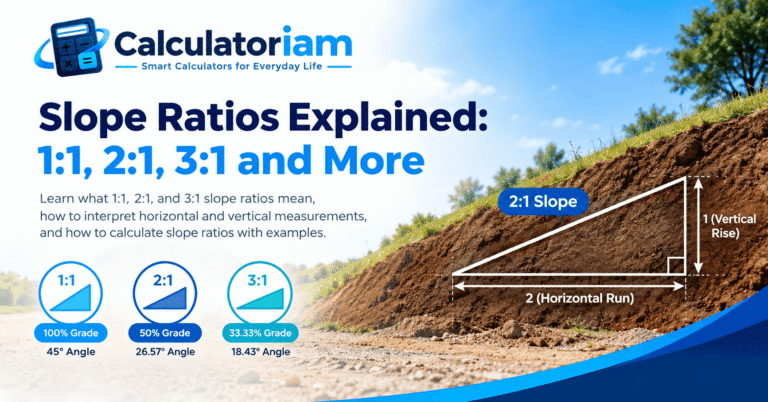
A 100% grade corresponds to a 45-degree angle because the rise equals the horizontal run. It does not represent a vertical surface. As the angle approaches 90 degrees, the horizontal run approaches zero and the percentage grade increases without a finite upper limit.
If you need to review grade, angle, and related measurements together, use the Calculatoriam Slope Calculator.
Common Mistakes When Calculating Slope Percentage
Even though the formula is straightforward, incorrect measurements or assumptions can produce misleading results. Check the following points before relying on a calculated grade.
Using Sloped Distance Instead of Horizontal Run
The denominator in the slope percentage formula is horizontal run, not the diagonal distance along the surface. These values differ whenever the surface rises or falls.
Measure the horizontal separation between the endpoints or obtain it from an appropriate measurement method. Do not automatically substitute the length of a ramp, hillside, or inclined driveway.
Mixing Measurement Units
Dividing a rise measured in inches by a run measured in feet without converting one of them produces an incorrect result.
For example, a 3-inch rise over 12 feet must be calculated as either 3 inches divided by 144 inches or 0.25 feet divided by 12 feet. Both approaches produce approximately 2.08%.
Confusing Percentage With Degrees
A 5% grade is not a 5-degree angle. A 5% grade corresponds to an angle of approximately 2.86 degrees, while a 5-degree angle corresponds to a grade of approximately 8.75%.
Always confirm whether a plan, specification, or measurement gives a percentage, an angle in degrees, or a ratio before using the value.
Ignoring Uphill and Downhill Direction
The magnitude of the grade indicates steepness, but the sign indicates direction when the starting and ending points are defined. An uphill change can be represented as positive, while a downhill change can be represented as negative.
For drainage and elevation planning, direction can be as important as the percentage itself. Make sure the measurements follow a clearly defined direction of travel.
Assuming a Calculated Grade Meets Project Requirements
A mathematically correct percentage does not automatically establish that a driveway, patio, ramp, pipe, or other surface is suitable for its intended use.
Drainage performance, accessibility, structural design, and construction requirements can depend on additional measurements, applicable codes, surface conditions, and project specifications. Verify those requirements separately before construction.
Frequently Asked Questions
How do you calculate slope percentage?
Divide the vertical rise by the horizontal run and multiply the result by 100. For example, a 4-foot rise over a 100-foot horizontal run produces a 4% slope.
Formula: Slope (%) = (Rise / Run) × 100
What is the formula for a 5% slope?
A 5% slope means the vertical rise or fall equals 5% of the horizontal run.
Formula: Rise = 0.05 × Run
For a 100-foot horizontal run, a 5% grade corresponds to a 5-foot elevation change. For a 20-foot run, it corresponds to a 1-foot change.
Is a 5% slope the same as a 5-degree slope?
No. A 5% grade corresponds to approximately 2.86 degrees. A 5-degree angle corresponds to approximately 8.75% grade. Percentage and degrees are different ways of expressing steepness.
Can slope percentage be greater than 100%?
Yes. A slope exceeds 100% when the magnitude of the vertical rise is greater than the horizontal run. For example, a 150-foot rise over a 100-foot horizontal run produces a 150% grade.
Can I calculate slope percentage using inches and feet?
Yes, but convert the measurements to the same unit first. For example, if the rise is 3 inches and the horizontal run is 10 feet, convert 10 feet to 120 inches before calculating the grade.
Calculation: Slope (%) = (3 / 120) × 100 = 2.5%
How do you calculate slope percentage when the ground falls?
Use the vertical elevation change and horizontal run in the standard formula. If direction is important, represent a fall as a negative rise. For example, a 2-foot fall over a 100-foot horizontal run corresponds to a signed grade of -2% when measured in the downhill direction.
How do you calculate slope percentage without a calculator?
Divide the rise by the horizontal run, then multiply by 100. For simple values, you can perform the division mentally or by hand. For example, 5 divided by 100 equals 0.05, and 0.05 multiplied by 100 equals 5%.
What is the difference between rise, run, and slope length?
Rise is the vertical elevation change, run is the horizontal distance, and slope length is the diagonal distance along the inclined line connecting the two endpoints. Slope percentage uses rise and horizontal run, not slope length.
Does slope percentage determine whether a ramp is accessible?
No. Slope percentage describes the geometric grade, but it does not establish compliance with accessibility requirements. Ramp design may also depend on factors such as rise limits, landings, clear width, cross slope, handrails, and other applicable criteria. Check the requirements that apply to the specific project.
Conclusion
Calculating slope percentage requires only two measurements: vertical rise or fall and horizontal run. Divide the elevation change by the horizontal distance and multiply by 100 to obtain the grade.
Remember: Slope (%) = (Rise / Run) × 100
Use consistent measurement units, measure horizontal distance rather than diagonal surface length, and distinguish percentage grade from angle in degrees. For a faster calculation, open the Calculatoriam Slope Calculator and enter your measurements.
For actual construction, drainage, or accessibility projects, treat the calculated grade as a geometric measurement and verify the design against the requirements and conditions that apply to the site.


3 Comments