
Slope Ratios Explained: 1:1, 2:1, 3:1 and More
A slope ratio describes how much a surface rises or falls compared with the distance it travels horizontally. You may see slope ratios written as 1:1, 2:1, 3:1, or other combinations when working with landscaping, grading, embankments, drainage, and construction projects.
A 2:1 slope commonly means 2 units of horizontal distance for every 1 unit of vertical change when the ratio is written as horizontal:vertical. Under this convention, a slope that extends 2 feet horizontally for every 1 foot of rise or fall has a 2:1 ratio.
However, not every source uses the same ratio order. Some mathematical and technical contexts express slope as vertical change divided by horizontal change, or rise over run. Always check the convention before interpreting a ratio.
You can use the Calculatoriam Slope Calculator to calculate slope, grade percentage, angle, and elevation change from rise and horizontal run.
What Is a Slope Ratio?
A slope ratio expresses the relationship between two measurements that describe the steepness of a line or surface.
For construction and land grading, the two measurements are commonly:
- Horizontal run: The level distance between two points.
- Vertical rise or fall: The elevation difference between those points.
A slope ratio may be written as horizontal distance to vertical distance or vertical distance to horizontal distance. The order matters because the same numbers can describe different slopes when reversed.
For example, under the horizontal-to-vertical convention:
- A 1:1 slope has 1 unit of horizontal distance for every 1 unit of vertical change.
- A 2:1 slope has 2 units of horizontal distance for every 1 unit of vertical change.
- A 3:1 slope has 3 units of horizontal distance for every 1 unit of vertical change.
As the horizontal distance increases relative to the same vertical change, the slope becomes flatter.
What Is a 2:1 Slope?
A 2:1 slope commonly describes a surface with 2 units of horizontal run for every 1 unit of vertical rise or fall.
The ratio is:
Horizontal distance : Vertical distance = 2:1
For example, if a slope extends 2 feet horizontally and changes elevation by 1 foot, its horizontal-to-vertical ratio is 2:1.
The same relationship works with other units, provided both measurements use the same unit.
Examples include:
- 2 inches horizontally for 1 inch vertically.
- 4 feet horizontally for 2 feet vertically.
- 10 meters horizontally for 5 meters vertically.
Each example has the same 2:1 ratio because the horizontal measurement is twice the vertical measurement.
What Does a 2:1 Slope Look Like?
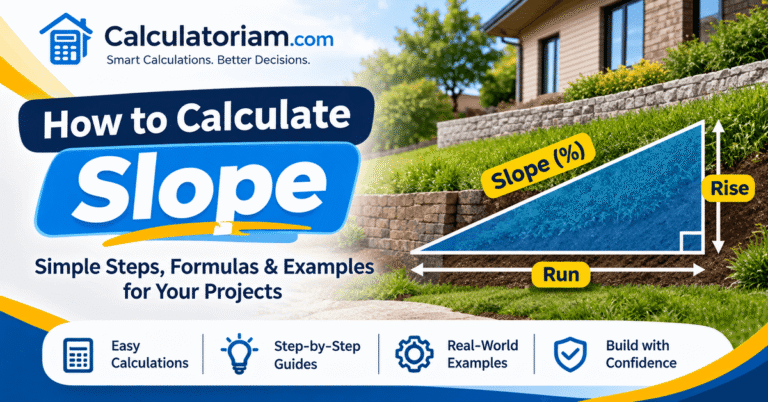
Imagine a triangular cross-section with a horizontal base of 2 feet and a vertical height of 1 foot.
The horizontal leg is twice as long as the vertical leg. The diagonal line between the endpoints represents the sloped surface.
Conceptual diagram: a 2:1 horizontal-to-vertical slope. The horizontal run is twice the vertical change.
A 2:1 slope is steeper than a 3:1 slope but flatter than a 1:1 slope, assuming all ratios use the horizontal-to-vertical convention.
What Is a 1:1 Slope?
A 1:1 slope has equal horizontal and vertical measurements when written as horizontal:vertical.
For example:
- Horizontal run = 1 foot
- Vertical rise = 1 foot
The ratio is:
Slope ratio = 1:1
Because the vertical and horizontal changes are equal, the slope forms a 45-degree angle with the horizontal.
This can also be expressed as a 100% grade because the rise equals the run.
A 1:1 ratio is steeper than 2:1 and 3:1 under the horizontal-to-vertical convention. Whether such a slope is suitable for a real project depends on the soil, materials, loading, drainage, and applicable engineering requirements.
What Is a 3:1 Slope?
A 3:1 slope means 3 units of horizontal distance for every 1 unit of vertical change when written as horizontal:vertical.
For example:
- Horizontal run = 3 feet
- Vertical rise = 1 foot
The ratio is:
Slope ratio = 3:1
Compared with a 2:1 slope, a 3:1 slope is flatter because it requires more horizontal distance to achieve the same elevation change.
For the same 1-foot vertical change:
- A 1:1 slope requires 1 foot of horizontal run.
- A 2:1 slope requires 2 feet of horizontal run.
- A 3:1 slope requires 3 feet of horizontal run.
- A 4:1 slope requires 4 feet of horizontal run.
This comparison is useful when estimating the horizontal space needed for a proposed grade.
Slope Ratio Comparison: 1:1, 2:1, 3:1, and 4:1
The following table uses the horizontal-to-vertical convention. Each ratio represents horizontal run first and vertical change second.
| Slope Ratio | Horizontal Run | Vertical Change | Approximate Angle | Slope Percentage |
| 1:1 | 1 unit | 1 unit | 45.00° | 100% |
| 2:1 | 2 units | 1 unit | 26.57° | 50% |
| 3:1 | 3 units | 1 unit | 18.43° | 33.33% |
| 4:1 | 4 units | 1 unit | 14.04° | 25% |
| 5:1 | 5 units | 1 unit | 11.31° | 20% |
| 10:1 | 10 units | 1 unit | 5.71° | 10% |
The angle and percentage values are mathematical conversions based on the stated convention. They are not recommendations for a particular construction project.
How to Calculate a Slope Ratio
You can calculate a slope ratio by measuring the horizontal run and vertical rise or fall, then expressing those measurements in a consistent ratio.
Step 1: Measure the Horizontal Run
Determine the horizontal distance between the two points.
For example:
Horizontal run = 12 feet
Use the level distance, not the length measured along the sloped surface.
Step 2: Measure the Vertical Rise or Fall
Determine the difference in elevation between the same points.
For example:
Vertical change = 4 feet
The measurements should describe the same two endpoints.
Step 3: Write the Ratio
For a horizontal-to-vertical ratio, write the horizontal run first and the vertical change second.
Slope ratio = Horizontal run : Vertical change
Substitute the measurements:
Slope ratio = 12:4
Step 4: Simplify the Ratio
Divide both sides by the same positive number until the ratio is in its simplest form.
12 ÷ 4 = 3
4 ÷ 4 = 1
Therefore:
Slope ratio = 3:1
The slope has 3 units of horizontal run for every 1 unit of vertical change.
How to Calculate the Horizontal Run From a Slope Ratio
If you know the slope ratio and vertical change, you can calculate the required horizontal run.
For a horizontal-to-vertical ratio written as H:V:
Horizontal run = Vertical change × (H / V)
Here:
- H is the horizontal part of the ratio.
- V is the vertical part of the ratio.
For example, suppose a slope has a 3:1 ratio and a vertical change of 2 feet.
Horizontal run = 2 × (3 / 1)
Horizontal run = 6 feet
The horizontal distance is 6 feet.
This calculation can help establish basic dimensions, but it does not confirm that a proposed slope is structurally stable or suitable for a specific site.
How to Calculate Vertical Rise From a Slope Ratio
You can also calculate the vertical change when the horizontal run and slope ratio are known.
For a horizontal-to-vertical ratio written as H:V:
Vertical change = Horizontal run × (V / H)
For example, a 4:1 slope extends 20 feet horizontally.
Vertical change = 20 × (1 / 4)
Vertical change = 5 feet
The vertical change is 5 feet.
This method works when the measurements and ratio use the same convention. If the surface descends instead of rising, the magnitude remains 5 feet, but the direction is downward.
How to Convert a Slope Ratio to a Percentage
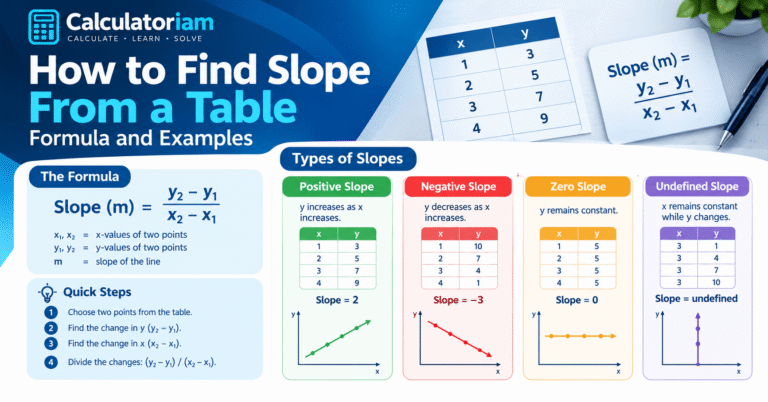
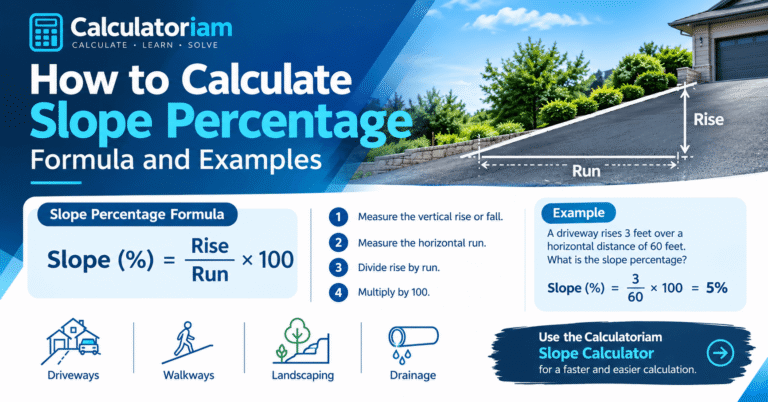
A slope ratio can be converted into a percentage grade by dividing the vertical change by the horizontal run and multiplying by 100.
Slope percentage = (Vertical change / Horizontal run) × 100
For a horizontal-to-vertical ratio of H:V:
Slope percentage = (V / H) × 100
For example, convert a 2:1 horizontal-to-vertical slope into a percentage.
Vertical change = 1 unit
Horizontal run = 2 units
Slope percentage = (1 / 2) × 100
Slope percentage = 50%
Therefore, a 2:1 horizontal-to-vertical slope represents a 50% grade.
For a 3:1 ratio:
Slope percentage = (1 / 3) × 100
Slope percentage ≈ 33.33%
A larger horizontal-to-vertical ratio generally corresponds to a smaller percentage grade when the vertical component remains 1 unit.
How to Convert a Slope Ratio to Degrees
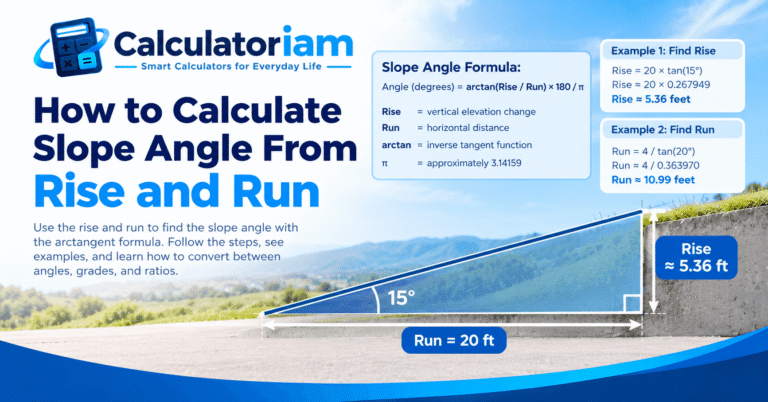
You can calculate the angle of a slope using the inverse tangent function.
Slope angle = arctan(Vertical change / Horizontal run)
For a horizontal-to-vertical ratio of H:V:
Slope angle = arctan(V / H)
The result is the angle measured from the horizontal.
For a 2:1 slope:
Slope angle = arctan(1 / 2)
Slope angle ≈ 26.57°
For a 3:1 slope:
Slope angle = arctan(1 / 3)
Slope angle ≈ 18.43°
These angles show that a 3:1 slope is flatter than a 2:1 slope.
If you need to calculate a grade or angle from actual measurements, use the Slope Calculator rather than estimating from the ratio alone.
Horizontal-to-Vertical vs. Vertical-to-Horizontal Slope Ratios
One of the most important things to understand about slope ratios is that the order may differ between sources.
Horizontal-to-Vertical Convention
In this convention, the horizontal distance appears first and the vertical change appears second.
For example:
- 2:1 means 2 horizontal units for 1 vertical unit.
- 3:1 means 3 horizontal units for 1 vertical unit.
This format is commonly encountered in land grading and earthwork descriptions.
Vertical-to-Horizontal Convention
In this convention, the vertical change appears first and the horizontal distance appears second.
For example:
- 1:2 means 1 vertical unit for 2 horizontal units.
- 1:3 means 1 vertical unit for 3 horizontal units.
These examples describe the same geometric relationships as 2:1 and 3:1 under the horizontal-to-vertical convention, respectively.
However, a ratio written as 2:1 cannot be interpreted safely without knowing which component comes first.
How to Avoid Ratio Confusion
Before using a slope ratio, check the documentation or calculation method to confirm whether it means:
- Horizontal distance : Vertical change, or
- Vertical change : Horizontal distance.
Do not assume that every website, drawing, specification, or calculator uses the same order. When possible, write the measurements explicitly, such as “2 feet horizontal for every 1 foot vertical,” rather than relying on the ratio alone.
Common Mistakes When Reading Slope Ratios
Assuming a Larger First Number Means a Steeper Slope
When the first number represents horizontal distance and the second represents vertical change, a larger first number means the slope is flatter.
For example, a 4:1 slope is flatter than a 2:1 slope under the horizontal-to-vertical convention.
This comparison changes if the ratio order is reversed, so always verify the convention.
Confusing Slope Ratio With Slope Percentage
A ratio of 2:1 does not mean a 2% slope.
Under the horizontal-to-vertical convention, a 2:1 ratio represents a 50% grade.
The percentage is calculated by dividing vertical change by horizontal run, not by reading the first number of the ratio as a percentage.
Confusing Slope Percentage With Degrees
Percentage grade and angle in degrees measure slope differently.
For example, a 50% grade corresponds to an angle of approximately 26.57°, not 50°.
Use the correct conversion formula when switching between ratios, percentages, and angles.
Using Sloped Distance Instead of Horizontal Run
Slope calculations typically use horizontal run, not the diagonal length along the surface.
If the horizontal distance is 10 feet and the vertical change is 2 feet, the horizontal-to-vertical ratio is 5:1.
Using the diagonal distance instead would produce a different and incorrect ratio for this convention.
Assuming a Mathematical Ratio Guarantees Safety
A slope ratio describes geometry, but it does not by itself establish that a slope is safe or suitable for construction.
Real projects may require assessment of soil conditions, erosion, drainage, loading, materials, site boundaries, and applicable local requirements. Consult the relevant project specifications or a qualified professional when these factors matter.
Frequently Asked Questions
What is a 2 to 1 slope?
A 2:1 slope commonly means 2 units of horizontal distance for every 1 unit of vertical change when written as horizontal:vertical. It corresponds to a 50% grade and an angle of approximately 26.57°.
What does a 3:1 slope mean?
A 3:1 slope commonly means 3 horizontal units for every 1 vertical unit. It corresponds to a grade of approximately 33.33% and an angle of about 18.43°.
Is a 2:1 slope steeper than a 3:1 slope?
Yes, when both ratios use the horizontal-to-vertical convention. A 2:1 slope has less horizontal run for the same vertical change, making it steeper than a 3:1 slope.
What is a 1:1 slope in degrees?
A 1:1 slope has equal horizontal and vertical measurements. Its angle is 45° when measured from the horizontal, and its grade is 100%.
How do I calculate a 3:1 slope?
For a horizontal-to-vertical ratio, multiply the vertical change by 3 to calculate the horizontal run. For example, a 2-foot vertical change requires 6 feet of horizontal run for a 3:1 ratio.
Is a 2:1 slope the same as a 2% slope?
No. Under the horizontal-to-vertical convention, a 2:1 slope represents a 50% grade. A 2% grade means 2 units of vertical change for every 100 units of horizontal run.
How do I know whether a slope ratio is horizontal-to-vertical or vertical-to-horizontal?
Check the source’s definition, drawing, specification, or calculator instructions. If the convention is not stated, do not assume the ratio order. Confirm which measurement is represented by each number before using it.
Can I use slope ratios for landscaping and grading?
Slope ratios can describe the geometry of landscaping, grading, and embankments. However, the appropriate ratio for a real project depends on site conditions, materials, drainage, stability, and applicable requirements. A ratio alone does not establish design compliance.
Conclusion
Slope ratios provide a straightforward way to describe the relationship between horizontal distance and vertical elevation change. Ratios such as 1:1, 2:1, and 3:1 are useful for comparing slopes, estimating dimensions, and understanding the steepness of a surface.
The most important rule is to confirm the ratio convention before calculating. Under the horizontal-to-vertical convention, a 2:1 slope means 2 units horizontally for every 1 unit vertically, while a 3:1 slope is flatter because it requires more horizontal distance for the same elevation change.
For practical calculations, you can use the Calculatoriam Slope Calculator to determine slope percentage, angle, and elevation change from measured rise and horizontal run. Always evaluate project-specific conditions and requirements