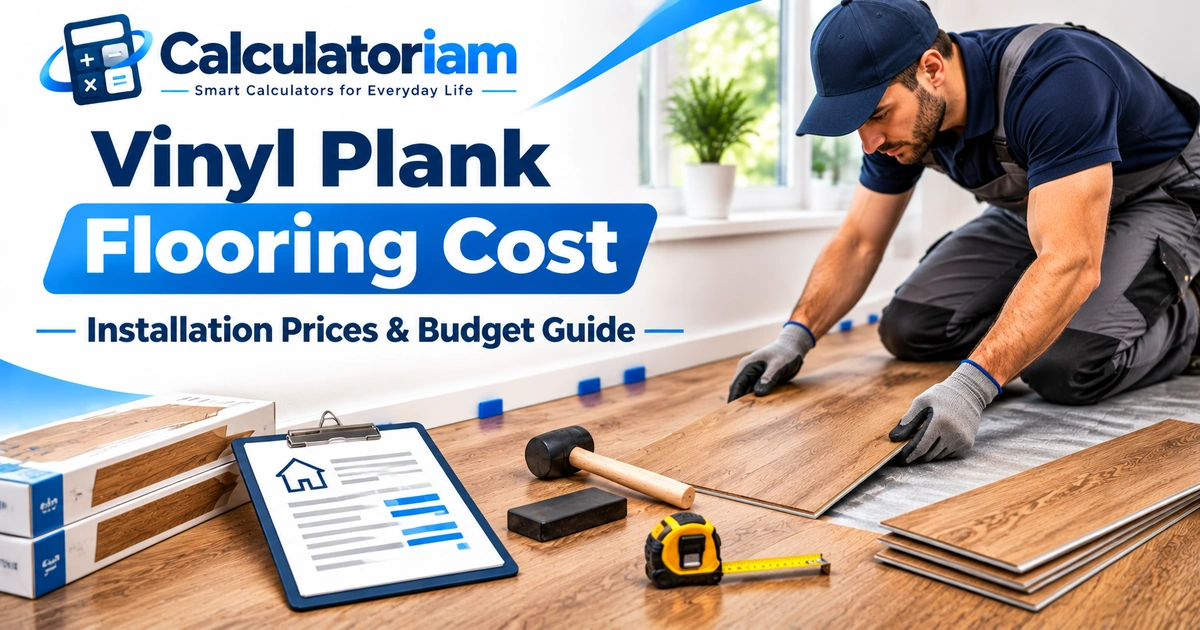
Vinyl Plank Flooring Cost & Installation Prices: Complete Guide
The cost to install vinyl plank flooring typically ranges from approximately $4 to $16 per square foot, including materials and professional installation, according to published US flooring cost guides. However, your actual expense depends on the vinyl product, installation method, room size, labor rates, and subfloor condition.
For example, installing vinyl plank flooring in a simple bedroom may cost considerably less than replacing flooring throughout a home. Additionally, old flooring removal, subfloor repairs, underlayment, and finishing materials can increase the final project budget.
Luxury vinyl plank (LVP) is popular because it offers wood-look designs, relatively straightforward maintenance, and numerous installation options. Nevertheless, not every vinyl product has the same construction, wear resistance, or installation requirements.
Understanding these differences helps you compare flooring quotations and avoid unexpected expenses.
This guide explains vinyl plank flooring prices per square foot, material and labor costs, installation methods, additional expenses, and how to calculate your total project budget.
How Much Does It Cost to Install Vinyl Plank Flooring?
For an initial US budget, expect vinyl plank flooring installation to cost approximately $4–$16 per square foot, including materials and labor.
This broad range is consistent with published HomeGuide estimates for luxury vinyl plank and luxury vinyl tile. However, basic products, premium materials, regional labor conditions, and unusual installation requirements can produce prices outside the range.
The total expense generally consists of three main categories:
- Flooring materials: Vinyl planks, tiles, and compatible installation accessories.
- Installation labor: Professional work required to prepare, cut, fit, and install the flooring.
- Additional expenses: Existing floor removal, subfloor preparation, transitions, delivery, and other project-specific work.
Importantly, an advertised installation rate may cover only labor.
Therefore, always check whether the quotation includes flooring materials and other required services.
Average Vinyl Plank Flooring Installation Prices
| Cost Component | General Cost Consideration |
|---|---|
| Basic vinyl plank material | Usually less expensive than premium LVP |
| Luxury vinyl plank material | Price varies by construction and finish |
| Professional installation labor | Often approximately $1–$10 per sq. ft. across published vinyl installation estimates |
| Underlayment | Product-dependent; may be included or unnecessary |
| Existing flooring removal | Depends on material and removal complexity |
| Subfloor preparation | Depends on surface condition |
| Complete LVP or LVT installation | Approximately $4–$16 per sq. ft. as a broad planning range |
The published labor range comes from general vinyl flooring installation research and is not a guaranteed rate for every LVP project.
Consequently, material and labor figures should not be combined mechanically to create a supposedly universal price.
Vinyl Plank Flooring Installation Cost by Room Size
Room size directly affects the amount of flooring required and the total installation expense.
The following examples use an illustrative installed price range of $4–$16 per square foot.
| Room Size | Floor Area | Estimated Installed Cost |
|---|---|---|
| 10 × 10 ft | 100 sq. ft. | $400–$1,600 |
| 10 × 12 ft | 120 sq. ft. | $480–$1,920 |
| 12 × 12 ft | 144 sq. ft. | $576–$2,304 |
| 12 × 15 ft | 180 sq. ft. | $720–$2,880 |
| 15 × 20 ft | 300 sq. ft. | $1,200–$4,800 |
| 20 × 20 ft | 400 sq. ft. | $1,600–$6,400 |
| 20 × 25 ft | 500 sq. ft. | $2,000–$8,000 |
| 25 × 30 ft | 750 sq. ft. | $3,000–$12,000 |
| 25 × 40 ft | 1,000 sq. ft. | $4,000–$16,000 |
These are area-based budgeting examples, not contractor quotations.
Actual costs can vary because small rooms may have minimum labor charges, while larger projects may qualify for different installation rates.
Furthermore, these estimates do not necessarily include major subfloor repairs, unusual preparation, or other separately quoted work.
Vinyl Plank Flooring Material Cost
Vinyl plank flooring prices depend on product construction, appearance, wear protection, and manufacturer specifications.
Some products are designed for affordable residential installations. Others offer premium textures, specialized cores, and additional performance features.
Basic Vinyl Plank Flooring
Budget-friendly vinyl plank flooring generally provides standard wood-look designs and relatively simple construction.
Depending on the product, it may be suitable for bedrooms, guest rooms, or other residential spaces.
Common characteristics include:
- Basic decorative finishes.
- Standard plank dimensions.
- Fewer premium texture options.
- Product-specific wear protection.
- Relatively accessible material pricing.
However, an inexpensive product is not necessarily suitable for every installation.
Check the manufacturer’s requirements for room use, subfloor preparation, and expected traffic.
Mid-Range Luxury Vinyl Plank
Mid-range LVP often provides a balance between appearance, durability, and price.
Depending on the product, features may include:
- More detailed wood-look patterns.
- Textured surfaces.
- Rigid-core construction.
- Attached underlayment.
- Improved wear-layer specifications.
- Different locking systems.
This category is often considered for living rooms, kitchens, hallways, and family spaces.
Nevertheless, performance depends on the complete product specification rather than its price category alone.
Premium Luxury Vinyl Plank
Premium vinyl plank products may include thicker wear layers, enhanced surface textures, specialized cores, or additional design options.
Some products also provide improved sound performance or more detailed wood-grain finishes.
However, higher prices do not automatically guarantee better durability or suitability.
For example, a premium floating floor may still require careful subfloor preparation and specific expansion allowances.
Before purchasing, compare the actual performance requirements rather than relying only on marketing descriptions.
What Affects the Cost to Install Vinyl Plank Flooring?
Several factors influence the final installation price.
Understanding these details makes it easier to compare flooring products and contractor estimates.
1. Vinyl Plank Thickness
Vinyl plank flooring is available in different overall thicknesses.
Generally, thickness affects the product’s construction, feel, and compatibility with particular installation systems.
However, overall plank thickness and wear-layer thickness are different measurements.
A thicker plank does not automatically have a more durable wear surface.
2. Wear Layer Thickness
The wear layer helps protect the decorative flooring surface from everyday abrasion.
Manufacturers commonly describe vinyl wear layers in mils.
One mil equals one-thousandth of an inch.
Therefore:
- 6 mil = 0.006 inch.
- 12 mil = 0.012 inch.
- 20 mil = 0.020 inch.
Higher wear-layer thickness may be appropriate for certain demanding applications.
However, surface coatings, product construction, and manufacturer testing also influence performance.
Compare the complete specifications before choosing a product.
3. Flooring Core Construction
Luxury vinyl plank products can use different core technologies.
Common categories include flexible LVP, stone-plastic composite (SPC), and wood-plastic or polymer composite (WPC) products.
These constructions can differ in rigidity, comfort, weight, and installation requirements.
As a result, the material price may vary.
4. Installation Method
Some vinyl flooring products use click-lock floating installation, while others require adhesive.
The selected method can affect preparation, labor, materials, and installation time.
5. Room Shape
A simple rectangular room usually requires fewer complicated cuts than a room with multiple corners, closets, or narrow sections.
Therefore, complex layouts may require additional material and installation labor.
6. Existing Floor Condition
If the subfloor is uneven, damaged, or unsuitable, additional repairs may be necessary.
For example, raised joints and concrete depressions may need correction before vinyl installation.
However, the correct preparation method depends on the substrate and flooring manufacturer’s requirements.
Vinyl Plank Flooring Installation Labor Cost
Professional labor is an important part of the overall vinyl plank flooring installation cost.
Published vinyl flooring labor estimates vary widely. For example, Angi’s 2026 research reports approximately $1–$10 per square foot for vinyl flooring installation labor, depending on project complexity and location.
However, this range covers vinyl flooring more broadly and should not be interpreted as a fixed rate for every luxury vinyl plank installation.
What Does Installation Labor Include?
A standard quotation may include:
- Measuring and layout planning.
- Cutting vinyl planks.
- Installing the flooring.
- Fitting planks around doorways.
- Completing ordinary installation details.
- Basic cleanup.
However, the scope varies between contractors.
Consequently, ask which services are included in the quoted price.
What Can Increase Labor Costs?
Several conditions can increase installation labor:
- Complicated room layouts.
- Numerous doorways.
- Stairs and landings.
- Subfloor repairs.
- Old flooring removal.
- Extensive furniture moving.
- Specialized adhesive systems.
- Additional finishing work.
For example, a straightforward click-lock installation over a suitable subfloor may require less work than a glue-down project involving extensive surface preparation.
Minimum Installation Charges
Some flooring contractors apply a minimum project charge.
As a result, a small room may have a higher effective cost per square foot than a larger installation.
Therefore, request the total project price instead of assuming the labor rate will always scale directly with room area.
Click-Lock vs. Glue-Down Vinyl Flooring Installation Cost
Vinyl flooring installation methods differ in how the material is attached to the supporting surface.
Understanding these differences helps you select a suitable product and estimate labor requirements.
Click-Lock Vinyl Plank Flooring
Click-lock vinyl planks connect through specially designed edges.
Most are installed as floating floors without individually fastening each plank to the subfloor.
Potential advantages:
- Convenient plank connections.
- No full-spread adhesive in many systems.
- Suitable for certain DIY projects.
- Available in a broad range of designs.
Important considerations:
- Subfloor flatness.
- Expansion clearance.
- Locking-system compatibility.
- Heavy furniture restrictions.
- Underlayment requirements.
A floating floor should not be permanently fastened through the planks unless the manufacturer specifically permits it.
Glue-Down Luxury Vinyl Flooring
Glue-down flooring uses a manufacturer-approved adhesive to attach the material to a suitable substrate.
Potential advantages:
- Direct attachment to the prepared surface.
- Compatibility with certain commercial applications.
- Different repair and installation options.
Important considerations:
- Adhesive cost.
- Subfloor smoothness.
- Moisture requirements.
- Working and curing times.
- Professional installation expertise.
Glue-down installation may involve additional preparation, although the final labor price depends on the actual project.
Installation Method Comparison
| Feature | Click-Lock Vinyl | Glue-Down Vinyl |
|---|---|---|
| Attachment | Floating connection | Adhesive |
| Adhesive required | Generally no | Yes |
| Subfloor preparation | Important | Important |
| Installation skill | Product-dependent | Often more technical |
| Expansion requirements | Manufacturer-specific | Manufacturer-specific |
| Labor cost | Project-dependent | Project-dependent |
| Repairs | Depends on locking system | Depends on adhesive and product |
Neither installation method is automatically cheaper in every situation.
The correct choice depends on product compatibility, room conditions, and the complete installation quotation.
Additional Costs of Vinyl Plank Flooring Installation
The flooring and labor prices are not always the complete project expense.
Additional services can significantly affect the final amount.
Old Flooring Removal
Existing carpet, laminate, hardwood, vinyl, or tile may need removal before installing the new flooring.
Removal expenses depend on the existing material and how it was installed.
For example, removing loose carpet generally involves different work from demolishing bonded ceramic tile.
Ask whether removal and disposal are included in the contractor’s quotation.
Subfloor Repair and Leveling
Vinyl plank flooring requires a suitable installation surface.
Common preparation tasks include:
- Securing loose subfloor panels.
- Correcting high and low spots.
- Repairing damaged sections.
- Removing unsuitable adhesive residue.
- Addressing moisture problems.
- Preparing concrete surfaces.
Significant structural damage should be evaluated before new flooring is installed.
Underlayment Cost
Some vinyl products include attached padding, while others require a separate approved underlayment.
However, adding unnecessary underlayment can create problems with certain flooring systems.
Therefore, check the manufacturer’s specifications before buying additional material.
Moisture Protection
Concrete floors may require moisture testing or an approved moisture-control system.
Waterproof vinyl planks do not automatically prevent moisture from damaging the subfloor or surrounding building materials.
Consequently, existing leaks or unsuitable moisture conditions should be corrected before installation.
Transition Strips and Trim
Transition strips create finished connections between different flooring surfaces.
Depending on the room, you may need:
- T-molding.
- Reducer strips.
- End caps.
- Baseboard adjustments.
- Quarter-round molding.
- Stair nosing.
These products may be priced separately.
Furniture Moving and Delivery
Large furniture may need to be removed before installation.
Additionally, flooring suppliers may charge for delivery, while installers may charge for furniture moving.
Include these expenses when comparing complete quotations.
How to Calculate Vinyl Plank Flooring Installation Cost
A practical budget starts with accurate floor measurements.
Next, calculate the material quantity, account for waste and carton coverage, and add labor and other project expenses.
The following example shows the complete process.
Step 1: Measure the Room
Suppose a room measures:
- Length = 18 feet.
- Width = 13 feet.
For a rectangular room, calculate the floor area using:
A=L\times W
Where:
- A = Floor area in square feet.
- L = Length in feet.
- W = Width in feet.
Substitute the measurements:
A=18\times13=234
Answer: The room has an area of 234 square feet.
You can use the Calculatoriam Square Footage Calculator to measure rectangular or irregular spaces before estimating materials.
Step 2: Add a Waste Allowance
For this example, assume a hypothetical 8% cutting allowance.
The adjusted flooring area is calculated as:
A_w=A\times(1+\frac{P}{100})
Where:
- A_w = Waste-adjusted area.
- A = Original measured area.
- P = Waste allowance percentage.
Substitute the values:
A_w=234\times(1+\frac{8}{100})
Calculate the result:
A_w=252.72
Answer: The estimated material requirement is 252.72 square feet before carton rounding.
The 8% allowance is illustrative. Actual requirements depend on plank dimensions, room layout, cutting pattern, and installation conditions.
Step 3: Calculate Flooring Cartons
Suppose each carton covers 22 square feet.
Use this formula:
N=\frac{A_w}{C}
Where:
- N = Number of cartons.
- A_w = Waste-adjusted floor area.
- C = Coverage per carton.
Substitute the values:
N=\frac{252.72}{22}\approx11.49
Round up to 12 full cartons.
Calculate the purchased coverage:
A_p=12\times22=264
Answer: Purchase 12 cartons, providing 264 square feet of nominal flooring coverage.
Step 4: Calculate Material Cost
Assume the vinyl plank material costs $3.40 per square foot of purchased coverage.
Use:
C_m=A_p\times R_m
Where:
- C_m = Material cost.
- A_p = Purchased coverage.
- R_m = Material price per square foot.
Substitute the values:
C_m=264\times3.40=897.60
Estimated material cost: $897.60.
Step 5: Calculate Installation Labor
Suppose a contractor charges a hypothetical $3.25 per square foot of installed area.
The labor formula is:
C_l=A\times R_l
Where:
- C_l = Labor cost.
- A = Actual installation area.
- R_l = Labor rate per square foot.
Substitute the values:
C_l=234\times3.25=760.50
Estimated installation labor: $760.50.
Importantly, labor is calculated using the installed floor area in this example, not the total purchased carton coverage.
However, contractors may use different pricing methods. Always confirm the basis of your actual quotation.
Step 6: Add Other Project Costs
For this hypothetical project, assume:
| Expense | Estimated Amount |
|---|---|
| Vinyl plank materials | $897.60 |
| Installation labor | $760.50 |
| Old flooring removal | $200.00 |
| Subfloor preparation | $150.00 |
| Transitions and trim | $95.00 |
| Delivery | $65.00 |
| Total estimated cost | $2,168.10 |
Add the individual expenses:
C_t=897.60+760.50+200+150+95+65
The total becomes:
C_t=2168.10
Answer: The hypothetical vinyl plank flooring installation budget is $2,168.10.
This example excludes applicable taxes and unforeseen repairs.
The effective total is approximately $9.27 per square foot of installed floor area.
These prices are illustrative inputs, not live supplier or contractor quotations.
Calculate Your Flooring Materials and Labor
For your own project, use the Calculatoriam Flooring Calculator.
The calculator can help estimate:
- Floor area.
- Waste-adjusted material quantities.
- Required full cartons.
- Material purchase costs.
- Optional installation labor costs.
However, the results depend on the measurements and prices you enter.
The calculator does not replace a contractor’s inspection or detailed project quotation.
How Much Does It Cost to Install 400 Square Feet of Vinyl Plank Flooring?
The cost to install 400 square feet of vinyl plank flooring depends on the chosen material and installation rate.
Using the broad installed-price range of $4–$16 per square foot:
C_{\min}=400\times4=1600
The lower planning estimate is $1,600.
For the upper end:
C_{\max}=400\times16=6400
The upper planning estimate is $6,400.
Answer: A 400-square-foot vinyl plank flooring project may have an initial installed-cost budget of approximately $1,600–$6,400.
However, the actual quotation may fall outside this range.
Additional work such as major subfloor repairs, difficult removal, or specialized installation can increase the total cost.
How Much Does It Cost to Install 1,000 Square Feet of Vinyl Plank Flooring?
For a larger project, the total cost increases with the installation area.
Using the same broad planning range:
C_{\min}=1000\times4=4000
The lower estimate is $4,000.
For the higher rate:
C_{\max}=1000\times16=16000
The upper estimate is $16,000.
Answer: Installing 1,000 square feet of luxury vinyl plank flooring may cost approximately $4,000–$16,000 before unusual additional expenses.
Larger projects may involve different labor rates or additional services.
Consequently, obtain an itemized contractor quotation rather than treating the area-based estimate as a final project price.
DIY vs. Professional Vinyl Plank Flooring Installation
Some vinyl plank products are designed for relatively straightforward installation.
However, DIY installation still requires suitable tools, accurate measurements, and proper subfloor preparation.
DIY Vinyl Plank Installation
DIY installation can reduce direct labor expenses.
Nevertheless, homeowners remain responsible for:
- Measuring and ordering materials.
- Preparing the subfloor.
- Cutting planks.
- Following expansion requirements.
- Installing transitions.
- Handling tools safely.
- Correcting installation mistakes.
DIY may be appropriate for a straightforward room when the selected product supports homeowner installation.
However, complicated layouts, damaged subfloors, and specialized adhesive systems may require professional assistance.
Professional Installation
Professional installers generally provide specialized tools and installation experience.
Depending on the contractor, services may include measuring, preparation, fitting, and finishing work.
However, confirm exactly what the quotation includes.
DIY vs. Professional Installation Comparison
| Factor | DIY Installation | Professional Installation |
|---|---|---|
| Direct labor expense | Lower | Higher |
| Tools | Homeowner provides | Generally supplied |
| Installation experience | Homeowner responsibility | Installer experience |
| Subfloor preparation | Homeowner responsibility | Depends on quotation |
| Project duration | Skill-dependent | Project-dependent |
| Workmanship coverage | Usually unavailable | Depends on contractor |
| Best application | Suitable straightforward projects | Complex installations |
The better choice depends on project difficulty, available tools, experience, and the value of professional workmanship.
How to Save Money on Vinyl Plank Flooring Installation
Reducing flooring costs does not mean choosing unsuitable materials or skipping essential preparation.
Instead, plan the project carefully and compare complete prices.
1. Measure the Floor Accurately
Incorrect measurements can cause material shortages or unnecessary purchases.
Measure each room separately and include suitable cutting allowances.
2. Compare Multiple Quotes
Request detailed quotations from several installers.
Check whether the prices include identical services and material specifications.
3. Choose the Correct Vinyl Product
A premium product may not be necessary for every room.
However, selecting an inexpensive floor unsuitable for your conditions can create future expenses.
Compare wear protection, construction, moisture limitations, and warranty requirements.
4. Prepare the Room Before Installation
Where appropriate, clear furniture and personal belongings before the installation date.
However, leave hazardous-material removal and structural repairs to qualified professionals.
5. Avoid Unnecessary Material Upgrades
Some specialty features may not provide meaningful benefits for your intended application.
Compare products based on actual room requirements rather than paying extra for every available upgrade.
6. Confirm Carton Coverage
Check how many square feet each carton covers.
Additionally, review the supplier’s return policy for unopened extra cartons.
Accurate ordering can reduce waste and avoid unnecessary expenses.
Common Vinyl Plank Flooring Cost Estimating Mistakes
Several mistakes can make a project appear less expensive than it actually is.
| Common Mistake | Why It Matters | Better Approach |
|---|---|---|
| Comparing material prices only | Excludes labor | Calculate total installed cost |
| Forgetting cutting waste | May cause material shortages | Use a suitable allowance |
| Rounding cartons down | Cannot cover the adjusted area | Round up to whole cartons |
| Ignoring subfloor damage | Additional preparation may be required | Inspect before installation |
| Assuming waterproof planks waterproof the room | Water can reach the subfloor | Address moisture conditions |
| Forgetting transition strips | Adds finishing expenses | Include trim materials |
| Comparing different installation methods | Labor requirements differ | Compare equivalent work |
| Ignoring minimum labor charges | Small projects may cost more per square foot | Request the total project quote |
| Counting the same expense twice | Inflates the budget | Check what installed prices include |
A complete estimate should separate actual floor area, purchased material coverage, labor, and additional expenses.
This approach makes contractor quotations easier to compare.
Is Vinyl Plank Flooring Worth the Installation Cost?
Luxury vinyl plank can be a practical flooring choice for homeowners who want wood-look designs and relatively easy maintenance.
However, its value depends on product quality and suitability.
Advantages of Vinyl Plank Flooring
Common advantages include:
- Wide selection of wood-look designs.
- Many water-resistant or waterproof products.
- Relatively straightforward maintenance.
- Different installation methods.
- Options for various residential budgets.
- Suitable products for many busy household spaces.
Disadvantages of Vinyl Plank Flooring
Possible limitations include:
- Scratches or dents from heavy objects.
- Restrictions involving sunlight and temperature.
- Product-specific underlayment requirements.
- Difficulty repairing certain locking systems.
- Subfloor imperfections affecting installation.
- Wide variation in product quality.
Before purchasing, compare the manufacturer’s specifications with your actual room conditions.
For example, flooring suitable for a dry bedroom may have different requirements from flooring installed in a basement.
Frequently Asked Questions About Vinyl Plank Flooring Installation Cost
How much does it cost to install vinyl plank flooring per square foot?
Luxury vinyl plank flooring generally costs approximately $4–$16 per square foot installed, according to published US cost guides. However, the final price depends on materials, labor, project size, and preparation requirements.
How much does it cost to install 400 square feet of vinyl plank flooring?
Using a broad installed rate of $4–$16 per square foot, a 400-square-foot project could cost approximately $1,600–$6,400. Actual contractor prices vary by material and installation scope.
How much does it cost to install 1,000 square feet of LVP flooring?
A 1,000-square-foot LVP project could have an initial installed budget of approximately $4,000–$16,000 using the same published planning range. Additional repairs and project-specific services may increase the total.
How much is vinyl plank flooring installation labor?
Published general vinyl installation labor estimates can range from approximately $1–$10 per square foot. However, rates vary according to the installation method, location, project complexity, and included services.
Is click-lock vinyl cheaper to install than glue-down vinyl?
Click-lock installation can require less adhesive-related work. Nevertheless, it is not automatically cheaper because product prices, preparation requirements, and labor rates differ between projects.
Is luxury vinyl tile more expensive than vinyl plank flooring?
Luxury vinyl tile and luxury vinyl plank prices can overlap. Material construction, design, quality, and installation method generally matter more than the product’s shape alone.
Can vinyl plank flooring be installed over existing flooring?
Some products can be installed over certain existing surfaces if the manufacturer permits it. However, the underlying floor must meet the required stability, flatness, and moisture conditions.
Does vinyl plank flooring need underlayment?
Some products require compatible underlayment, while others include attached padding or restrict additional layers. Follow the manufacturer’s instructions before purchasing.
Is DIY vinyl plank installation worth it?
DIY installation can save direct labor costs for suitable projects. However, the homeowner must provide tools, prepare the surface, and follow the installation requirements correctly.
Does waterproof vinyl flooring need moisture protection?
Waterproof planks do not automatically waterproof the entire floor assembly. Concrete moisture, leaks, and other sources of water may still require appropriate evaluation and protection.
How much extra vinyl plank flooring should I buy?
The allowance depends on plank dimensions, room shape, layout pattern, and cutting requirements. Use a suitable project-specific waste percentage and round purchases up to full cartons.
How do I calculate my vinyl plank installation budget?
Measure the floor area, calculate material quantities with a suitable waste allowance, determine full-carton coverage, and add material, labor, and other installation expenses. The Calculatoriam Flooring Calculator can help organize the main quantity and cost estimates.
Final Thoughts
The cost to install vinyl plank flooring depends on the material, installation method, room dimensions, labor rates, and condition of the existing floor.
Luxury vinyl plank offers a range of design and construction options, but its final installed price includes more than the planks themselves.
Before purchasing, measure the room accurately, check the required waste allowance, and confirm carton coverage. Additionally, compare complete contractor quotations that include preparation, labor, transitions, and other required services.
For a practical starting estimate, use the Calculatoriam Flooring Calculator to calculate flooring quantities, material costs, and optional installation labor using your own project details.
Careful planning can help you understand the total expense and choose a vinyl plank flooring system that suits your budget and installation requirements.