Slope Distance Formula: How to Calculate Sloped Length and Horizontal Run
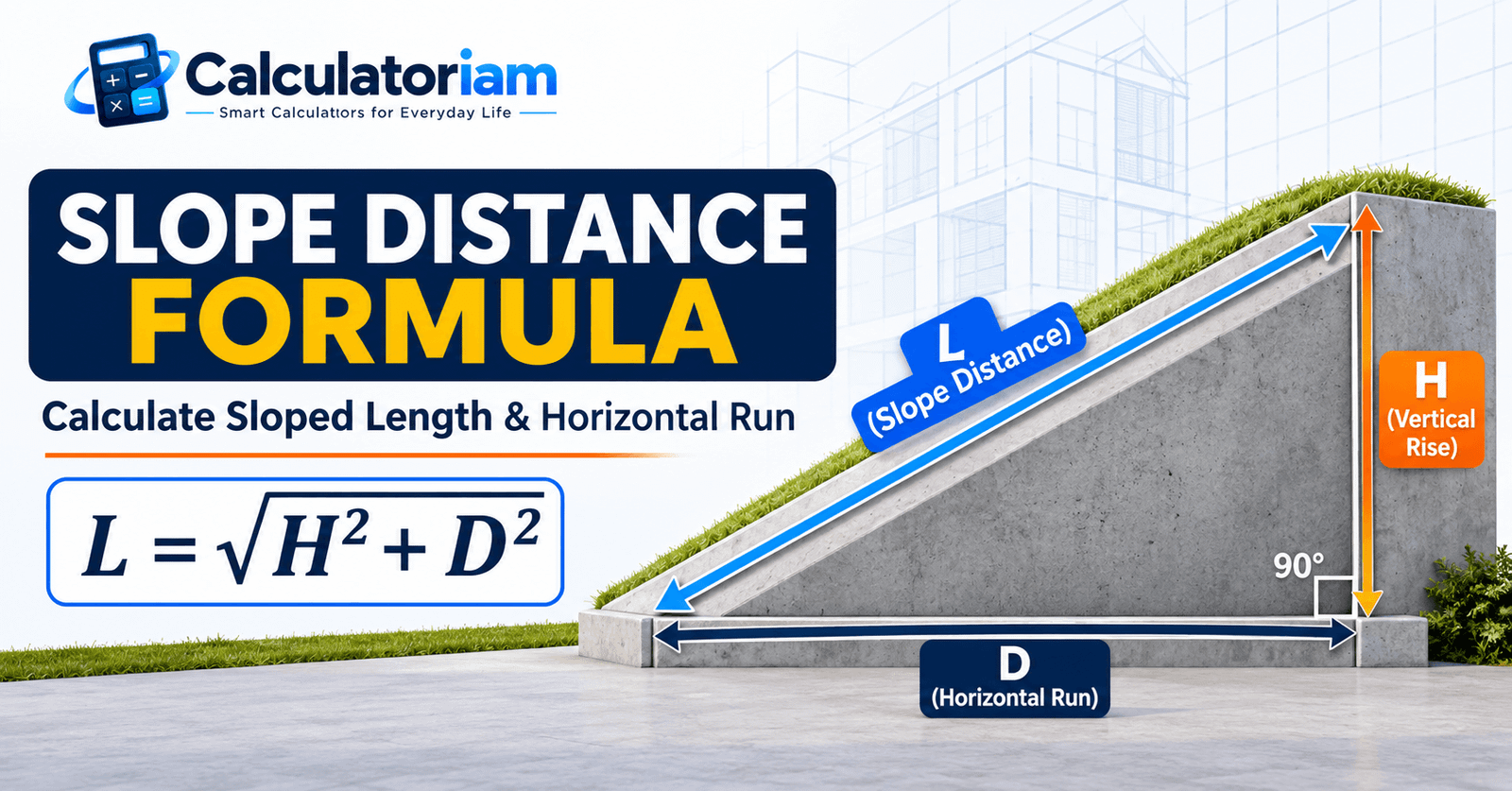
The slope distance formula helps you calculate the length of an inclined surface using its vertical rise and horizontal run. It is based on the Pythagorean theorem and is useful for measuring ramps, hillsides, sloped paths, and construction layouts.
The standard slope distance formula is:
L=\sqrt{H^2+D^2}
Here, L represents slope distance, H represents vertical rise, and D represents horizontal run.
For example, if a surface rises 3 feet over a horizontal distance of 4 feet, its sloped length is 5 feet.
Slope distance is different from horizontal distance because it follows the incline rather than a level path between two points.
What Is Slope Distance?
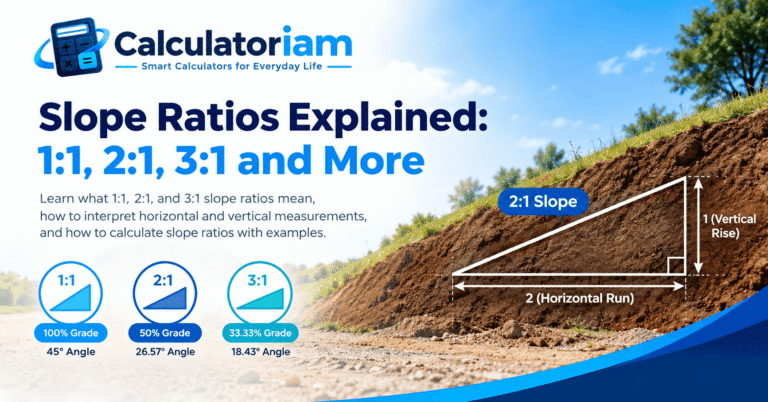
Slope distance is the straight-line distance between two points at different elevations. It represents the diagonal side of a right triangle formed by vertical rise and horizontal run.
Three measurements describe this triangle:
- Slope Distance (L): The diagonal length along the incline.
- Vertical Rise (H): The elevation difference between two points.
- Horizontal Run (D): The level distance separating those points.
In a right triangle, slope distance is the hypotenuse. It is always at least as long as the horizontal run.
For a nonzero elevation difference, the slope distance is longer than the horizontal distance.
This relationship matters when measuring an inclined structure because a horizontal measurement alone does not represent its full diagonal length.
Slope Distance Formula
The slope distance formula comes from the Pythagorean theorem.
For a right triangle:
L^2=H^2+D^2
To calculate the slope distance, take the square root of the sum of the squared rise and horizontal run.
L=\sqrt{H^2+D^2}
Where:
- L = slope distance
- H = vertical rise or elevation change
- D = horizontal run
All measurements must use the same units.
For example, if the rise is measured in feet, the horizontal run must also be measured in feet before applying the formula.
Why Does the Formula Work?
The Pythagorean theorem states that the square of the hypotenuse of a right triangle equals the sum of the squares of its other two sides.
An inclined straight line forms the hypotenuse when the vertical elevation change and horizontal distance meet at a right angle.
Squaring the rise and run, adding them, and taking the square root gives the diagonal distance.
The formula applies to straight-line slope measurements. A curved or uneven surface may require multiple measurements to determine its actual surface length.
How to Calculate Slope Distance Step by Step
Follow these steps to calculate the diagonal distance between two points at different elevations.
Step 1: Measure the Vertical Rise
Determine the elevation difference between the starting and ending points.
Suppose the upper point is 6 feet higher than the lower point.
The vertical rise is 6 feet.
Step 2: Measure the Horizontal Run
Find the level horizontal distance between the same two points.
Assume the horizontal run is 8 feet.
Do not use the diagonal distance along the inclined surface as the horizontal run.
Step 3: Apply the Slope Distance Formula
Use the Pythagorean formula:
L=\sqrt{H^2+D^2}
Substitute the measurements:
L=\sqrt{6^2+8^2}
Step 4: Square the Measurements
Calculate the squares of the rise and horizontal run.
L=\sqrt{36+64}
Add the squared values:
L=\sqrt{100}
Step 5: Calculate the Final Distance
Take the square root:
L=10
Answer: The slope distance is 10 feet.
The inclined length is 2 feet longer than the horizontal run in this example.
You can also use the Calculatoriam Slope Calculator to enter vertical rise and horizontal run and review the calculated sloped distance alongside the grade and angle.
How to Calculate Horizontal Run From Slope Distance
Sometimes the diagonal distance and vertical rise are known, but the horizontal run is missing.
You can rearrange the Pythagorean theorem to find it.
The horizontal run formula is:
D=\sqrt{L^2-H^2}
Here, D represents horizontal run, L represents slope distance, and H represents vertical rise.
Example: Find Horizontal Run
Suppose a straight inclined surface measures 13 feet along its slope and has a vertical rise of 5 feet.
Substitute the values:
D=\sqrt{13^2-5^2}
Calculate the squares:
D=\sqrt{169-25}
Subtract the values:
D=\sqrt{144}
Calculate the square root:
D=12
Answer: The horizontal run is 12 feet.
This means the inclined surface extends 12 feet horizontally while rising 5 feet vertically.
The slope distance must be greater than or equal to the absolute vertical rise for the measurements to form a valid right triangle.
How to Find Vertical Rise From Slope Distance
If you know the slope distance and horizontal run, you can calculate the vertical elevation difference.
Rearrange the formula:
H=\sqrt{L^2-D^2}
Here, H represents the magnitude of vertical rise, L represents slope distance, and D represents horizontal run.
Example: Calculate Vertical Rise
Suppose a straight inclined path has a slope distance of 25 meters and a horizontal run of 24 meters.
Substitute the values:
H=\sqrt{25^2-24^2}
Calculate the squares:
H=\sqrt{625-576}
Subtract the values:
H=\sqrt{49}
Calculate the result:
H=7
Answer: The vertical elevation difference is 7 meters.
This calculation gives the magnitude of the elevation difference. The direction of travel determines whether the change represents a rise or fall.
Slope Distance vs. Horizontal Distance
Slope distance and horizontal distance describe different measurements between the same two points.
| Measurement | Slope Distance | Horizontal Distance |
| Meaning | Diagonal distance along a straight incline | Level distance between points |
| Triangle side | Hypotenuse | Horizontal side |
| Symbol | L | D |
| Includes elevation change | Yes | No |
| Typical use | Inclined lengths and straight-line measurements | Grade and site layout calculations |
For example, consider a right triangle with a vertical rise of 9 feet and a horizontal run of 12 feet.
Calculate the slope distance:
L=\sqrt{9^2+12^2}
Simplify:
L=\sqrt{225}=15
The slope distance is 15 feet, while the horizontal run is only 12 feet.
The difference is 3 feet.
Using the horizontal run instead of the slope distance would underestimate the diagonal length by 3 feet in this example.
Worked Examples of Slope Distance Calculations
The following examples demonstrate how to calculate sloped length in different measurement situations.
Example 1: Calculate the Length of a Sloped Path
A straight path rises 2 meters over a horizontal distance of 10 meters.
Given:
- Vertical rise = 2 meters
- Horizontal run = 10 meters
Apply the formula:
L=\sqrt{2^2+10^2}
Calculate:
L=\sqrt{104}
Find the approximate result:
L\approx10.20
Answer: The straight-line slope distance is approximately 10.20 meters.
This is a geometric length calculation, not a determination of whether the path meets accessibility or construction requirements.
Example 2: Calculate Slope Distance in Feet
Suppose a straight hillside section has a vertical elevation difference of 15 feet and a horizontal run of 36 feet.
Given:
- Vertical rise = 15 feet
- Horizontal run = 36 feet
Substitute the values:
L=\sqrt{15^2+36^2}
Calculate the squares:
L=\sqrt{225+1296}
Simplify:
L=\sqrt{1521}=39
Answer: The slope distance is 39 feet.
This result represents the straight-line distance between the selected endpoints. It does not account for irregularities along the ground surface.
Example 3: Calculate Slope Distance With Mixed Units
A straight inclined surface has a vertical rise of 18 inches and a horizontal run of 8 feet.
Before applying the formula, convert the measurements into the same units.
Convert the rise into feet:
H=\frac{18}{12}=1.5
The vertical rise is 1.5 feet.
Apply the slope distance formula:
L=\sqrt{1.5^2+8^2}
Calculate:
L=\sqrt{66.25}
Find the approximate distance:
L\approx8.14
Answer: The slope distance is approximately 8.14 feet.
Converting measurements into compatible units prevents calculation errors.
How Slope Angle Relates to Slope Distance
Slope angle describes the inclination of a straight surface relative to a horizontal line.
If the slope angle and horizontal run are known, you can calculate the diagonal slope distance using trigonometry.
The formula is:
L=\frac{D}{\cos(\theta)}
Here, L represents slope distance, D represents horizontal run, and theta represents the slope angle.
For example, suppose the horizontal run is 10 meters and the angle is 30 degrees.
Substitute the values:
L=\frac{10}{\cos(30^\circ)}
Calculate the approximate result:
L\approx11.55
Answer: The slope distance is approximately 11.55 meters.
This method is useful when an angle measurement is available instead of the vertical rise.
Ensure your calculator uses degree mode when entering an angle measured in degrees.
Where Is the Slope Distance Formula Used?
The slope distance formula is useful whenever a straight inclined length must be calculated from horizontal and vertical measurements.
Ramp Length Measurements
The formula can determine the straight diagonal length of a ramp from its rise and horizontal run.
However, calculating length alone does not establish whether the ramp meets accessibility requirements or applicable construction standards.
Hillside and Terrain Measurements
Slope distance helps estimate the straight-line distance between two points at different elevations.
For uneven terrain, the actual ground distance may be longer because the surface does not follow one perfectly straight incline.
Construction Layouts
Builders and surveyors use geometric relationships to compare horizontal distances, elevation changes, and diagonal measurements.
These calculations can support preliminary layout planning, but they do not replace precise field measurements or engineering requirements.
Sloped Paths and Outdoor Surfaces
For a straight inclined walkway, the formula helps distinguish the actual diagonal length from its horizontal footprint.
This distinction is useful when checking dimensions or planning measurements along an incline.
Common Mistakes When Calculating Slope Distance
Confusing Slope Distance With Horizontal Run
Slope distance follows the diagonal incline, while horizontal run is measured level.
Using one in place of the other produces incorrect results whenever the elevation difference is nonzero.
Mixing Measurement Units
Both rise and run must use compatible units.
Convert inches into feet or centimeters into meters before performing the calculation.
Forgetting to Square the Measurements
The Pythagorean theorem requires each perpendicular side to be squared before adding the results.
Adding the rise and run directly does not give the diagonal distance.
Using the Formula for a Curved Surface
The standard formula calculates a straight-line distance between two endpoints.
A curved or irregular surface may need to be divided into smaller straight sections. The individual section lengths can then be added to estimate the total path length.
Subtracting in the Wrong Order
When calculating horizontal run or vertical rise from a known slope distance, subtract the square of the shorter perpendicular side from the square of the hypotenuse.
For valid right-triangle measurements, the hypotenuse cannot be shorter than either perpendicular side.
Frequently Asked Questions
What is the slope distance formula?
The slope distance formula is:
L=\sqrt{H^2+D^2}
Here, L is slope distance, H is vertical rise, and D is horizontal run.
How do you calculate slope distance from rise and run?
Square the vertical rise and horizontal run. Add the squared values and take the square root. The result is the straight-line diagonal distance between the two points.
Is slope distance always longer than horizontal distance?
Slope distance is greater than horizontal distance when the elevation difference is nonzero. Both distances are equal when the two points have the same elevation.
How do you calculate horizontal distance from slope distance?
Use the formula:
D=\sqrt{L^2-H^2}
Subtract the squared vertical rise from the squared slope distance and calculate the square root.
Can slope distance be calculated using an angle?
Yes. If the horizontal run and slope angle are known, divide the horizontal run by the cosine of the angle to find the straight-line slope distance.
Conclusion
The slope distance formula calculates the diagonal length between two points using vertical rise and horizontal run. It applies the Pythagorean theorem to the right triangle formed by those measurements.
You can also rearrange the formula to find a missing horizontal run or vertical elevation difference. When the slope angle is known, trigonometric relationships provide another way to calculate the diagonal length.
For accurate results, use consistent measurement units and distinguish straight-line slope distance from actual distance along uneven terrain.
To check your measurements, use the Calculatoriam Slope Calculator to calculate sloped distance, grade percentage, and slope angle from rise and horizontal run.