Perpendicular Slope Formula: How to Find Parallel and Perpendicular Slopes
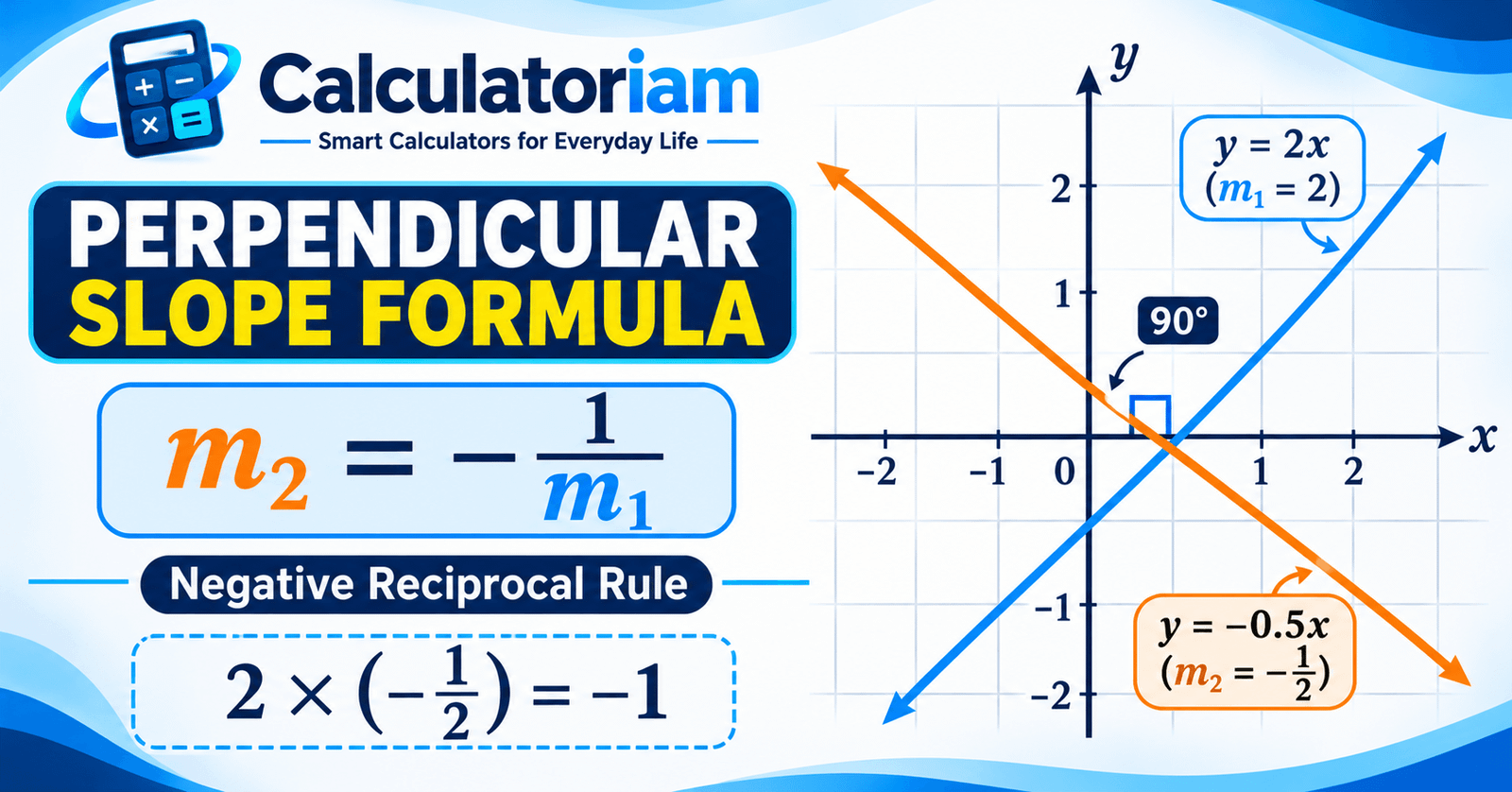
The perpendicular slope formula helps you find the slope of a line that intersects another line at a 90-degree angle. It is an important concept in algebra and coordinate geometry because it explains how the slopes of two straight lines are related.
For two non vertical, non horizontal perpendicular lines, the formula is:
m_2=-\frac{1}{m_1}
Here, m₁ represents the slope of the original line, while m₂ represents the slope of the perpendicular line.
For example, if a line has a slope of 2, its perpendicular slope is −1/2.
Parallel lines follow a different rule. Two distinct non vertical parallel lines have equal slopes.
The parallel slope formula is:
m_1=m_2
Understanding these relationships makes it easier to identify parallel and perpendicular lines, solve coordinate geometry problems, and write equations of straight lines.
What Is the Perpendicular Slope Formula?
The perpendicular slope formula calculates the slope of a line that meets another line at a right angle.
Two perpendicular lines intersect at exactly 90 degrees.
For lines with defined, nonzero slopes, their slopes are negative reciprocals.
The formula is:
m_{\perp}=-\frac{1}{m}
In this equation:
- m represents the original slope.
- m⊥ represents the perpendicular slope.
- The negative sign reverses the sign of the reciprocal.
A reciprocal is found by exchanging the numerator and denominator of a fraction.
For example, the reciprocal of 3/4 is 4/3.
To find the negative reciprocal, change its sign.
Therefore, the perpendicular slope of 3/4 is −4/3.
Why Do Perpendicular Slopes Have Negative Reciprocals?
A slope describes how much a line rises or falls compared with its horizontal movement.
When two non vertical lines are perpendicular, their directions create a 90-degree angle.
Their slopes satisfy the relationship:
m_1m_2=-1
This means the product of their slopes equals negative one.
For example, consider two slopes:
m_1=2
m_2=-\frac{1}{2}
Multiply them:
2\left(-\frac{1}{2}\right)=-1
Because the product equals −1, the lines are perpendicular.
This test applies when both slopes are defined and nonzero. Horizontal and vertical lines require a separate check.
How to Find a Perpendicular Slope Step by Step
You can calculate a perpendicular slope using three simple steps.
Step 1: Identify the Original Slope
Suppose a line has a slope of 4.
Then:
m=4
Step 2: Find the Reciprocal
Write 4 as a fraction:
4=\frac{4}{1}
Exchange the numerator and denominator:
\frac{1}{4}
Step 3: Change the Sign
Take the negative reciprocal:
m_{\perp}=-\frac{1}{4}
Answer: The perpendicular slope is −1/4.
A line with slope 4 and a line with slope −1/4 meet at a right angle.
Perpendicular Slope Formula Examples
The following examples demonstrate how the formula works with positive, negative, and fractional slopes.
Example 1: Positive Integer Slope
Problem: Find the perpendicular slope of a line with slope 5.
Start with:
m_{\perp}=-\frac{1}{m}
Substitute m = 5:
m_{\perp}=-\frac{1}{5}
Answer: −1/5.
The perpendicular line has a negative slope because the original slope is positive.
Example 2: Negative Integer Slope
Problem: Find the perpendicular slope of a line with slope −3.
Use the formula:
m_{\perp}=-\frac{1}{-3}
Simplify:
m_{\perp}=\frac{1}{3}
Answer: 1/3.
The perpendicular slope is positive because the original slope is negative.
Example 3: Positive Fractional Slope
Problem: Find the perpendicular slope of a line with slope 2/5.
Substitute:
m_{\perp}=-\frac{1}{\frac{2}{5}}
Taking the reciprocal gives:
m_{\perp}=-\frac{5}{2}
Answer: −5/2.
To verify, multiply the slopes:
\frac{2}{5}\left(-\frac{5}{2}\right)=-1
The result confirms the perpendicular relationship.
Example 4: Negative Fractional Slope
Problem: Find the perpendicular slope of −3/4.
Start with:
m_{\perp}=-\frac{1}{-\frac{3}{4}}
Simplify:
m_{\perp}=\frac{4}{3}
Answer: 4/3.
The perpendicular slope is positive.
Example 5: Decimal Slope
Problem: Find the perpendicular slope of 0.5.
First, convert the decimal to a fraction:
0.5=\frac{1}{2}
Take the negative reciprocal:
m_{\perp}=-2
Answer: −2.
You can also calculate the result directly by dividing −1 by 0.5.
What Is the Parallel Slope Formula?
The parallel slope formula states that nonvertical parallel lines have the same slope.
The equation is:
m_1=m_2
Here, m₁ and m₂ represent the slopes of two lines.
Parallel lines run in the same direction and never intersect when they are distinct lines in the same plane.
For example, consider:
y=3x+2
And:
y=3x-5
Both lines have a slope of 3.
However, their y intercepts are different.
Therefore, the lines are parallel and distinct.
How to Find the Slope of a Parallel Line
Problem: A line has a slope of −4. What is the slope of a parallel line?
Use:
m_2=m_1
Substitute:
m_2=-4
Answer: −4.
The parallel line must have the same slope.
Parallel Line Slope Formula Example
Problem: Determine whether these two lines are parallel.
y=2x+1
y=2x+7
The first line has slope 2.
The second line also has slope 2.
Since the slopes are equal and the intercepts are different, the lines are parallel.
Answer: Yes, the lines are parallel.
Parallel vs. Perpendicular Slopes
Parallel and perpendicular lines have different slope relationships.
| Feature | Parallel lines | Perpendicular lines |
|---|---|---|
| Direction | Same direction | Meet at 90 degrees |
| Slope relationship | Equal slopes | Negative reciprocal slopes |
| Formula | m₁ = m₂ | m₁m₂ = −1 |
| Example | 3 and 3 | 3 and −1/3 |
| Intersection | Distinct lines do not intersect | Intersect at a right angle |
The formulas in the table apply to lines with defined slopes, with the perpendicular product rule requiring nonzero slopes.
For vertical and horizontal lines, use their directions instead.
Two distinct vertical lines are parallel.
A horizontal line and a vertical line are perpendicular.
Quick Slope Comparison
| Original slope | Parallel slope | Perpendicular slope |
|---|---|---|
| 2 | 2 | −1/2 |
| −3 | −3 | 1/3 |
| 4/5 | 4/5 | −5/4 |
| −2/7 | −2/7 | 7/2 |
| 1 | 1 | −1 |
| −1 | −1 | 1 |
This table provides a quick reference for common slope relationships.
How to Find Parallel and Perpendicular Slopes From an Equation
When a line is written in slope intercept form, you can identify its slope directly.
The slope intercept equation is:
y=mx+b
The coefficient of x represents the slope.
Worked Example
Problem: Find the parallel and perpendicular slopes of:
y=4x-7
Step 1: Identify the original slope.
The coefficient of x is 4.
Therefore:
m=4
Step 2: Find the parallel slope.
Parallel lines have equal slopes.
m_{\parallel}=4
Step 3: Find the perpendicular slope.
Take the negative reciprocal:
m_{\perp}=-\frac{1}{4}
Final answers:
- Parallel slope = 4
- Perpendicular slope = −1/4
How to Find Perpendicular Slopes From Standard Form
Sometimes the equation is not written in slope intercept form.
For example:
3x+2y=12
You must first rearrange the equation to identify its slope.
Step 1: Isolate the Y Term
Subtract 3x from both sides:
2y=-3x+12
Step 2: Divide by 2
y=-\frac{3}{2}x+6
The original slope is −3/2.
Step 3: Find the Perpendicular Slope
Take the negative reciprocal:
m_{\perp}=\frac{2}{3}
Answer: The perpendicular slope is 2/3.
The parallel slope would remain −3/2.
How to Write the Equation of a Perpendicular Line
The perpendicular slope formula is especially useful when you need to write the equation of a new line.
Suppose a line is perpendicular to:
y=2x+5
And passes through the point (4, 3).
Step 1: Identify the Original Slope
The original slope is 2.
Step 2: Calculate the Perpendicular Slope
m_{\perp}=-\frac{1}{2}
Step 3: Use the Given Point
The new line passes through (4, 3).
Use the point slope formula:
y-y_1=m(x-x_1)
Substitute the coordinates and perpendicular slope:
y-3=-\frac{1}{2}(x-4)
Step 4: Simplify the Equation
Distribute −1/2:
y-3=-\frac{1}{2}x+2
Add 3:
y=-\frac{1}{2}x+5
Final answer:
y=-\frac{1}{2}x+5
The new line has slope −1/2 and passes through (4, 3).
It is perpendicular to the original line because their slopes multiply to −1.
How to Write the Equation of a Parallel Line
Writing a parallel line equation follows a similar process.
The main difference is that you keep the original slope.
Problem: Find the equation of a line parallel to y = 3x + 2 that passes through (2, 8).
Step 1: Identify the Slope
The original line has slope 3.
A parallel line must also have slope 3.
Step 2: Apply the Point Slope Formula
Use the point (2, 8):
y-8=3(x-2)
Step 3: Simplify
Distribute:
y-8=3x-6
Add 8:
y=3x+2
Answer: y = 3x + 2.
Notice that this result is exactly the original line, not a distinct parallel line.
The given point (2, 8) already lies on the original line because 3(2) + 2 = 8.
This illustrates an important distinction: equal slopes describe parallel directions, but if the intercepts are also equal, the lines coincide.
To construct a distinct parallel line, the new line must have a different intercept.
How to Check Whether Two Lines Are Perpendicular
You can check perpendicularity using the slopes of the two lines.
For lines with defined, nonzero slopes, multiply the slopes.
If the product equals −1, the lines are perpendicular.
Example 1: Perpendicular Lines
Consider:
y=3x+4
And:
y=-\frac{1}{3}x+2
The slopes are 3 and −1/3.
Multiply:
3\left(-\frac{1}{3}\right)=-1
Answer: The lines are perpendicular.
Example 2: Lines That Are Not Perpendicular
Consider:
y=2x+1
And:
y=-3x+5
The slopes are 2 and −3.
Multiply:
2(-3)=-6
Since the product is not −1, the lines are not perpendicular.
Their slopes are also different, so they are not parallel.
What Happens With Horizontal and Vertical Lines?
Horizontal and vertical lines are special cases.
A horizontal line has a slope of zero.
For example:
y=4
A vertical line has an undefined slope.
For example:
x=2
These lines are perpendicular because they meet at a 90-degree angle.
However, the negative reciprocal formula cannot be applied directly when the original slope is zero or undefined.
Parallel Horizontal Lines
Two distinct horizontal lines are parallel.
For example:
y=2
y=7
Both have zero slope.
Parallel Vertical Lines
Two distinct vertical lines are also parallel.
For example:
x=3
x=8
Both have undefined slopes.
Their parallel relationship comes from their direction, not from applying an equality test to undefined slope values.
Real-World Applications of Parallel and Perpendicular Slopes
Parallel and perpendicular slopes are useful in geometry, technical drawing, and coordinate-based design.
Coordinate Geometry
Students use these formulas to identify relationships between lines, find missing equations, and solve geometry problems involving right angles.
Engineering Drawings
Technical drawings often use parallel and perpendicular lines to represent geometric features.
Slope relationships help describe those lines mathematically on a coordinate plane.
Computer Graphics
In two-dimensional graphics, perpendicular directions are useful for constructing right angles, normals, and geometric shapes.
A perpendicular direction can be found from a line’s direction vector, even when its slope is undefined.
Mapping and Surveying
Coordinate geometry can describe lines and directions on a planar map.
Parallel and perpendicular relationships may help analyze geometric layouts.
For real-world slope measurements involving elevation change, horizontal distance, and grade percentage, you can also explore the Calculatoriam Slope Calculator.
This tool focuses on physical slope measurements rather than calculating perpendicular line equations.
Common Mistakes When Using the Perpendicular Slope Formula
1. Changing Only the Sign
If the original slope is 2, the perpendicular slope is not −2.
You must take the negative reciprocal.
The correct answer is −1/2.
2. Taking Only the Reciprocal
If the original slope is 3/4, its reciprocal is 4/3.
However, the perpendicular slope is −4/3.
Remember to change the sign.
3. Confusing Parallel and Perpendicular Slopes
Parallel lines have equal slopes.
Perpendicular lines have negative reciprocal slopes when both slopes are defined and nonzero.
These relationships are not interchangeable.
4. Forgetting Negative Signs
If the original slope is −5, the perpendicular slope is positive 1/5.
Taking the negative reciprocal of a negative value produces a positive result.
5. Applying the Formula to Vertical Lines
A vertical line has an undefined slope.
Its perpendicular line is horizontal and has a slope of zero.
Use the geometric relationship instead of attempting to divide by an undefined value.
6. Assuming Equal Slopes Always Mean Distinct Parallel Lines
Two lines with equal slopes may be distinct parallel lines or the same line.
Check their intercepts or equations to distinguish between these cases.
Practice Problems With Answers
Try these problems to strengthen your understanding.
Practice Problem 1: Find a Perpendicular Slope
Question: What is the perpendicular slope of 6?
Use the formula:
m_{\perp}=-\frac{1}{6}
Answer: −1/6.
Practice Problem 2: Find a Perpendicular Fractional Slope
Question: What is the perpendicular slope of −2/5?
Take the negative reciprocal:
m_{\perp}=\frac{5}{2}
Answer: 5/2.
Practice Problem 3: Identify Parallel Lines
Question: Are these lines parallel?
y=4x+3
y=4x-8
Both slopes equal 4, and their intercepts differ.
Answer: Yes, they are distinct parallel lines.
Practice Problem 4: Check Perpendicular Lines
Question: Are lines with slopes −4 and 1/4 perpendicular?
Multiply the slopes:
-4\left(\frac{1}{4}\right)=-1
Answer: Yes, they are perpendicular.
Practice Problem 5: Find a Perpendicular Line Equation
Question: Find the equation of a line perpendicular to y = −2x + 3 that passes through (2, 1).
The original slope is −2.
The perpendicular slope is 1/2.
Use the point slope formula:
y-1=\frac{1}{2}(x-2)
Simplify:
y-1=\frac{1}{2}x-1
Add 1:
y=\frac{1}{2}x
Answer: y = x/2.
Frequently Asked Questions
What is the perpendicular slope formula?
The perpendicular slope formula is m₂ = −1/m₁ for a line with a defined, nonzero slope. It calculates the negative reciprocal of the original slope.
How do you find the perpendicular slope of a fraction?
Exchange the numerator and denominator, then change the sign. For example, the perpendicular slope of 3/5 is −5/3.
What is the parallel slope formula?
The parallel slope formula is m₁ = m₂ for nonvertical lines. Distinct lines with equal slopes are parallel.
How do you know if two lines are perpendicular?
For two lines with defined, nonzero slopes, multiply their slopes. If the product equals −1, the lines are perpendicular. A horizontal line and a vertical line are also perpendicular.
Can perpendicular lines have the same slope?
No. Two distinct lines with the same defined slope have the same direction, so they cannot intersect at a right angle. Perpendicular lines have different directions and meet at 90 degrees.
Conclusion
The perpendicular slope formula helps you find the slope of a line that intersects another line at a right angle.
For a defined, nonzero original slope, the formula is:
m_{\perp}=-\frac{1}{m}
To calculate a perpendicular slope, take the reciprocal of the original slope and change its sign.
The parallel slope formula follows a different rule:
m_1=m_2
Nonvertical parallel lines have equal slopes, while perpendicular lines with defined, nonzero slopes have negative reciprocal slopes.
Understanding these relationships makes it easier to solve linear equations, graph coordinate lines, and recognize right angles in geometry.