
Slope Formula Worksheet: 24 Practice Problems With Answers
This slope formula worksheet includes 24 original practice problems with answers and step-by-step solutions. It covers finding slope from two points, reading coordinate tables, identifying slope from equations, and solving real-world rise-and-run problems.
The questions progress from basic calculations to more challenging algebra problems. Students can complete the worksheet first, then use the answer key to check their work.
Worksheet details:
- Subject: Algebra and coordinate geometry
- Level: Grade 8, Algebra 1, and introductory high school mathematics
- Questions: 24
- Topics: Positive, negative, zero, undefined, and fractional slopes
- Includes: Worked examples, practice exercises, answer key, and explanations
Slope Formula Quick Reference
Before starting the worksheet, review the formula used to calculate the slope of a straight line.
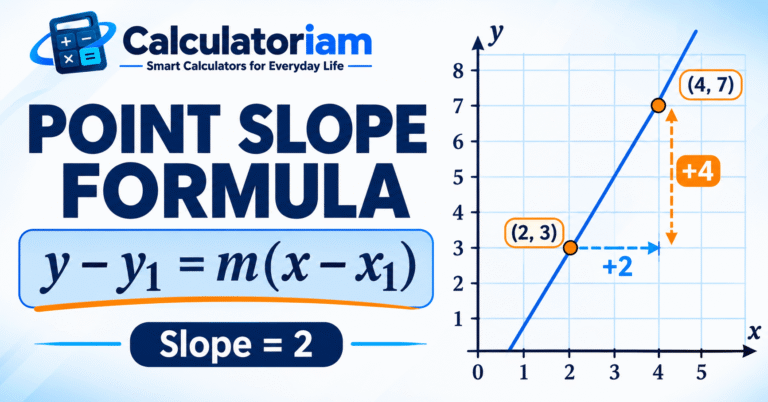
\boxed{m=\frac{y_2-y_1}{x_2-x_1}}
Where:
- m = slope of the line
- x1 and y1 = coordinates of the first point
- x2 and y2 = coordinates of the second point
- y2 − y1 = vertical change, or rise
- x2 − x1 = horizontal change, or run
You can also write the formula as:
m=\frac{\text{Rise}}{\text{Run}}
The denominator must not equal zero. When two distinct points have the same x-coordinate, the line is vertical and its slope is undefined.
Example: How to Solve a Slope Problem
Find the slope of the line passing through (2, 5) and (6, 13).
Step 1: Write the slope formula.
m=\frac{y_2-y_1}{x_2-x_1}
Step 2: Substitute the coordinates.
m=\frac{13-5}{6-2}
Step 3: Calculate the differences.
m=\frac{8}{4}
Step 4: Simplify.
\boxed{m=2}
Answer: The slope is 2. The line rises 2 units for every 1-unit increase in x.
For a more detailed explanation of this method, read the Slope Formula guide.
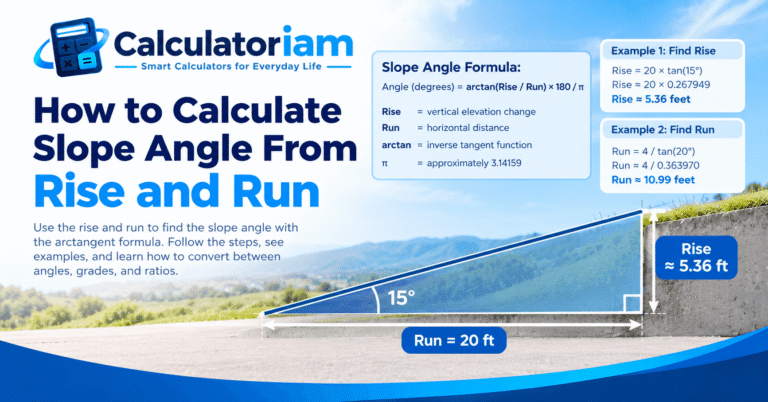
You can also check numerical rise-and-run calculations using the Calculatoriam Slope Calculator. Enter the vertical change and horizontal change to review the corresponding slope relationship and grade. The calculator is primarily designed for measurement and construction slopes rather than solving coordinate algebra automatically.
Slope Formula Practice Worksheet
Student Name: __________________________
Date: __________________
Score: ______ / 24
Instructions: Solve each problem. Show your calculations, simplify fractions where possible, and identify undefined slopes correctly. For word problems, use the stated direction of measurement when determining whether the slope is positive or negative.
Part A: Find the Slope From Two Points
For questions 1–8, calculate the slope of the line passing through each pair of points.
| No. | Point 1 | Point 2 | Your Answer |
|---|---|---|---|
| 1 | (1, 3) | (5, 11) | __________ |
| 2 | (-4, 2) | (2, 8) | __________ |
| 3 | (0, 7) | (4, -1) | __________ |
| 4 | (-3, -5) | (1, 1) | __________ |
| 5 | (2, -1) | (8, -4) | __________ |
| 6 | (-6, 4) | (-2, 4) | __________ |
| 7 | (7, -3) | (7, 6) | __________ |
| 8 | (0.5, 1) | (2.5, 4) | __________ |
Practice focus: These questions test positive, negative, fractional, zero, and undefined slopes. Pay special attention to negative signs when subtracting coordinates.
Part B: Find the Slope From a Table
For questions 9–12, each row below contains three pairs of corresponding x- and y-values. Determine the slope represented by each table.
| No. | X-Values | Corresponding Y-Values | Your Answer |
|---|---|---|---|
| 9 | -2, 0, 2 | -1, 3, 7 | __________ |
| 10 | 1, 3, 5 | 9, 5, 1 | __________ |
| 11 | -1, 2, 5 | 6, 6, 6 | __________ |
| 12 | 4, 4, 4 | -2, 1, 5 | __________ |
Use two distinct points from each table to calculate the change in y divided by the change in x. Then check the remaining value to confirm the relationship.
If you need additional instruction, see How to Find Slope From a Table.
Part C: Find the Slope From a Line Equation
For questions 13–18, determine the slope of each line without plotting a graph.
| No. | Equation | Your Answer |
|---|---|---|
| 13 | y = 3x – 4 | __________ |
| 14 | y = -(2/5)x + 7 | __________ |
| 15 | 4x + 2y = 10 | __________ |
| 16 | 3x – 6y = 12 | __________ |
| 17 | x = -3 | __________ |
| 18 | y = 8 | __________ |
Hint: For equations that can be written as y = mx + b, the coefficient of x is the slope. A vertical line does not have a defined numerical slope.
Part D: Real-World Slope Problems
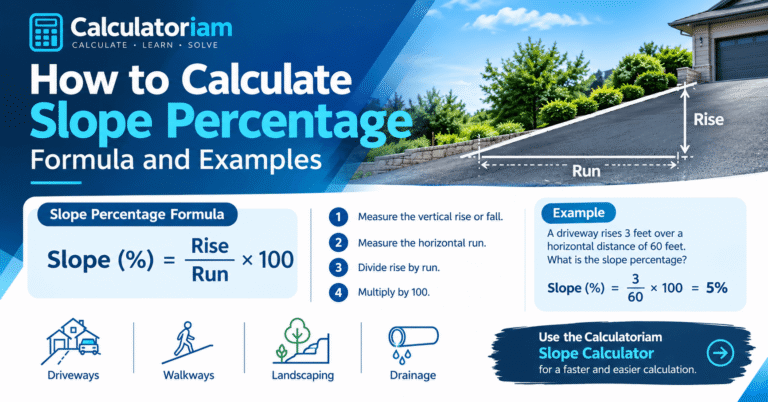
For questions 19–22, calculate the slope using vertical rise or fall divided by horizontal run. Express the slope as a simplified fraction and percentage grade.
19. Ramp Slope
A ramp rises 18 inches over a horizontal distance of 12 feet.
Find the slope as a simplified fraction and percentage.
Answer: __________________
20. Descending Trail
A trail descends 6 meters over a horizontal distance of 80 meters.
Find the signed slope and percentage grade when traveling downhill.
Answer: __________________
21. Roof Incline
A roof rises 4 feet over a horizontal run of 12 feet.
Calculate its rise-over-run slope and percentage grade.
Answer: __________________
22. Drainage Fall
A surface drops 1.5 inches over a horizontal distance of 10 feet.
Calculate its signed slope and percentage grade in the downhill direction.
Answer: __________________
Part E: Challenge Questions
For questions 23–24, use the given slope to find the missing coordinate.
23. Find the Missing Y-Coordinate
A line has a slope of 3 and passes through (2, 4) and (6, y).
What is the value of y?
Answer: __________________
24. Find the Missing X-Coordinate
A line has a slope of -1/2 and passes through (-2, 5) and (x, 1).
What is the value of x?
Answer: __________________
Slope Formula Worksheet Answer Key
Use this answer key after completing all 24 questions. Each solution shows how the result is obtained so that you can identify and correct mistakes.
Part A Answers: Slope From Two Points
Question 1: (1, 3) and (5, 11)
m=\frac{11-3}{5-1}=\frac{8}{4}=2
Answer: 2
The line rises 2 units for each unit of horizontal movement.
Question 2: (-4, 2) and (2, 8)
m=\frac{8-2}{2-(-4)}=\frac{6}{6}=1
Answer: 1
Subtracting a negative x-coordinate increases the denominator.
Question 3: (0, 7) and (4, -1)
m=\frac{-1-7}{4-0}=\frac{-8}{4}=-2
Answer: -2
The negative slope indicates that the line falls from left to right.
Question 4: (-3, -5) and (1, 1)
m=\frac{1-(-5)}{1-(-3)}=\frac{6}{4}=\frac{3}{2}
Answer: 3/2
The exact result is a positive fractional slope.
Question 5: (2, -1) and (8, -4)
m=\frac{-4-(-1)}{8-2}=\frac{-3}{6}=-\frac{1}{2}
Answer: -1/2
The line decreases by 1 unit for every 2-unit horizontal increase.
Question 6: (-6, 4) and (-2, 4)
m=\frac{4-4}{-2-(-6)}=\frac{0}{4}=0
Answer: 0
Both points have the same y-coordinate, so the line is horizontal.
Question 7: (7, -3) and (7, 6)
m=\frac{6-(-3)}{7-7}=\frac{9}{0}
Answer: Undefined
The line is vertical because both points have the same x-coordinate. Division by zero is undefined.
Question 8: (0.5, 1) and (2.5, 4)
m=\frac{4-1}{2.5-0.5}=\frac{3}{2}=1.5
Answer: 3/2 or 1.5
Decimals in coordinates do not change the slope formula.
Part B Answers: Slope From Tables
Question 9: Positive Slope
Choose the points (-2, -1) and (0, 3).
m=\frac{3-(-1)}{0-(-2)}=\frac{4}{2}=2
Answer: 2
The remaining point (2, 7) follows the same rate of change.
Question 10: Negative Slope
Choose (1, 9) and (3, 5).
m=\frac{5-9}{3-1}=\frac{-4}{2}=-2
Answer: -2
The y-values decrease by 4 whenever x increases by 2.
Question 11: Zero Slope
Choose (-1, 6) and (2, 6).
m=\frac{6-6}{2-(-1)}=\frac{0}{3}=0
Answer: 0
All three points lie on the horizontal line y = 6.
Question 12: Undefined Slope
Choose (4, -2) and (4, 1).
m=\frac{1-(-2)}{4-4}=\frac{3}{0}
Answer: Undefined
Every point has x = 4, producing a vertical line.
Part C Answers: Slope From Equations
Question 13: y = 3x – 4
Compare the equation with the slope-intercept form:
y=mx+b
The coefficient of x is 3.
Answer: 3
Question 14: y = -(2/5)x + 7
The coefficient of x is -2/5.
Answer: -2/5
Question 15: 4x + 2y = 10
Rearrange the equation:
2y=-4x+10
Divide both sides by 2:
y=-2x+5
Answer: -2
Question 16: 3x – 6y = 12
Move the x-term to the right:
-6y=-3x+12
Divide both sides by -6:
y=\frac{1}{2}x-2
Answer: 1/2
Question 17: x = -3
This equation describes a vertical line.
Answer: Undefined
Question 18: y = 8
This equation describes a horizontal line.
Answer: 0
A useful distinction is that horizontal lines have zero slope, while vertical lines have undefined slope. For more examples, see What Is the Slope of x = 5?.
Part D Answers: Real-World Slope Problems
Question 19: Ramp Slope
Given:
- Rise = 18 inches
- Horizontal run = 12 feet
Convert 12 feet into inches:
12\times12=144\text{ inches}
Calculate the slope:
m=\frac{18}{144}=\frac{1}{8}
Convert to percentage:
\frac{1}{8}\times100=12.5%
Answer: Slope = 1/8; grade = 12.5%.
This is a mathematical exercise, not a statement that the resulting ramp meets accessibility requirements.
Question 20: Descending Trail
Given:
- Vertical change = -6 meters
- Horizontal run = 80 meters
Calculate:
m=\frac{-6}{80}=-\frac{3}{40}
Convert to percentage:
-\frac{3}{40}\times100=-7.5%
Answer: Slope = -3/40; grade = -7.5%.
The negative sign indicates a descending direction.
Question 21: Roof Incline
Given:
- Rise = 4 feet
- Horizontal run = 12 feet
Calculate the ratio:
m=\frac{4}{12}=\frac{1}{3}
Express the slope as a percentage:
\frac{1}{3}\times100=33.333\ldots%
Answer: Slope = 1/3; grade ≈ 33.33%.
The roof also has a rise-to-run ratio of 4:12, which simplifies to 1:3.
Question 22: Drainage Fall
Given:
- Vertical change = -1.5 inches
- Horizontal run = 10 feet
Convert horizontal distance to inches:
10\times12=120\text{ inches}
Calculate:
m=\frac{-1.5}{120}=-\frac{1}{80}
Convert to percentage:
-\frac{1}{80}\times100=-1.25%
Answer: Slope = -1/80; grade = -1.25%.
The signed grade indicates a fall in the stated direction. Whether that grade is appropriate for an actual drainage project depends on its design requirements.
Part E Answers: Missing Coordinates
Question 23: Find y
Given:
- Slope = 3
- Points: (2, 4) and (6, y)
Start with the slope formula:
3=\frac{y-4}{6-2}
Simplify:
3=\frac{y-4}{4}
Multiply both sides by 4:
12=y-4
Add 4:
\boxed{y=16}
Answer: y = 16
Check: (16 – 4) / (6 – 2) = 12 / 4 = 3.
Question 24: Find x
Given:
- Slope = -1/2
- Points: (-2, 5) and (x, 1)
Substitute:
-\frac{1}{2}=\frac{1-5}{x-(-2)}
Simplify:
-\frac{1}{2}=\frac{-4}{x+2}
Cross-multiply:
-(x+2)=-8
Solve:
x+2=8
\boxed{x=6}
Answer: x = 6
Check: (1 – 5) / (6 – (-2)) = -4 / 8 = -1/2.
Quick Answer Key: All 24 Questions
Use this table to check your final answers without reviewing every calculation.
| Question | Correct Answer |
|---|---|
| 1 | 2 |
| 2 | 1 |
| 3 | -2 |
| 4 | 3/2 |
| 5 | -1/2 |
| 6 | 0 |
| 7 | Undefined |
| 8 | 3/2 |
| 9 | 2 |
| 10 | -2 |
| 11 | 0 |
| 12 | Undefined |
| 13 | 3 |
| 14 | -2/5 |
| 15 | -2 |
| 16 | 1/2 |
| 17 | Undefined |
| 18 | 0 |
| 19 | 1/8; 12.5% |
| 20 | -3/40; -7.5% |
| 21 | 1/3; approximately 33.33% |
| 22 | -1/80; -1.25% |
| 23 | y = 16 |
| 24 | x = 6 |
How to Check Your Slope Worksheet Answers
After completing the worksheet, review your results using these checks.
1. Verify the Subtraction Order
When using two coordinates, subtract the y-values in the same point order as the x-values.
Correct:
m=\frac{y_2-y_1}{x_2-x_1}
Reversing both subtraction orders produces the same answer. Reversing only one generally changes the sign incorrectly.
2. Check Whether the Line Rises or Falls
For a standard coordinate graph read from left to right:
- Positive slope: The line rises.
- Negative slope: The line falls.
- Zero slope: The line is horizontal.
- Undefined slope: The line is vertical.
If a line clearly descends but your calculation gives a positive result, check the subtraction order.
3. Simplify Fractions
An answer of 6/4 is numerically correct, but 3/2 is its simplified form.
Unless a problem requests decimals, keeping the exact simplified fraction helps avoid rounding errors.
4. Check Measurement Units
For real-world problems, vertical and horizontal measurements must use compatible units before calculating a percentage grade.
For example, a rise of 6 inches over a run of 2 feet must first use the same unit:
m=\frac{6}{24}=\frac{1}{4}
Therefore, the percentage grade is 25%, not 300%.
5. Distinguish Zero From Undefined
A numerator of zero with a nonzero denominator gives a slope of zero.
A denominator of zero makes the ordinary slope formula undefined. Never treat division by zero as a numeric answer.
Common Mistakes Students Make on Slope Worksheets
The most frequent errors involve signs, coordinate order, and fractions.
| Mistake | Why It Happens | How to Correct It |
|---|---|---|
| Dividing run by rise | Formula order is reversed | Always divide vertical change by horizontal change |
| Losing a negative sign | Subtracting negative coordinates incorrectly | Use parentheses during substitution |
| Incorrect point order | Numerator and denominator use inconsistent orders | Subtract coordinates in matching order |
| Writing zero for a vertical line | Confusing horizontal and vertical changes | Check whether the denominator is zero |
| Forgetting to simplify | Leaving a reducible fraction | Divide numerator and denominator by their greatest common factor |
| Using mixed units | Inches and feet are combined directly | Convert to compatible units first |
Learning to identify these mistakes is just as useful as memorizing the formula. If a result appears unexpected, review each calculation before changing the answer.
Frequently Asked Questions
What is a slope formula worksheet?
A slope formula worksheet is a set of practice questions designed to help students calculate and interpret the slope of straight lines. Problems commonly use coordinate pairs, tables, line equations, and rise-over-run measurements.
What grade level is this worksheet for?
This worksheet is suitable for many Grade 8 and Algebra 1 learners. Its early questions cover basic coordinate calculations, while later exercises introduce fractions, equations, unit conversions, and missing coordinates. Exact grade placement varies by curriculum.
How do I print this slope formula worksheet?
You can copy the practice worksheet section, from the student-name fields through question 24, into a document and print it. Keep the answer key separate so students can complete the problems independently.
What is the easiest way to remember the slope formula?
Remember the phrase rise over run. Rise means vertical change, and run means horizontal change. When using two coordinates, subtract the y-values and divide by the corresponding difference between the x-values.
What happens if a slope calculation has a zero denominator?
The slope is undefined because division by zero is undefined. When two distinct points share the same x-coordinate, they lie on a vertical line.
Can a slope be a fraction?
Yes. Slopes can be whole numbers, negative numbers, fractions, or decimals. For example, a line that rises 3 units over a horizontal run of 5 units has a slope of 3/5, or 0.6.
How can I check a slope calculation online?
For numerical rise-and-run problems, use the Slope Calculator. Enter the vertical change and horizontal run in matching units to review the corresponding slope, percentage grade, and angle. For problems involving missing coordinates, complete the algebra before checking your result.
Final Practice Tips
The best way to become confident with slope problems is to practice several types of questions rather than repeatedly solving the same kind.
Start with simple coordinate pairs, then move to negative coordinates and fractions. Once those calculations feel familiar, practice identifying slopes from tables and equations. Finish with real-world measurement problems that require unit conversions.
This slope formula worksheet provides 24 exercises and complete worked solutions to support that progression.
For a deeper understanding of the mathematical relationship, review Rise Over Run Explained With Examples, and use the Calculatoriam Slope Calculator to explore how changing rise and horizontal run affects numerical slope.