How Steep Is a 15 Degree Slope? Visual Examples and Grade
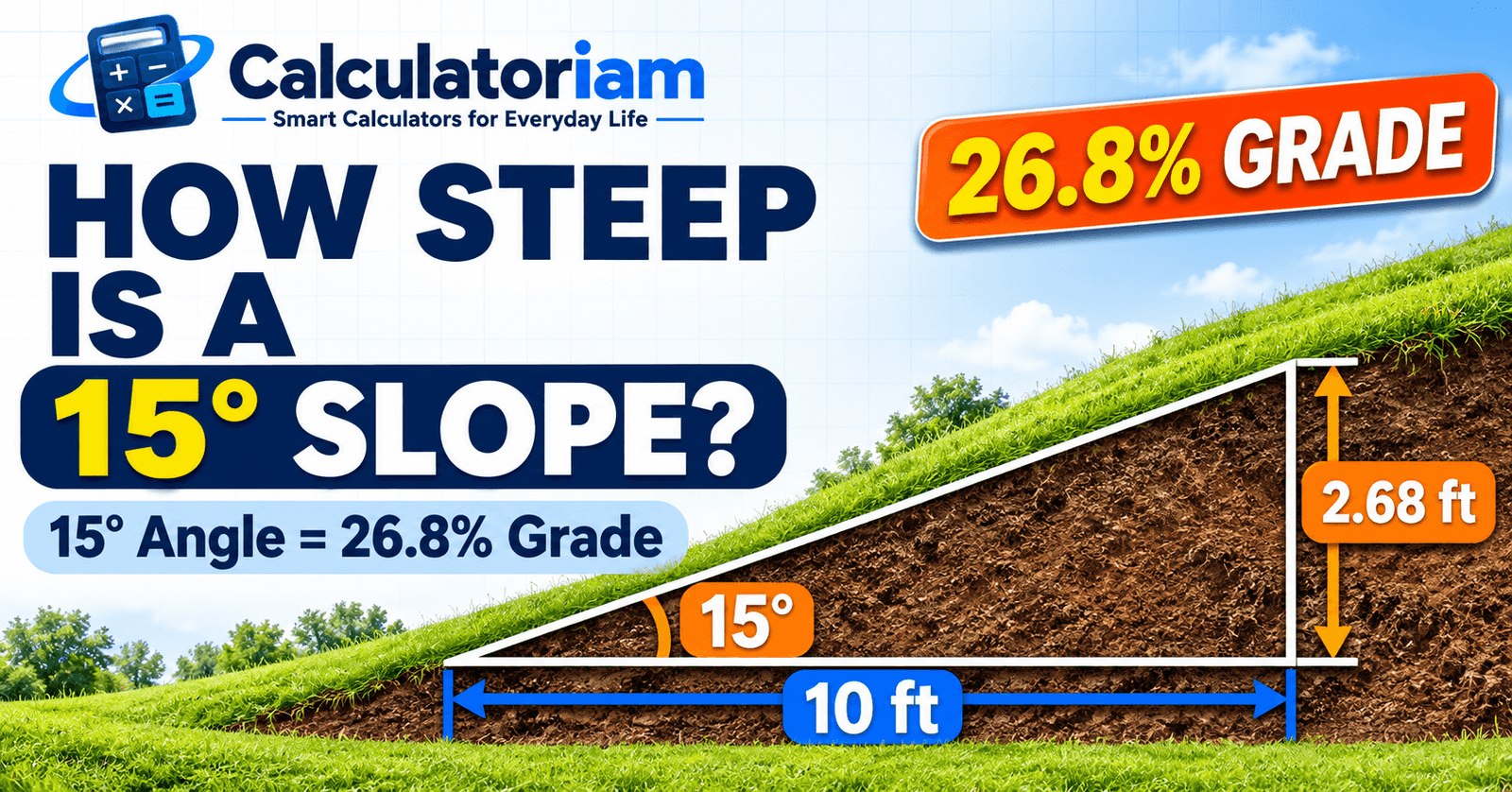
A 15-degree slope is a noticeably steep incline that rises approximately 2.68 feet for every 10 feet of horizontal distance. It is equivalent to a 26.8% grade, which means the elevation changes by about 26.8 units for every 100 horizontal units.
Although 15 degrees may sound like a small angle, it creates a substantial elevation change over a relatively short distance. You would notice the incline when walking uphill, moving equipment, or traveling across sloped terrain.
Understanding what a 15-degree slope looks like helps you interpret hillside measurements, construction grades, and outdoor surface angles.
What Does a 15 Degree Slope Look Like?
A 15-degree slope forms an angle of 15° between an inclined surface and a level horizontal line.
Imagine standing at the bottom of a straight hillside. As you look toward a point 10 feet away horizontally, the ground rises approximately 2 feet and 8 inches.
That is the approximate elevation change created by a 15-degree incline.
You can visualize the slope using a right triangle:
- Horizontal run: The level distance between two points.
- Vertical rise: The height gained between those points.
- Slope angle: The angle between the inclined line and the horizontal base.
- Sloped distance: The diagonal distance along the incline.
The triangle becomes taller as the angle increases while the horizontal run remains the same.
At 15 degrees, the incline is clearly visible rather than nearly level.
Is a 15 Degree Slope Steep?
Yes. A 15-degree slope is substantial compared with many gently graded surfaces.
Its steepness becomes easier to understand when compared with smaller angles:
| Slope angle | Approximate grade | Rise over 10 ft horizontal |
| 2° | 3.5% | 0.35 ft |
| 5° | 8.7% | 0.87 ft |
| 10° | 17.6% | 1.76 ft |
| 15° | 26.8% | 2.68 ft |
| 20° | 36.4% | 3.64 ft |
| 30° | 57.7% | 5.77 ft |
The table shows why a 15-degree slope should not be confused with a 15% grade.
A 15-degree incline has a much greater elevation change than a 15% slope over the same horizontal distance.
What Is a 15 Degree Slope in Percentage?
A 15-degree slope equals approximately 26.8% grade.
Slope percentage compares the vertical rise with the horizontal run, while slope angle describes the incline in degrees.
The conversion uses the tangent function:
G=\tan(\theta)\times100
Where:
- G = slope grade percentage
- θ = slope angle in degrees
For a 15-degree slope, substitute the angle:
G=\tan(15^\circ)\times100
The tangent of 15 degrees is approximately 0.267949.
G\approx0.267949\times100
Calculate the percentage:
G\approx26.79%
Answer: A 15-degree slope is approximately a 26.8% grade.
This means that for every 100 feet of horizontal run, the elevation changes by approximately 26.8 feet.
You can check slope angle, percentage grade, and rise-to-run measurements using the Calculatoriam Slope Calculator.
How Much Does a 15 Degree Slope Rise Over 10 Feet?
A 15-degree incline rises approximately 2.68 feet over a 10-foot horizontal run.
To calculate the elevation change, multiply the horizontal distance by the tangent of the slope angle.
The formula is:
H=D\times\tan(\theta)
Where:
- H = vertical rise
- D = horizontal run
- θ = slope angle
For a horizontal distance of 10 feet:
H=10\times\tan(15^\circ)
Calculate the result:
H\approx10\times0.267949
Therefore:
H\approx2.68
Answer: A 15-degree slope rises approximately 2.68 feet over 10 horizontal feet.
That is about 32.2 inches of vertical rise.
This example illustrates how quickly elevation can change on a relatively short incline.
How Much Does a 15 Degree Slope Rise Over 20 Feet?
Suppose a straight hillside or inclined surface extends 20 feet horizontally at a constant 15-degree angle.
Apply the same formula:
H=D\times\tan(\theta)
Substitute the measurements:
H=20\times\tan(15^\circ)
Calculate the approximate rise:
H\approx20\times0.267949
The result is:
H\approx5.36
Answer: A 15-degree slope rises approximately 5.36 feet over 20 horizontal feet.
Doubling the horizontal run from 10 feet to 20 feet also doubles the vertical rise when the angle remains constant.
Quick Reference: Elevation Change at 15 Degrees
| Horizontal run | Approximate vertical rise |
| 5 ft | 1.34 ft |
| 10 ft | 2.68 ft |
| 15 ft | 4.02 ft |
| 20 ft | 5.36 ft |
| 25 ft | 6.70 ft |
| 50 ft | 13.40 ft |
| 100 ft | 26.79 ft |
These values assume a straight, constant 15-degree incline. Actual terrain may change angle along its length.
How Does a 15 Degree Slope Compare With Other Inclines?
Comparing different angles makes it easier to understand the steepness of a 15-degree slope.
5 Degree vs. 15 Degree Slope
A 5-degree slope has an approximate grade of 8.75%, while a 15-degree slope has a grade of 26.79%.
Over 10 horizontal feet, the 5-degree slope rises approximately 0.87 feet.
The 15-degree incline rises approximately 2.68 feet over the same distance.
That makes the 15-degree incline substantially steeper.
10 Degree vs. 15 Degree Slope
A 10-degree slope corresponds to approximately 17.63% grade.
Increasing the angle to 15 degrees raises the grade to approximately 26.79%.
Over 20 horizontal feet, a 10-degree slope gains approximately 3.53 feet in elevation. A 15-degree slope gains approximately 5.36 feet.
Even a five-degree difference creates a noticeable change in height.
15 Degree vs. 30 Degree Slope
A 30-degree slope has an approximate grade of 57.74%.
This is more than twice the percentage grade of a 15-degree slope.
Although the angle doubles from 15 to 30 degrees, the percentage grade does not double because the tangent relationship is nonlinear.
This is an important distinction when interpreting slope measurements.
What Does a 15 Degree Slope Feel Like When Walking?
A 15-degree incline generally feels noticeably uphill when walking.
On a sustained slope, you may need to shorten your steps or work harder than you would on level ground. Descending can also require more careful footing, especially on loose, wet, or uneven surfaces.
The actual difficulty depends on several factors:
- Surface condition: Loose gravel, mud, or wet grass can reduce traction.
- Distance: A short incline is different from a long continuous climb.
- Footwear: Suitable footwear can improve stability.
- Load: Carrying tools, equipment, or a backpack can change how demanding the slope feels.
- Individual ability: Fitness, balance, and mobility affect how people experience the incline.
There is no universal difficulty rating for a 15-degree slope. Its practical impact depends on the terrain and activity.
Where Might You Encounter a 15 Degree Slope?
A 15-degree incline can occur in several outdoor and construction-related settings.
Hillsides and Natural Terrain
Natural hills may contain sections with an incline of approximately 15 degrees.
However, a hillside rarely maintains exactly the same angle across its entire surface. Measuring multiple sections gives a more useful understanding of changing terrain.
Sloped Residential Lots
Some properties contain noticeable elevation differences between the front and rear boundaries.
A 15-degree section may affect how the site is measured, accessed, drained, or landscaped.
Site planning also depends on soil conditions, erosion risk, and local requirements.
Outdoor Paths and Access Routes
An outdoor path can cross sloped ground, but the ground angle does not automatically determine the finished path’s slope.
Path design may require grading, switchbacks, retaining structures, or other changes to achieve the intended route.
A 15-degree incline should not be assumed suitable for an accessible pedestrian ramp. Accessibility compliance involves specific slope limits and additional design requirements.
Construction and Excavation Areas
Slope angles are relevant when describing changes in ground elevation.
However, a measured 15-degree incline does not establish whether an excavation face, embankment, or retaining structure is stable.
Those decisions depend on soil properties, water conditions, loads, and applicable engineering or safety requirements.
How Long Is a 15 Degree Slope?
A 15-degree incline has a diagonal length slightly greater than its horizontal run.
To calculate the straight-line sloped distance from the horizontal run and angle, use:
L=\frac{D}{\cos(\theta)}
Where:
- L = diagonal sloped distance
- D = horizontal run
- θ = slope angle
Suppose the horizontal run is 20 feet.
Substitute the measurements:
L=\frac{20}{\cos(15^\circ)}
Since the cosine of 15 degrees is approximately 0.965926:
L\approx\frac{20}{0.965926}
Calculate the result:
L\approx20.71
Answer: The straight-line slope distance is approximately 20.71 feet.
This means the diagonal distance is about 0.71 feet longer than the horizontal run.
For irregular terrain, the actual distance traveled along the ground may be greater than this straight-line measurement.
How to Visualize a 15 Degree Slope Accurately
You can visualize a 15-degree slope by drawing a right triangle with a horizontal base and an inclined line.
Start with a 10-inch horizontal line on paper or a digital drawing.
At one end, draw a vertical line approximately 2.68 inches high. Connect the top of the vertical line to the opposite end of the horizontal base.
The resulting diagonal forms an angle of approximately 15 degrees with the horizontal line.
For an accurate drawing, use a ruler and protractor or a digital geometry tool.
Remember that the 2.68-inch rise corresponds to a 10-inch horizontal base, not a 10-inch diagonal line.
This distinction prevents a common visualization error.
Common Mistakes When Interpreting a 15 Degree Slope
Confusing 15 Degrees With 15 Percent
A 15-degree slope is approximately a 26.8% grade.
A 15% grade corresponds to an angle of only about 8.53 degrees.
These measurements are not interchangeable.
Measuring Distance Along the Incline
Percentage grade is based on horizontal run rather than diagonal slope distance.
Using the diagonal measurement as the run produces an incorrect grade calculation.
Assuming All Hills Have Constant Slopes
A hillside may contain sections with different angles.
An average 15-degree incline does not mean every section has exactly that angle.
Treating Steepness as a Safety Rating
The angle describes geometry, not whether a surface is safe for walking, driving, construction, or excavation.
Safety depends on the intended use, surface conditions, design, and applicable requirements.
Comparing Angles Without Considering Distance
A 15-degree angle describes steepness, but the total elevation gain depends on the horizontal distance.
A short incline and a long hillside can have the same angle while producing very different total height changes.
Frequently Asked Questions
How steep is a 15 degree slope?
A 15-degree slope is a noticeable incline equivalent to approximately 26.8% grade. It rises about 2.68 feet for every 10 feet of horizontal run.
What does a 15 degree slope look like?
It looks like a clearly inclined surface rather than a nearly level one. Over 10 horizontal feet, the surface gains approximately 2 feet and 8 inches in height.
Is a 15 degree slope the same as a 15% grade?
No. A 15-degree slope equals approximately 26.8% grade, while a 15% grade corresponds to an angle of about 8.53 degrees.
How much does a 15 degree slope rise over 100 feet?
Over 100 horizontal feet, a constant 15-degree slope rises approximately 26.79 feet.
Is a 15 degree slope difficult to walk on?
It can be demanding, particularly over long distances or on loose, slippery, or uneven ground. Walking difficulty varies with surface conditions and individual ability.
Conclusion
A 15-degree slope is a substantial incline with an approximate grade of 26.8%. It gains around 2.68 feet in elevation for every 10 feet of horizontal distance.
Visualizing this relationship makes it easier to understand how a seemingly modest angle creates a noticeable height difference.
Whether you are examining a hillside, measuring a sloped lot, or interpreting construction geometry, distinguish slope angle from percentage grade and horizontal run from diagonal distance.
For a practical calculation, use the Calculatoriam Slope Calculator to enter rise and horizontal run and review the corresponding angle, percentage grade, and sloped dista