
Slope of a Tangent Line Formula: Tangent vs. Secant Lines
The slope of a tangent line formula finds the instantaneous rate of change of a curve at a specific point. In calculus, the slope of the tangent line is the derivative of the function at that point, provided the derivative exists.
For a function f(x), the tangent slope at x = a is:
m_{\text{tangent}}=f'(a)
Using the limit definition of a derivative:
m_{\text{tangent}}=\lim_{h\to0}\frac{f(a+h)-f(a)}{h}
A secant line, by comparison, connects two distinct points on a curve. Its slope measures the average rate of change between those points.
The essential difference is that a secant slope describes change over an interval, while a tangent slope describes change at one point.
What Is the Slope of a Tangent Line?
A tangent line represents the local direction of a curve at a particular point.
Unlike a straight line, whose slope remains constant, a curved function can have different slopes at different locations.
For example, consider the function:
f(x)=x^2
Its graph is a parabola. Moving from left to right, the curve initially decreases, reaches its lowest point, and then increases.
The tangent slope changes along the curve:
| Point on Curve | Tangent Slope | Meaning |
|---|---|---|
| x = -2 | -4 | The curve is decreasing. |
| x = -1 | -2 | The curve is decreasing. |
| x = 0 | 0 | The tangent is horizontal. |
| x = 1 | 2 | The curve is increasing. |
| x = 2 | 4 | The curve is increasing more rapidly. |
These values come from the derivative:
f'(x)=2x
At any given x-value, substitute that value into the derivative to obtain the tangent slope.
For instance, at x = 2:
f'(2)=2(2)=4
Answer: The slope of the tangent line at x = 2 is 4.
The value describes how quickly the function changes at that particular point.
Slope of Tangent Line Formula
There are two closely related ways to calculate the slope of a tangent line.
1. Using the Derivative Formula
When the derivative of a function is known, the tangent slope at x = a is:
\boxed{m_{\text{tangent}}=f'(a)}
Here:
- f(x) is the original function.
- f'(x) is its derivative.
- a is the x-coordinate where the tangent is required.
- m is the slope of the tangent line.
The derivative is evaluated at the chosen x-coordinate.
For example, suppose:
f(x)=3x^2+2x-1
Differentiate the function:
f'(x)=6x+2
To find the tangent slope at x = 2, substitute:
m=f'(2)=6(2)+2=14
The tangent slope is 14.
This method is convenient when standard differentiation rules are available.
2. Using the Limit Definition
When you need to calculate a tangent slope from first principles, use the difference quotient:
\boxed{m_{\text{tangent}}=\lim_{h\to0}\frac{f(a+h)-f(a)}{h}}
The quantity h represents a small horizontal change from the point x = a.
For every nonzero value of h, the difference quotient gives the slope of a secant line connecting two points on the curve.
As h approaches zero, the second point approaches the first. If the difference quotient approaches a finite limit, that limit gives the tangent slope.
The same definition can be written as:
m_{\text{tangent}}=\lim_{x\to a}\frac{f(x)-f(a)}{x-a}
Both expressions describe the same limiting process.
For a more detailed mathematical explanation, see OpenStax Calculus Volume 1: Defining the Derivative.
How to Find the Slope of a Tangent Line Step by Step
Consider the function:
f(x)=x^2+2x
Find the slope of the tangent line at x = 1.
Step 1: Identify the Function and Point
The given function is:
f(x)=x^2+2x
The required x-coordinate is a = 1.
First, calculate the corresponding y-coordinate:
f(1)=1^2+2(1)=3
Therefore, the point of tangency is (1, 3).
Step 2: Apply the Derivative
Differentiate the function using the power rule:
f'(x)=2x+2
The derivative expresses the slope of the curve’s tangent line as a function of x.
Step 3: Substitute the X-Coordinate
Evaluate the derivative at x = 1:
f'(1)=2(1)+2
Simplify:
f'(1)=4
Step 4: Interpret the Result
Final answer: The tangent slope at (1, 3) is 4.
At this point, the curve has an instantaneous rate of change of 4 units of y per unit of x.
The tangent line rises from left to right because the slope is positive.
Finding the Tangent Slope Using the Limit Formula
Now solve the same example without applying the power rule.
This demonstrates why the derivative gives the tangent slope.
Given:
f(x)=x^2+2x
At x = 1, the limit formula becomes:
m=\lim_{h\to0}\frac{f(1+h)-f(1)}{h}
Step 1: Calculate f(1 + h)
Substitute 1 + h into the function:
f(1+h)=(1+h)^2+2(1+h)
Expand:
f(1+h)=1+2h+h^2+2+2h
Combine like terms:
f(1+h)=3+4h+h^2
Step 2: Substitute Into the Difference Quotient
Since f(1) = 3:
m=\lim_{h\to0}\frac{3+4h+h^2-3}{h}
Simplify the numerator:
m=\lim_{h\to0}\frac{4h+h^2}{h}
Factor out h:
m=\lim_{h\to0}\frac{h(4+h)}{h}
For h ≠ 0, cancel the common factor:
m=\lim_{h\to0}(4+h)
Step 3: Evaluate the Limit
As h approaches zero:
m=4+0=4
Final answer: The slope of the tangent line is 4.
Both the derivative method and the limit method produce the same result.
Notice that we did not substitute h = 0 into the original fraction. That would create division by zero. Instead, we simplified the expression for nonzero h and then evaluated its limit.
How to Find the Equation of a Tangent Line
Finding the tangent slope is often only the first part of a calculus problem. You may also need the equation of the tangent line.
Once you know the slope and a point on the curve, use point-slope form:
y-y_1=m(x-x_1)
For the previous example:
- Tangent point: (1, 3)
- Tangent slope: 4
Substitute these values:
y-3=4(x-1)
Expand the right side:
y-3=4x-4
Add 3 to both sides:
\boxed{y=4x-1}
The tangent line equation is y = 4x – 1.
This line passes through (1, 3) and has the same slope as the curve at that point.
For a more detailed explanation of converting a known slope and point into a linear equation, read Calculatoriam’s Point-Slope Formula guide.
What Is the Slope of a Secant Line?
A secant line passes through two distinct points on a curve. Its slope measures the function’s average rate of change between those points.
The slope of a secant line formula is:
\boxed{m_{\text{secant}}=\frac{f(b)-f(a)}{b-a}}
Where:
- a is the first x-coordinate.
- b is the second x-coordinate.
- f(a) is the function value at a.
- f(b) is the function value at b.
- b − a is the horizontal change.
The denominator must not equal zero.
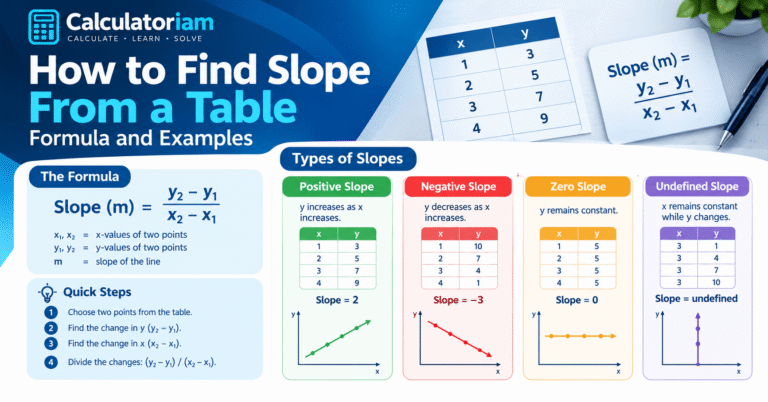
This formula uses the same two-point relationship explained in Calculatoriam’s Slope Formula guide.
Worked Example: Find the Slope of a Secant Line
Use the function:
f(x)=x^2+2x
Find the secant slope between x = 1 and x = 4.
Step 1: Calculate both function values.
At x = 1:
f(1)=1^2+2(1)=3
At x = 4:
f(4)=4^2+2(4)=24
The two points are (1, 3) and (4, 24).
Step 2: Apply the secant slope formula.
m_{\text{secant}}=\frac{24-3}{4-1}
Step 3: Simplify.
m_{\text{secant}}=\frac{21}{3}=7
Final answer: The secant slope is 7.
The function increases by an average of 7 units in y for each 1-unit increase in x across the interval from 1 to 4.
However, the tangent slope at x = 1 is 4.
These results differ because the secant slope measures change across an interval, while the tangent slope measures the rate of change at a single point.
Tangent vs. Secant Line: Key Differences
A tangent line and a secant line are related concepts, but they answer different mathematical questions.
| Feature | Tangent Line | Secant Line |
|---|---|---|
| Main purpose | Instantaneous rate of change | Average rate of change |
| Points used in calculation | One target point and a limit | Two distinct points |
| Formula | f'(a) | (f(b) − f(a)) / (b − a) |
| Calculus concept | Derivative | Difference quotient |
| Example slope | 4 at x = 1 | 7 from x = 1 to x = 4 |
| When useful | Local behavior of a curve | Change over an interval |
A tangent line matches the curve’s local direction at the chosen point. It does not necessarily touch the graph at only one point; a tangent can cross a curve or intersect it elsewhere.
A secant line is determined by two distinct points on the curve.
Both lines are straight, but their slopes describe different aspects of the curved function.
How a Secant Line Approaches a Tangent Line
The connection between tangent and secant slopes is one of the central ideas of differential calculus.
To find a tangent slope, begin with a point on the curve and calculate secant slopes using other points increasingly close to it.
For the function:
f(x)=x^2+2x
At x = 1, the difference quotient simplifies to:
m_{\text{secant}}=4+h
This lets us compare the secant slopes as the horizontal change h becomes smaller.
| Horizontal Change (h) | Second X-Value | Secant Slope |
|---|---|---|
| 2 | 3 | 6 |
| 1 | 2 | 5 |
| 0.5 | 1.5 | 4.5 |
| 0.1 | 1.1 | 4.1 |
| -0.1 | 0.9 | 3.9 |
| -0.5 | 0.5 | 3.5 |
The values approach 4 as h approaches zero from either side.
Therefore:
\lim_{h\to0}(4+h)=4
The tangent slope is 4.
This process explains the derivative concept: when nearby secant slopes approach a single finite value, that value is the tangent slope.
At h = 0, the two points coincide, so the original secant fraction is undefined. The derivative describes the limit of the secant slopes, not the result of directly dividing zero by zero.
What Do Positive, Negative, and Zero Tangent Slopes Mean?
The sign of a tangent slope helps describe the local direction of a differentiable curve.
Positive Tangent Slope
A positive tangent slope means the function is increasing at that point.
For example:
f(x)=x^2+2x
At x = 2:
f'(2)=2(2)+2=6
The slope is positive, indicating an upward trend from left to right.
Negative Tangent Slope
A negative tangent slope means the function is decreasing at that point.
Consider:
f(x)=x^2-6x
Its derivative is:
f'(x)=2x-6
At x = 2:
f'(2)=4-6=-2
The tangent slope is -2, showing a local downward trend.
Zero Tangent Slope
A zero tangent slope means the tangent line is horizontal.
Using the same function:
f'(x)=2x-6
Set the derivative equal to zero:
2x-6=0
Solve:
x=3
The curve has a horizontal tangent at x = 3.
A zero derivative does not always indicate a maximum or minimum. It identifies a stationary point, which requires further examination to classify.
When Is the Tangent Slope Undefined?
Not every point on a curve has a defined derivative.
A tangent slope may be undefined when the function has a sharp corner, cusp, discontinuity, or certain types of vertical tangent behavior.
Example: A Sharp Corner
Consider:
f(x)=|x-2|
The graph has a sharp corner at x = 2.
To the left of this point, the slope is -1. To the right, the slope is +1.
Because the left-hand and right-hand derivatives do not agree, the ordinary derivative at x = 2 does not exist.
Therefore, the function has no single finite tangent slope at that point.
This is different from a horizontal tangent, where the derivative exists and equals zero.
Common Mistakes When Calculating Tangent and Secant Slopes
1. Using the Secant Slope as the Tangent Slope
A secant slope generally does not equal the tangent slope at either endpoint.
Correction: Use the derivative for an exact tangent slope when it exists. Use a difference quotient for average change over an interval.
2. Substituting Zero Before Simplifying a Limit
Directly replacing h with zero in the original difference quotient leads to an undefined expression.
Correction: Simplify the expression for nonzero h before evaluating the limit.
3. Differentiating Correctly but Evaluating at the Wrong Point
If the question asks for the tangent slope at x = 2, substituting a different coordinate gives the wrong result.
Correction: Identify the target x-coordinate before evaluating the derivative.
4. Confusing the Slope With the Tangent Line Equation
A derivative produces the tangent slope, not automatically the complete equation of the tangent line.
Correction: Use the point of tangency and its slope in point-slope form to obtain the line equation.
5. Assuming Every Curve Has a Tangent Slope Everywhere
A function may have a derivative at some points but not others.
Correction: Check whether the derivative exists, especially at corners, cusps, discontinuities, or points with vertical tangent behavior.
Can You Calculate Tangent and Secant Slopes With Calculatoriam?
Calculatoriam provides tools for evaluating numerical calculations and measuring straight-line slopes.
The Advanced Calculator can help with arithmetic, powers, and numerical substitutions in worked calculus examples. However, it should not be treated as a symbolic differentiation tool.
For a straight-line rise-over-run calculation, the Slope Calculator accepts vertical rise and horizontal run to calculate grade, angle, and related measurements.
That tool can help check the numerical ratio between two known points when their coordinate differences are used as rise and run. It does not automatically calculate derivatives or identify tangent lines on curved functions.
For exact tangent slopes, use the appropriate derivative or limit formula.
Frequently Asked Questions
What is the formula for the slope of a tangent line?
The slope of a tangent line at x = a is f'(a), the derivative of the function evaluated at that point. It can also be calculated using the limit of a difference quotient, provided the limit exists.
What is the slope of a secant line formula?
The formula is (f(b) − f(a)) / (b − a), where a and b are two distinct x-values. This gives the average rate of change of the function between the selected points.
Is the derivative the same as the tangent slope?
Yes. When a function is differentiable at a point, its derivative at that point equals the slope of the tangent line.
Can a tangent line have a negative slope?
Yes. A negative tangent slope means the function is decreasing locally as x increases. The derivative at that point is negative.
Can a tangent line have a slope of zero?
Yes. A zero derivative represents a horizontal tangent line. Such a point may be a local maximum, local minimum, or another stationary point.
Does a tangent line always touch a curve at only one point?
No. A tangent line can cross a curve at the point of tangency or intersect the same curve at other points. Tangency is determined by the local behavior of the curve, not by a requirement of exactly one intersection.
Why do secant slopes approach the tangent slope?
As the second point approaches the first along the curve, the secant slope may approach a single limiting value. When that finite limit exists, it is the derivative and therefore the tangent slope at the point.
Final Answer
The slope of a tangent line formula is based on the derivative of a function at a specified point:
\boxed{m_{\text{tangent}}=f'(a)}
The corresponding secant line formula is:
\boxed{m_{\text{secant}}=\frac{f(b)-f(a)}{b-a}}
A tangent slope measures instantaneous change at one point, while a secant slope measures average change across an interval.
For the function f(x) = x² + 2x, the tangent slope at x = 1 is 4, whereas the secant slope between x = 1 and x = 4 is 7.
Understanding this difference provides the foundation for derivatives, tangent line equations, and the study of changing quantities in calculus.