How to Calculate Slope Angle From Rise and Run
To calculate a slope angle from rise and run, divide the vertical rise by the horizontal run, then find the inverse tangent (arctangent) of that ratio. The result gives the incline angle in degrees when your calculator is set to degree mode.
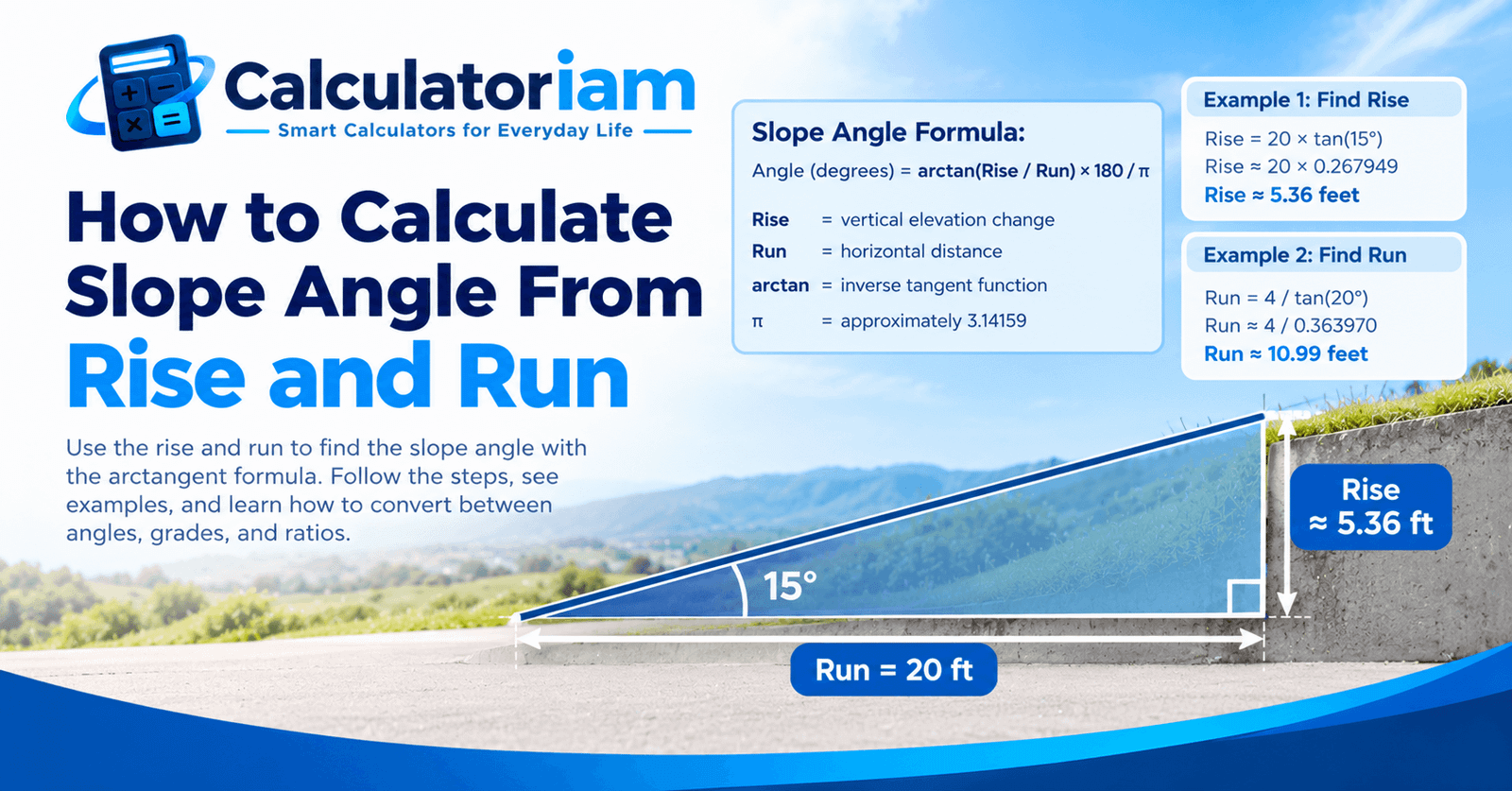
Slope angle formula:
Angle (degrees) = arctan(Rise / Run) × 180 / π
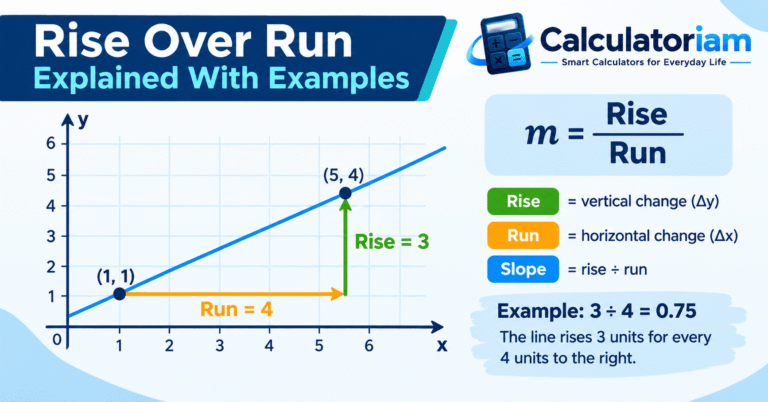
For example, if a surface rises 3 feet over a horizontal run of 4 feet, its slope angle is approximately 36.87 degrees.
You can use this method to calculate the angle of a sloped surface, driveway, hillside, ramp, or line on a graph. The important requirement is to use the vertical change and horizontal distance between the same two points.
What Are Rise, Run, and Slope Angle?
Before calculating an angle, understand the three measurements involved.
- Rise: The vertical change in height between two points. It is positive for an uphill change and negative for a downhill change when direction is defined.
- Run: The horizontal distance between those same points, measured parallel to the ground or horizontal reference.
- Slope angle: The angle between the inclined line or surface and the horizontal.
Rise and run form the two perpendicular sides of a right triangle. The inclined surface forms the hypotenuse, while the slope angle is measured between the horizontal run and the inclined line.
The slope angle describes steepness in degrees. It is different from slope ratio and percent grade, which express the relationship between rise and run in other ways.
How to Calculate Slope Angle From Rise and Run
Follow these steps to calculate the incline angle when you know the vertical rise and horizontal run.
Step 1: Measure the Rise
Find the vertical difference between the starting and ending points.
For example, suppose a sloped path rises 3 feet from its lower end to its upper end.
Rise = 3 feet
Step 2: Measure the Horizontal Run
Measure the horizontal distance between the same two points. Do not use the diagonal length along the sloped surface.
Suppose the horizontal run is 4 feet.
Run = 4 feet
Because rise and run are both measured in feet, you can use them directly in the formula.
Step 3: Divide Rise by Run
Divide the vertical rise by the horizontal run to obtain the slope ratio.
Rise / Run = 3 / 4 = 0.75
The resulting ratio is the tangent of the incline angle.
Step 4: Calculate the Inverse Tangent
Apply the arctangent function, commonly written as atan or tan⁻¹, to the ratio.
Angle (degrees) = arctan(0.75) × 180 / π
Angle ≈ 36.87°
Answer: The slope angle is approximately 36.87 degrees.
For a quicker result, use the Calculatoriam Slope Calculator, which calculates slope angle from rise and horizontal run.
Formula for Calculating Slope Angle
The slope angle formula uses the inverse tangent function because rise divided by run represents the tangent of the angle.
Slope angle formula:
Angle (degrees) = arctan(Rise / Run) × 180 / π
In this formula:
- Angle is the incline measured in degrees.
- Rise is the vertical elevation change.
- Run is the horizontal distance.
- arctan is the inverse tangent function.
- π is approximately 3.14159.
Rise and run must use the same unit of measurement, such as feet, inches, meters, or centimeters. Since the formula divides one distance by another, the units cancel out.
The conversion factor 180 / π converts the angle from radians to degrees. Many calculators can display degrees directly, so you may not need to perform this conversion manually.
A Simpler Calculator Formula
If your scientific calculator is already set to degree mode, use the shorter expression:
Angle = tan⁻¹(Rise / Run)
For the previous example:
Angle = tan⁻¹(3 / 4)
Angle ≈ 36.87°
Make sure you select the inverse tangent function rather than the ordinary tangent function. Ordinary tangent calculates a ratio from an angle, whereas inverse tangent calculates an angle from a ratio.
Worked Examples of Slope Angle Calculations
The same formula works with different rise-and-run measurements. Here are several examples to show how the calculation changes with the steepness of a surface.
Example 1: Calculate the Angle for a 2-Foot Rise and 10-Foot Run
Suppose a sloped surface rises 2 feet over a horizontal distance of 10 feet.
Given:
- Rise = 2 feet
- Run = 10 feet
First, calculate the ratio.
Rise / Run = 2 / 10 = 0.2
Next, calculate the inverse tangent.
Angle = arctan(0.2) × 180 / π
Angle ≈ 11.31°
Answer: The slope angle is approximately 11.31 degrees.
This relatively shallow angle corresponds to a rise of 2 feet for every 10 feet of horizontal distance.
Example 2: Calculate the Angle for a 3-Inch Rise and 12-Inch Run
Imagine a small inclined surface rises 3 inches over a horizontal run of 12 inches.
Given:
- Rise = 3 inches
- Run = 12 inches
Calculate the ratio.
Rise / Run = 3 / 12 = 0.25
Apply the inverse tangent.
Angle = arctan(0.25) × 180 / π
Angle ≈ 14.04°
Answer: The slope angle is approximately 14.04 degrees.
Because both measurements use inches, no unit conversion is needed.
Example 3: Calculate the Angle for a 5-Foot Rise and 20-Foot Run
A hillside rises 5 feet over a horizontal distance of 20 feet. Find its angle of inclination.
Given:
- Rise = 5 feet
- Run = 20 feet
Calculate the ratio.
Rise / Run = 5 / 20 = 0.25
Now apply the inverse tangent.
Angle = arctan(0.25) × 180 / π
Angle ≈ 14.04°
Answer: The hillside’s angle is approximately 14.04 degrees.
Notice that this result matches the previous example. Both have the same rise-to-run ratio, even though their actual dimensions differ.
Example 4: Calculate the Angle for Equal Rise and Run
Suppose a surface rises 8 feet over a horizontal run of 8 feet.
Given:
- Rise = 8 feet
- Run = 8 feet
Calculate the ratio.
Rise / Run = 8 / 8 = 1
Then calculate the angle.
Angle = arctan(1) × 180 / π
Angle = 45°
Answer: The slope angle is 45 degrees.
Whenever the vertical rise equals the positive horizontal run, the incline angle is 45 degrees.
Example 5: Calculate the Angle for a 1:20 Slope Ratio
A slope ratio of 1:20 means 1 vertical unit for every 20 horizontal units.
Given:
- Rise = 1 foot
- Run = 20 feet
Calculate the ratio.
Rise / Run = 1 / 20 = 0.05
Apply the inverse tangent.
Angle = arctan(0.05) × 180 / π
Angle ≈ 2.86°
Answer: A 1:20 slope has an angle of approximately 2.86 degrees.
This example shows why a slope ratio should not be confused with an angle. The ratio 1:20 represents a shallow incline, not an angle of 20 degrees.
Slope Angle Reference Table
The following table shows approximate angles for several common rise-to-run relationships.
| Rise-to-run ratio | Percent grade | Slope angle |
| 1:100 | 1% | 0.57° |
| 1:50 | 2% | 1.15° |
| 1:20 | 5% | 2.86° |
| 1:10 | 10% | 5.71° |
| 1:5 | 20% | 11.31° |
| 1:4 | 25% | 14.04° |
| 1:2 | 50% | 26.57° |
| 1:1 | 100% | 45° |
These values assume the ratio is expressed as vertical rise to horizontal run. The angles are rounded to two decimal places.
A larger rise relative to the horizontal run produces a larger incline angle. However, the relationship is nonlinear: doubling the rise-to-run ratio does not necessarily double the angle.
How to Calculate Slope Angle From Percent Grade
Sometimes, the available measurement is a percentage grade rather than separate rise and run values. You can still calculate the angle by converting the percentage into a ratio first.
Percent grade is calculated as:
Percent grade = (Rise / Run) × 100
Rearrange the relationship to calculate the angle.
Angle (degrees) = arctan(Percent grade / 100) × 180 / π
For example, suppose a surface has a 10% grade.
First, convert the percentage into a decimal ratio.
Ratio = 10 / 100 = 0.1
Then calculate the angle.
Angle = arctan(0.1) × 180 / π
Angle ≈ 5.71°
Answer: A 10% grade corresponds to an angle of approximately 5.71 degrees.
For a detailed explanation of the percentage calculation, read How to Calculate Slope Percentage.
Remember that percentage grade and degrees describe steepness differently. A 10% grade does not mean a 10-degree incline.
How to Calculate Rise or Run When the Angle Is Known
If you know the incline angle and one side of the right triangle, you can calculate the missing measurement using tangent.
The tangent relationship is:
tan(Angle) = Rise / Run
Calculate Rise From Angle and Run
Use the following formula to find the vertical rise:
Rise = Run × tan(Angle)
For a 15-degree incline with a horizontal run of 20 feet, substitute the known values:
Rise = 20 × tan(15°)
Since tan(15°) ≈ 0.267949, the calculation becomes:
Rise ≈ 20 × 0.267949
The vertical rise is approximately 5.36 feet.
Calculate Run From Angle and Rise
To determine the horizontal distance, rearrange the tangent formula:
Run = Rise / tan(Angle)
Suppose the surface rises 4 feet at an angle of 20 degrees. Substituting these values gives:
Run = 4 / tan(20°)
Using tan(20°) ≈ 0.363970, calculate:
Run ≈ 4 / 0.363970
The horizontal run is approximately 10.99 feet.
These calculations assume the angle is measured from the horizontal and the slope forms a right triangle.
Slope Angle vs. Percent Grade vs. Slope Ratio
These three measurements are related, but each expresses the relationship between rise and run differently.
| Measurement | What it represents | Calculation |
| Slope angle | Inclination measured in degrees | arctan(Rise / Run) |
| Percent grade | Rise relative to run, expressed as a percentage | (Rise / Run) × 100 |
| Slope ratio | Vertical rise compared with horizontal run | Rise : Run |
For example, a rise of 5 feet over a horizontal run of 100 feet produces:
- Slope ratio: 1:20
- Percent grade: 5%
- Slope angle: approximately 2.86°
The same geometry produces all three results. Only the way the steepness is expressed changes.
If you need to compare these measurements or check a practical construction calculation, use the Calculatoriam Slope Calculator.
Common Mistakes When Calculating Slope Angle
A small mistake in the measurements or calculator settings can produce an incorrect result. Check these common problems before relying on your calculation.
Using Sloped Distance Instead of Horizontal Run
The slope angle formula uses horizontal run, not the diagonal length measured along the inclined surface.
For example, a ramp may have a 10-foot sloped length but a horizontal run of less than 10 feet. Using the sloped length as the denominator changes the ratio and produces the wrong angle.
If you only know the sloped length and the vertical rise, you need a different calculation to determine the angle.
Forgetting to Use Inverse Tangent
The ordinary tangent function converts an angle into a ratio. To calculate an angle from rise and run, use inverse tangent.
Correct: Angle = arctan(Rise / Run)
Incorrect: Angle = tan(Rise / Run)
The second expression does not calculate the desired incline angle.
Using Different Units Without Checking Them
Rise and run must use consistent distance units before you divide.
For example, if the rise is 6 inches and the run is 4 feet, convert 4 feet to 48 inches.
Rise / Run = 6 / 48 = 0.125
Angle = arctan(0.125) × 180 / π
Angle ≈ 7.13°
The same result is obtained by converting 6 inches to 0.5 feet and dividing 0.5 by 4.
Leaving the Calculator in Radian Mode
Scientific calculators may operate in degrees or radians. If you use inverse tangent in radian mode, the displayed number will be in radians rather than degrees.
To obtain degrees, either switch the calculator to degree mode or convert the radian result by multiplying by 180 / π.
Confusing a Negative Slope With a Negative Steepness
A negative rise indicates a downward change when measured in a defined direction. It does not mean that the physical steepness is negative.
For an uphill or downhill surface, the steepness magnitude can be expressed as a positive angle. If direction matters, state whether the surface rises or falls and define the direction in which the measurements were taken.
Frequently Asked Questions
How do you calculate slope angle from rise and run?
Divide the vertical rise by the horizontal run, then apply inverse tangent.
Angle (degrees) = arctan(Rise / Run) × 180 / π
For example, a 3-foot rise over a 4-foot horizontal run gives an angle of approximately 36.87 degrees.
What is the formula for slope angle?
The formula is:
Angle (degrees) = arctan(Rise / Run) × 180 / π
Rise is the vertical elevation change, and run is the horizontal distance between the same two points.
How do you convert rise over run to degrees?
Divide rise by run to obtain the ratio. Next, use the inverse tangent function to calculate the angle.
For example, a rise of 1 and a run of 10 give a ratio of 0.1. The inverse tangent of 0.1 is approximately 5.71 degrees.
What angle is a 1:10 slope?
A 1:10 slope, interpreted as 1 unit of vertical rise for every 10 units of horizontal run, has an angle of approximately 5.71 degrees.
Its percent grade is 10%.
Is a 45-degree slope equal to a 100% grade?
Yes. A 45-degree incline has equal vertical rise and horizontal run. Because Rise / Run = 1, its percent grade is 100%.
Can slope angle be calculated without a scientific calculator?
A scientific calculator is the easiest option because it includes the inverse tangent function. You can also use a calculator tool that accepts rise and horizontal run and returns the angle.
Without an inverse tangent function or a reference table, an accurate angle calculation is less convenient.
Does the slope angle formula work for downhill surfaces?
Yes. The formula works when the vertical change and horizontal run are measured consistently. For a downhill surface, the signed rise is negative if the direction of measurement follows the descent. The inverse tangent then returns a negative angle in the usual calculator convention.
If you only need the steepness, use the magnitude of the angle and describe the direction separately.
Is slope angle the same as roof pitch?
Not exactly. Slope angle measures inclination in degrees, while roof pitch is often expressed as a rise over a specified horizontal run, commonly 12 inches in US roof measurements.
You can convert a roof’s rise and horizontal run into an angle using the same inverse tangent formula, but roof pitch and angle should not be treated as interchangeable labels.
Conclusion
To calculate slope angle from rise and run, divide the vertical rise by the horizontal run and apply the inverse tangent function.
Slope angle formula:
Angle (degrees) = arctan(Rise / Run) × 180 / π
Use consistent units, measure horizontal run rather than diagonal slope length, and confirm that your calculator is set to degrees when you want the answer in degrees.
For a quick result, enter your measurements into the Calculatoriam Slope Calculator. For construction, drainage, or ramp projects, remember that the calculated angle describes the geometry only; project suitability and code compliance require separate checks.