

Slope Formula: How to Calculate Slope
The slope formula helps you calculate how steep a straight line is by comparing its vertical change with its horizontal change. It is widely used in algebra, coordinate geometry, graphing, and construction measurements.
The standard slope formula is:
m=\frac{y_2-y_1}{x_2-x_1}
Here, (m) represents the slope, (y_2-y_1) represents the vertical change, and (x_2-x_1) represents the horizontal change.
For example, suppose a line passes through the points ((2,3)) and ((6,11)).
Substitute the coordinates into the formula:
m=\frac{11-3}{6-2}
Calculate the differences:
m=\frac{8}{4}=2
Answer: The slope is 2.
This means the y-coordinate increases by 2 units for every 1-unit increase in the x-coordinate.
You can also calculate slope using the Slope Calculator. For a more detailed explanation of the relationship between vertical and horizontal changes, read Rise Over Run: Formula and Examples.
What Is the Slope Formula?
The slope formula is a mathematical equation that measures the rate of change between two points on a straight line. It describes how much the y-coordinate changes relative to the x-coordinate.
The two-point slope formula is:
m=\frac{y_2-y_1}{x_2-x_1}
The same relationship can be expressed using rise and run:
m=\frac{\text{Rise}}{\text{Run}}
Both formulas calculate slope when the rise represents vertical change and the run represents horizontal change. The first formula is particularly useful when coordinates are given, while the second is convenient when reading a graph or measuring an incline.
Understanding the Variables
The slope formula contains five main symbols.
| Symbol | Meaning |
|---|---|
| (m) | Slope of the line |
| (x_1) | x-coordinate of the first point |
| (y_1) | y-coordinate of the first point |
| (x_2) | x-coordinate of the second point |
| (y_2) | y-coordinate of the second point |
The vertical change is calculated by subtracting the first y-coordinate from the second:
\Delta y=y_2-y_1
The horizontal change is calculated by subtracting the first x-coordinate from the second:
\Delta x=x_2-x_1
Therefore, the slope can also be expressed as:
m=\frac{\Delta y}{\Delta x}
Consider the points ((3,4)) and ((7,12)).
The vertical change is:
\Delta y=12-4=8
The horizontal change is:
\Delta x=7-3=4
Divide the vertical change by the horizontal change:
m=\frac{8}{4}=2
The slope is 2.
Remember that the subscripts identify the first and second points. You can reverse the order of the points, but you must reverse the subtraction order in both the numerator and denominator.
How to Calculate Slope Using the Formula
You can calculate the slope between any two distinct points on a straight, nonvertical line by following four steps.
Step 1: Identify the Two Points
Step 2: Write the Slope Formula
Start with the standard formula:
m=\frac{y_2-y_1}{x_2-x_1}
The numerator contains the change in y, while the denominator contains the change in x.
Step 3: Substitute the Values
Replace each variable with its corresponding coordinate:
m=\frac{11-3}{6-2}
Calculate both differences:
m=\frac{8}{4}
Step 4: Calculate the Result
Divide the numerator by the denominator:
m=2
The final answer is:
\boxed{m=2}
The slope is 2, meaning the line rises 2 units for every 1 unit of horizontal movement to the right.
This method works for positive, negative, fractional, and decimal slopes. However, if both points have the same x-coordinate, the denominator becomes zero and the slope is undefined.
Slope Formula Examples
The following examples demonstrate how the formula works with different coordinate values and line directions.
Example 1: Finding a Positive Slope
Find the slope of a line passing through ((1,2)) and ((5,10)).
Step 1: Write the coordinates.
katex display=true=(1,2)[/katex]
katex display=true=(5,10)[/katex]
Step 2: Apply the formula.
m=\frac{y_2-y_1}{x_2-x_1}
Step 3: Substitute the coordinates.
m=\frac{10-2}{5-1}
Step 4: Simplify.
m=\frac{8}{4}=2
Final answer:
\boxed{m=2}
The slope is positive because the y-coordinate increases as the x-coordinate increases. On a standard coordinate graph, the line rises from left to right.
Example 2: Finding a Negative Slope
Find the slope of a line passing through ((2,9)) and ((6,3)).
Apply the slope formula:
m=\frac{y_2-y_1}{x_2-x_1}
Substitute the coordinates:
m=\frac{3-9}{6-2}
Calculate the differences:
m=\frac{-6}{4}
Simplify the fraction:
\boxed{m=-\frac{3}{2}=-1.5}
The slope is negative because the y-coordinate decreases as the x-coordinate increases. For every 1-unit increase in x, the y-coordinate decreases by 1.5 units.
A negative slope does not mean that both coordinates must be negative. Instead, it describes the direction of change between the points.
Example 3: Finding Slope With Negative Coordinates
Find the slope between ((-2,-1)) and ((4,8)).
Start with the formula:
m=\frac{y_2-y_1}{x_2-x_1}
Substitute the coordinates:
m=\frac{8-(-1)}{4-(-2)}
Subtracting a negative number is equivalent to adding:
m=\frac{8+1}{4+2}
Simplify:
m=\frac{9}{6}
Reduce the fraction:
\boxed{m=\frac{3}{2}=1.5}
The slope is positive because both coordinates increase as you move from the first point to the second.
Example 4: Finding Slope From a Graph
Suppose a straight line passes through ((1,2)) and ((5,5)).
To calculate slope from a graph, identify two points and count the vertical and horizontal changes between them.
The rise is:
\text{Rise}=5-2=3
The run is:
\text{Run}=5-1=4
Apply the rise-over-run formula:
m=\frac{\text{Rise}}{\text{Run}}
Substitute the values:
m=\frac{3}{4}=0.75
Answer:
\boxed{m=0.75}
The line rises 3 units for every 4 units of horizontal movement to the right.
When reading a graph, select points that lie exactly on the line whenever possible. If you estimate coordinates from a drawing, your answer may be approximate.
Example 5: Finding a Fractional Slope
Find the slope between ((1,2)) and ((4,4)).
Apply the formula:
m=\frac{4-2}{4-1}
Simplify:
m=\frac{2}{3}
Convert the fraction to a decimal:
\boxed{m=\frac{2}{3}\approx0.667}
The fraction is the exact result, while 0.667 is a rounded approximation.
A slope does not have to be a whole number. Fractions and decimals are valid slope values and often describe lines more precisely.
Types of Slope
A straight line can have a positive slope, negative slope, zero slope, or undefined slope. Each type describes a different relationship between the horizontal and vertical coordinates.
| Type | Description | Example |
|---|---|---|
| Positive slope | Rises from left to right | (m=2) |
| Negative slope | Falls from left to right | (m=-2) |
| Zero slope | Horizontal line | (m=0) |
| Undefined slope | Vertical line | Division by zero |
Positive Slope
A positive slope occurs when the vertical and horizontal changes have the same sign.
m>0
For example:
m=\frac{6-2}{3-1}=\frac{4}{2}=2
As you move to the right along the line, the y-coordinate increases.
Negative Slope
A negative slope occurs when the vertical and horizontal changes have opposite signs.
m<0
For example:
m=\frac{1-7}{4-1}=\frac{-6}{3}=-2
As you move to the right, the y-coordinate decreases.
Zero Slope
A horizontal line has zero slope because its vertical change is zero.
Consider the points ((1,4)) and ((6,4)).
m=\frac{4-4}{6-1}=\frac{0}{5}=0
The y-coordinate stays constant even though the x-coordinate changes.
Undefined Slope
A vertical line has an undefined slope because the horizontal change is zero.
Consider the points ((3,2)) and ((3,7)).
m=\frac{7-2}{3-3}=\frac{5}{0}
Division by zero is undefined, so the slope does not have a numerical value.
The distinction matters: a horizontal line has slope zero, while a vertical line has undefined slope.
How to Find Slope From a Line Equation
You can determine slope from a line’s equation without knowing two coordinate points.
Slope-Intercept Form
The slope-intercept form of a line is:
y=mx+b
Here, (m) represents the slope and (b) represents the y-intercept.
For example:
y=3x+4
The coefficient of (x) is 3, so the slope is:
\boxed{m=3}
Consider another equation:
y=-2x+7
The slope is:
\boxed{m=-2}
Standard Form
A line can also be written in standard form:
Ax+By=C
When (B\neq0), rearrange the equation to isolate (y):
y=-\frac{A}{B}x+\frac{C}{B}
The slope is:
m=-\frac{A}{B}
For example:
2x+4y=12
Subtract (2x) from both sides:
4y=-2x+12
Divide by 4:
y=-\frac{1}{2}x+3
Therefore:
\boxed{m=-\frac{1}{2}}
If (B=0) and (A\neq0), the equation represents a vertical line with an undefined slope.
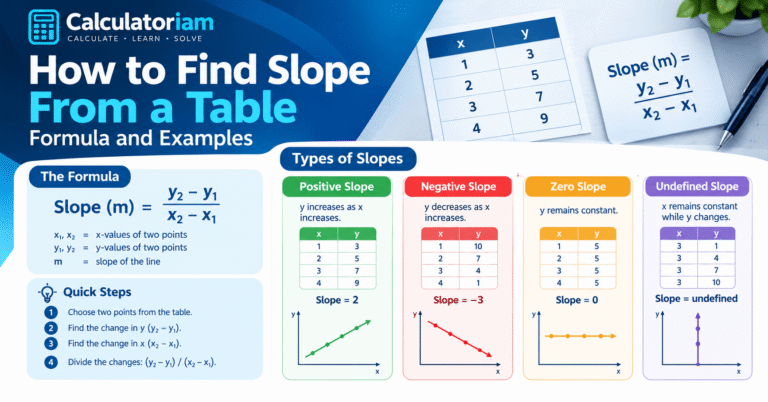
How to Find Slope From a Table
A table displays pairs of x- and y-values. You can use two rows to calculate slope if the points are distinct and have different x-coordinates.
Consider this table:
| x | y |
|---|---|
| 1 | 3 |
| 2 | 5 |
| 3 | 7 |
| 4 | 9 |
Choose the points ((1,3)) and ((2,5)).
Apply the formula:
m=\frac{5-3}{2-1}
Simplify:
m=\frac{2}{1}=2
The slope is 2.
You can verify the result using another pair:
m=\frac{7-5}{3-2}=2
The slope remains constant because the points follow a straight-line relationship.
For more worked examples, read How to Find Slope From a Table.
If different pairs produce different slopes, the data may not lie on a single straight line. In that case, distinguish between the average rate of change over an interval and the constant slope of a line.
Slope Formula for Construction and Real-World Measurements
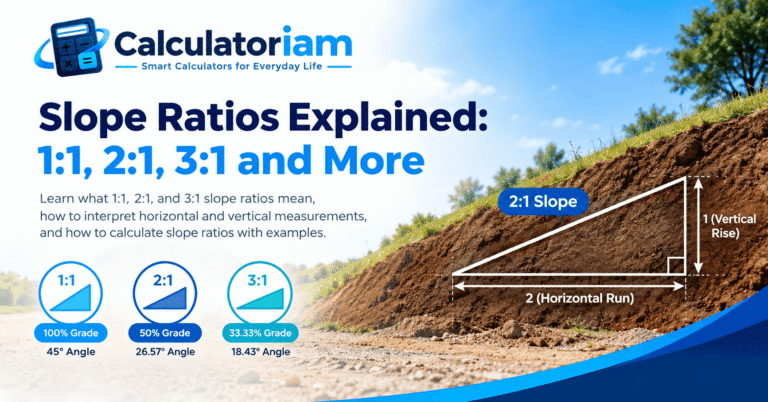
Slope is useful for describing elevation changes, driveways, ramps, stairs, drainage surfaces, and other inclines. In construction, slope is commonly expressed as a ratio, percentage grade, or angle.
However, these quantities are related but not interchangeable.
Rise Over Run
The rise-over-run formula expresses vertical change divided by horizontal change.
m=\frac{\text{Rise}}{\text{Run}}
Suppose a surface rises 3 feet over a horizontal distance of 60 feet.
m=\frac{3}{60}=0.05
The rise-to-run ratio is 1:20.
For a detailed explanation and additional examples, read Rise Over Run Explained With Examples.
When measuring physical surfaces, use the horizontal distance as the run, not the diagonal distance along the incline.
Slope Percentage Formula
Slope percentage expresses vertical rise or fall as a percentage of horizontal run.
\text{Slope (%)}=\frac{\text{Rise}}{\text{Horizontal Run}}\times100
Suppose a driveway rises 3 feet over a horizontal distance of 60 feet.
Substitute the values:
\text{Slope (%)}=\frac{3}{60}\times100
Simplify:
\frac{3}{60}=0.05
Multiply by 100:
0.05\times100=5
The final result is:
\boxed{\text{Slope Percentage}=5%}
The driveway has a 5% grade.
Both measurements must use compatible units. For example, if the rise is in inches and the run is in feet, convert one measurement before dividing.
For more examples involving grade calculations, read How to Calculate Slope Percentage.
Slope Angle Formula
You can calculate the angle of an incline from rise and horizontal run using the inverse tangent function.
\theta=\arctan\left(\frac{\text{Rise}}{\text{Horizontal Run}}\right)
To express the result in degrees, use:
\theta_{\text{degrees}}=\arctan\left(\frac{\text{Rise}}{\text{Horizontal Run}}\right)\times\frac{180}{\pi}
For a rise of 3 feet over a horizontal run of 60 feet:
\theta=\arctan\left(\frac{3}{60}\right)
The angle is approximately:
\boxed{\theta\approx2.862^\circ}
A 5% grade is approximately 2.862 degrees, not 5 degrees.
You can calculate grade percentage and slope angle with the Slope Calculator.
Slope for Driveways and Outdoor Surfaces
Slope calculations can help describe the grade of driveways, patios, and other outdoor surfaces.
Suppose a surface falls 2 inches over a horizontal distance of 10 feet. First, convert the horizontal distance to inches.
10\times12=120\text{ inches}
Calculate the grade magnitude:
\text{Grade (%)}=\frac{2}{120}\times100
Divide the rise magnitude by the horizontal run:
\frac{2}{120}\approx0.016667
Multiply by 100:
0.016667\times100\approx1.67
The grade magnitude is approximately:
\boxed{1.67%}
If the direction of travel is downhill, the signed grade can be expressed as:
\boxed{-1.67%}
The sign depends on the chosen direction of measurement. The magnitude remains approximately 1.67%.
This is a mathematical example, not a universal drainage recommendation. Actual drainage design depends on the surface, site conditions, project specifications, and applicable requirements.
Slope and Stair Measurements
Stair geometry also involves vertical rise and horizontal run. Their ratio describes the geometric steepness of a staircase.
Suppose a hypothetical stair layout has a total rise of 8 feet and a horizontal run of 10 feet.
m=\frac{8}{10}=0.8
The angle is approximately:
\theta=\arctan(0.8)\approx38.66^\circ
This example describes geometry only; it does not establish that a staircase meets building requirements. Actual stair design may depend on riser height, tread depth, headroom, landings, handrails, and local codes.
Common Mistakes When Using the Slope Formula
The slope formula is straightforward, but small errors can change the result.
Reversing the Subtraction Order
You can subtract the coordinates in either direction, provided you use the same order for both the numerator and denominator.
For example:
m=\frac{11-3}{6-2}=\frac{8}{4}=2
Reversing both subtractions gives the same answer:
m=\frac{3-11}{2-6}=\frac{-8}{-4}=2
However, reversing only one subtraction changes the sign and produces an incorrect result.
Mixing Up the x- and y-Coordinates
The numerator must contain the change in y, while the denominator must contain the change in x.
Correct formula:
m=\frac{\text{Change in }y}{\text{Change in }x}
Switching the numerator and denominator generally produces a different value. Keep the vertical change on top and the horizontal change on the bottom.
Forgetting Negative Signs
When a coordinate is negative, use parentheses during substitution.
For example:
5-(-3)=5+3=8
This simple step helps prevent arithmetic errors when working with negative coordinates.
Dividing by Zero
If both points have the same x-coordinate, the denominator becomes zero. In that case, the line is vertical and its slope is undefined.
m=\frac{7-2}{3-3}=\frac{5}{0}
Do not report zero as the answer. Zero slope applies to horizontal lines, where the numerator is zero and the denominator is nonzero.
Confusing Slope With Distance
Slope measures a ratio, not the length between two points.
Suppose the vertical change is 3 units and the horizontal change is 4 units. The slope is:
m=\frac{3}{4}=0.75
The straight-line distance between the points is a different quantity:
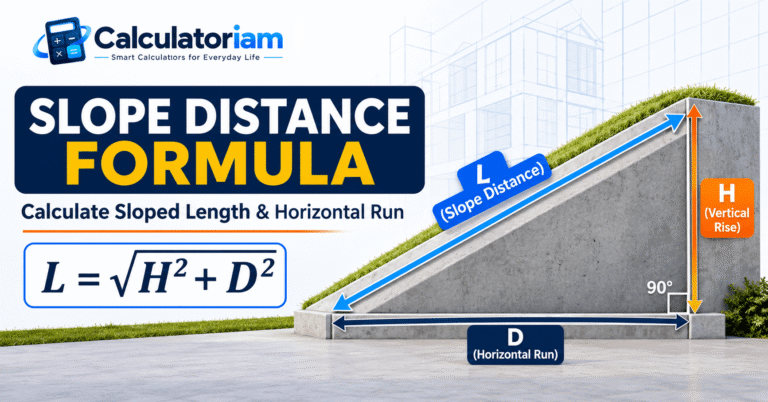
d=\sqrt{(\Delta x)^2+(\Delta y)^2}
Substitute the changes:
d=\sqrt{4^2+3^2}
Simplify:
d=\sqrt{16+9}=\sqrt{25}=5
Therefore, the slope is 0.75, while the distance is 5 units.
Using Inconsistent Units
Rise and run must use compatible units for a physical slope calculation.
Suppose the rise is 6 inches and the horizontal run is 4 feet. Convert 4 feet to 48 inches.
\text{Run}=4\times12=48\text{ inches}
Calculate the slope:
m=\frac{6}{48}=0.125
The corresponding grade percentage is:
0.125\times100=12.5%
Consistent units help prevent incorrect construction measurements.
Slope Formula vs. Other Related Formulas
Several mathematical formulas involve straight lines, but each serves a different purpose.
Two-point slope formula: Calculates slope from two coordinate points.
m=\frac{y_2-y_1}{x_2-x_1}
Rise-over-run formula: Expresses slope as vertical change divided by horizontal change.
m=\frac{\text{Rise}}{\text{Run}}
Slope percentage formula: Converts a slope ratio to percentage grade.
\text{Grade (%)}=\frac{\text{Rise}}{\text{Run}}\times100
Slope angle formula: Calculates the angle of an incline.
\theta=\arctan\left(\frac{\text{Rise}}{\text{Run}}\right)
Slope-intercept form: Expresses a line using its slope and y-intercept.
y=mx+b
Point-slope form: Writes a line equation when the slope and one point are known.
y-y_1=m(x-x_1)
Distance formula: Calculates the straight-line distance between two points.
d=\sqrt{(x_2-x_1)^2+(y_2-y_1)^2}
Choose the formula that matches the quantity you need. Slope measures the rate of vertical change relative to horizontal change, whereas distance measures the length between points.
Frequently Asked Questions
What Is the Basic Formula for Slope?
The basic slope formula is:
m=\frac{y_2-y_1}{x_2-x_1}
It calculates the change in the y-coordinate divided by the change in the x-coordinate between two points.
How Do You Calculate Slope Step by Step?
Identify two points, subtract their y-coordinates, subtract their x-coordinates in the same order, and divide the results. Simplify the fraction when possible. If the denominator is zero, the slope is undefined.
What Does m Mean in the Slope Formula?
The letter (m) represents the slope of a line. It describes the vertical change for each unit of horizontal change when the line is not vertical.
Can Slope Be a Fraction or Decimal?
Yes. Slope can be an integer, fraction, decimal, or negative number.
For example:
\frac{3}{4}=0.75
Both values represent the same slope.
What Is the Slope of a Horizontal Line?
A horizontal line has a slope of zero because its vertical change is zero while its horizontal change is nonzero.
m=\frac{0}{\text{Run}}=0
What Is the Slope of a Vertical Line?
A vertical line has an undefined slope because its horizontal change is zero. The slope formula would require division by zero.
Can You Calculate Slope Without a Graph?
Yes. You can calculate slope directly from two coordinate points using the two-point formula. You can also identify the slope from an equation written in slope-intercept form.
Does a Negative Slope Mean Both Coordinates Are Negative?
No. A negative slope means that y decreases as x increases. The coordinates themselves may be positive, negative, or a mixture of both.
What Is the Difference Between Slope and Rise Over Run?
Rise over run is the ratio used to calculate slope. Rise measures vertical change, while run measures horizontal change. Dividing rise by run gives the slope of a straight line in a standard coordinate plane.
Is Slope the Same as Percent Grade?
Not exactly. Slope is the ratio of vertical change to horizontal change. Percent grade expresses that ratio as a percentage.
\text{Grade (%)}=\frac{\text{Rise}}{\text{Run}}\times100
For example, a slope ratio of 0.05 corresponds to a 5% grade.
Is a 5% Slope the Same as a 5-Degree Angle?
No. A 5% grade corresponds to approximately 2.862 degrees. Percentage grade and angle in degrees are different ways of expressing steepness.
Can You Find Slope From a Table of Values?
Yes. Choose two coordinate pairs from the table and apply the slope formula. If the values represent a straight line, any two distinct points on that line will produce the same slope.
For additional worked examples, read How to Find Slope From a Table.
What Happens if Both Points Have the Same Coordinates?
If both points are identical, the numerator and denominator are both zero. The expression becomes (0/0), which is undefined.
A single point does not determine a unique line or slope. Two distinct points are needed to determine the slope of a line.
Conclusion
The slope formula provides a reliable way to calculate the rate of change and steepness of a straight line.
The standard formula is:
\boxed{m=\frac{y_2-y_1}{x_2-x_1}}
To calculate slope correctly, identify both points, subtract the coordinates in the same order, and divide the vertical change by the horizontal change.
A positive slope rises from left to right, a negative slope falls, a horizontal line has zero slope, and a vertical line has undefined slope.
For physical measurements, the rise-over-run relationship can also be expressed as percentage grade or angle. However, these quantities are not interchangeable, so always use the appropriate formula for your task.
For a quick calculation, use the Slope Calculator. You can also explore Rise Over Run and How to Calculate Slope Percentage for more detailed examples.



3 Comments