
Rise Over Run Explained With Examples
Rise over run is the vertical change divided by the horizontal change between two points on a straight line. It tells you how much a line rises or falls for each unit it moves horizontally. This ratio is the line’s slope.
Slope = Rise ÷ Run
For example, a line that rises 3 units over a horizontal run of 4 units has a slope of 3 / 4 = 0.75. In other words, it rises 0.75 units for every 1 unit to the right.
If you are measuring a real incline rather than reading a coordinate graph, the Slope Calculator can help you interpret rise and horizontal run as a grade percentage, angle, and rise-to-run ratio.
What Does Rise Over Run Mean?
Rise is the vertical change (change in y), while run is the horizontal change (change in x). Their ratio describes the steepness and direction of a straight line.
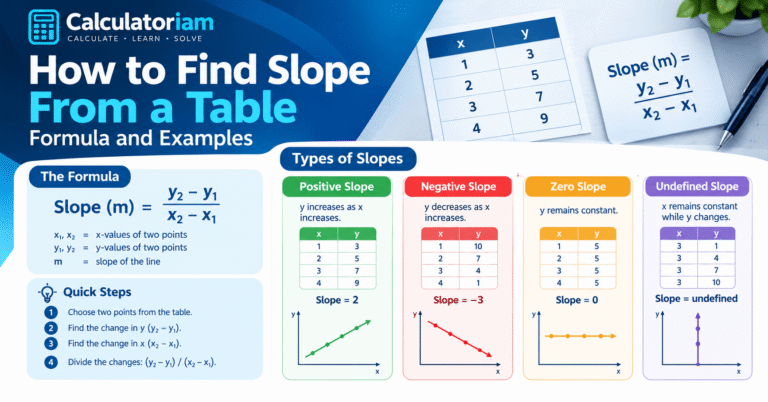
- Positive slope: The line goes upward from left to right.
- Negative slope: The line goes downward from left to right.
- Zero slope: The line is horizontal.
- Undefined slope: The line is vertical, so its horizontal change is zero.
The run is always the horizontal change, not the diagonal distance along an incline. On a coordinate graph, rise and run can be positive or negative depending on the direction you travel between points.
Rise Over Run Formula
The basic formula is:
m = Rise ÷ Run = Δy ÷ Δx
For two points (x1, y1) and (x2, y2), write it as:
m = (y₂ − y₁) ÷ (x₂ − x₁)
Here, m is slope; y2 – y1 is rise; and x2 – x1 is run. Subtract coordinates in the same order in both parts of the fraction. You can reverse both subtractions without changing the answer, but reversing only one changes its sign.
The formula works when the run is not zero. If x2 = x1, the line is vertical and its slope is undefined.
For a broader explanation of the coordinate formula, see Slope Formula: How to Calculate Slope.
How to Calculate Rise Over Run Step by Step
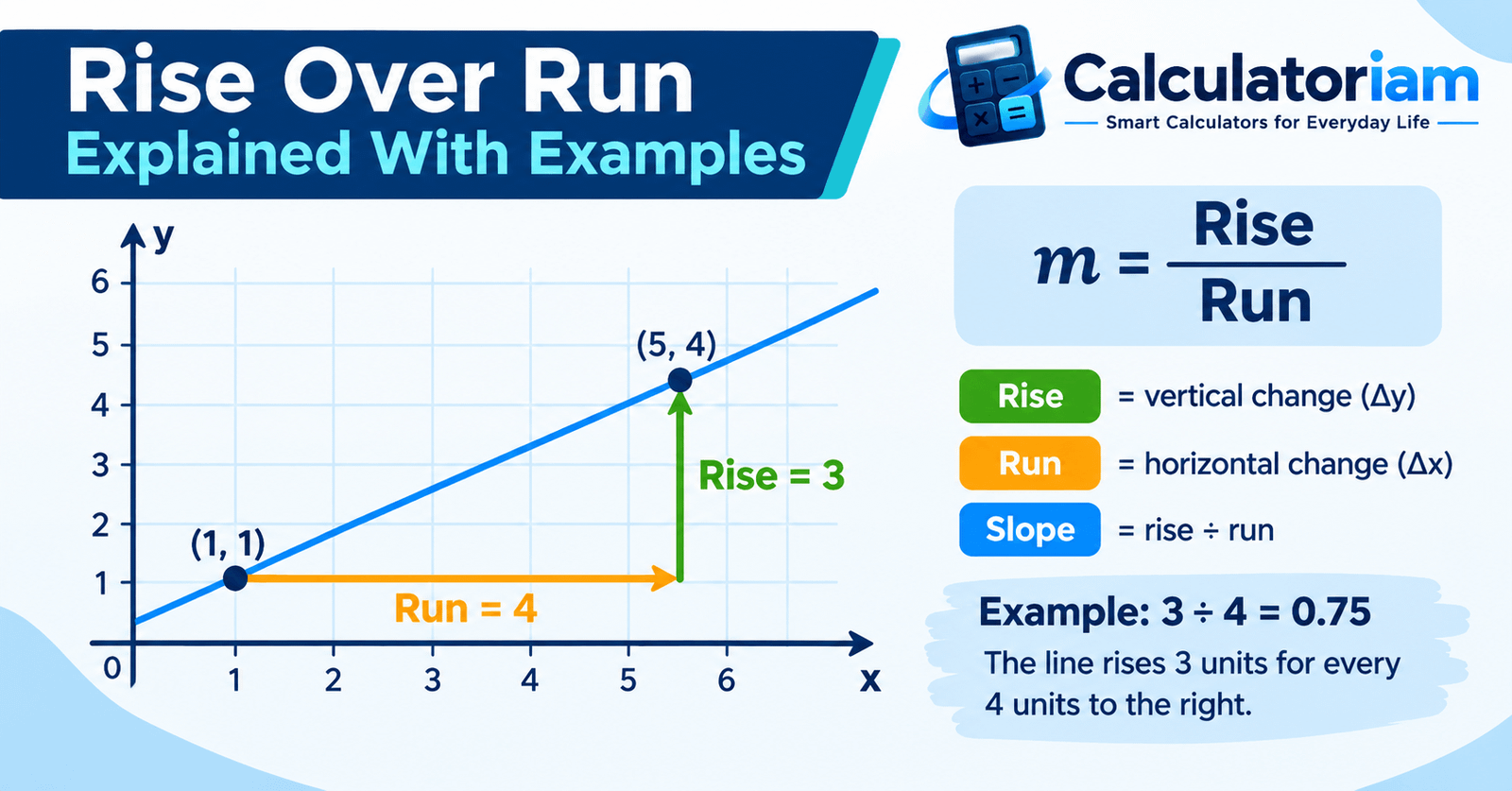
Suppose a line passes through (1, 1) and (5, 4).
- Choose two points: (x1, y1) = (1, 1) and (x2, y2) = (5, 4).
- Find the rise: y2 – y1 = 4 – 1 = 3.
- Find the run: x2 – x1 = 5 – 1 = 4.
- Divide: m = 3 / 4 = 0.75.
- Interpret the result: The line rises 3 units for every 4 units to the right.
You can express this slope as the fraction 3/4 or the decimal 0.75. Both mean the same thing.
Existing image placement: Keep the current rise-over-run diagram immediately after this example, provided its labels and measurements match the 3-unit rise and 4-unit run. Suggested alt text: *Coordinate diagram showing a vertical rise of 3 units and a horizontal run of 4 units, giving a slope of 3/4.*
Rise Over Run Examples
Example 1: Positive slope
A line passes through (2, 3) and (6, 7).
- Rise = 7 – 3 = 4
- Run = 6 – 2 = 4
- Slope = 4 / 4 = 1
The line rises one unit for each unit it moves right.
Example 2: Fractional slope
A line passes through (0, 2) and (6, 5).
- Rise = 5 – 2 = 3
- Run = 6 – 0 = 6
- Slope = 3 ÷ 6 = ½ = 0.5
The line rises one unit for every two units to the right.
Example 3: Negative slope
A line passes through (1, 8) and (5, 2).
- Rise = 2 – 8 = -6
- Run = 5 – 1 = 4
- Slope = -6 / 4 = -1.5
The negative sign means the line falls as x increases. It does not indicate an error.
Example 4: Zero slope
A line passes through (2, 4) and (7, 4).
- Rise = 4 – 4 = 0
- Run = 7 – 2 = 5
- Slope = 0 / 5 = 0
The line is horizontal because its y-value does not change.
Example 5: Undefined slope
A line passes through (3, 1) and (3, 6).
- Rise = 6 – 1 = 5
- Run = 3 – 3 = 0
- Slope = 5 ÷ 0 → undefined (division by zero)
A vertical line has no defined slope because division by zero is undefined.
How to Find Rise Over Run From a Graph
You do not need an equation if you can identify two points accurately on a straight-line graph.
- Select two clear points on the line, preferably where it crosses grid intersections.
- Read the change in x between them. This is the run.
- Read the change in y between them. This is the rise.
- Divide rise by run, keeping the correct signs.
For instance, moving 5 units right and 2 units up gives a slope of 2/5 = 0.4. Moving 5 units right and 2 units down gives -2/5 = -0.4.
Check the axis scale. A single grid square may represent 2, 5, or 10 units. Use the actual coordinate differences rather than counting squares without checking their values.
If the points are presented as rows of x- and y-values rather than on a graph, follow the dedicated guide to finding slope from a table.
Rise Over Run vs. Slope: Is There a Difference?
For a straight line, rise over run is the method used to calculate slope. The two phrases describe the same vertical-to-horizontal relationship, but “rise over run” emphasizes the measurements used in the calculation.
| Term | Meaning |
|---|---|
| Rise | The vertical change between two points, calculated as y₂ − y₁. |
| Run | Horizontal change between the same points, calculated as x₂ − x₁. |
| Slope | A ratio that compares vertical change with horizontal change (rise ÷ run). |
| Positive slope | Indicates that a line rises as it moves from left to right. |
| Negative slope | Describes a line that falls as it moves from left to right. |
The direction of a line determines whether its slope is positive or negative. An upward movement from left to right produces a positive slope, while a downward movement produces a negative slope. A horizontal line has zero slope, whereas a vertical line has an undefined slope because its run is zero.
Common Rise Over Run Mistakes
Dividing run by rise. If rise = 3 and run = 4, the slope is 3/4, not 4/3.
Reversing only one subtraction. Use (y2 – y1) / (x2 – x1), or reverse both differences together.
Using diagonal distance as run. The run is horizontal. The diagonal distance along a ramp or hillside is a different measurement.
Dropping the negative sign. A downward line can have a negative slope; do not automatically use absolute values when solving coordinate problems.
Dividing by zero. If the horizontal change is zero, the slope is undefined—not zero.
Mixing measurement units. For a physical incline, convert rise and run to the same length unit before interpreting the ratio as a dimensionless grade.
Where Is Rise Over Run Used in Real Life?
Algebra and coordinate graphs
Rise over run helps students understand linear equations, compare rates of change, and interpret graphs. The same principle applies when checking whether a relationship has a constant slope.
Stairs and ramps
Rise and run describe vertical and horizontal dimensions in layout geometry. For stair-specific measurements, use the Stair Calculator. A slope calculation alone does not establish whether a stair or ramp design meets applicable safety or accessibility requirements.
Driveways, drainage, and other inclines
Construction grades are often expressed as percentages rather than decimals. For example, a rise of 1 foot over 20 feet of horizontal run gives a slope of 1/20 = 0.05, or 5% grade. That is a mathematical example, not a universal recommended grade.
Use the Slope Calculator to convert measured rise and run into grade percentage and angle. To understand the conversion method, see How to Calculate Slope Percentage. These related guides cover grade conversion in more depth; rise over run remains the basic concept here.
Frequently Asked Questions
Is rise over run always a fraction?
No. It can be written as a fraction, decimal, or ratio. For example, 3/4 and 0.75 describe the same slope.
Can rise over run be negative?
Yes. If y decreases while x increases, the slope is negative. For example, a rise of -2 over a run of 5 gives -0.4.
What if the rise is zero?
When rise is zero and run is nonzero, the slope is 0 and the line is horizontal.
What if the run is zero?
The slope is undefined, because dividing by zero is not allowed. The line is vertical.
Is rise over run the same as slope percentage?
Not exactly. Rise divided by run gives the slope as a ratio or decimal. Multiply that result by 100 to express it as a percentage. For example, 0.05 corresponds to 5% grade.
Does rise over run have units?
When rise and run are both measured in the same length unit, the units cancel. If they use different units, convert first—for example, 6 inches over 10 feet becomes 6/120 = 0.05, or 5% grade.
Final Takeaway
Rise over run = vertical change / horizontal change. Identify two points, subtract their y-values to find rise, subtract their x-values to find run, and divide. Keep the subtraction order consistent and remember that a zero run produces an undefined slope.
For a physical incline, you can check the result with Calculatoriam’s Slope Calculator. For coordinate-table questions or percent-grade conversions, use the linked guides above rather than mixing several different tasks into one calculation.

2 Comments