
Slope Intercept Formula: How to Use y = mx + b With Examples
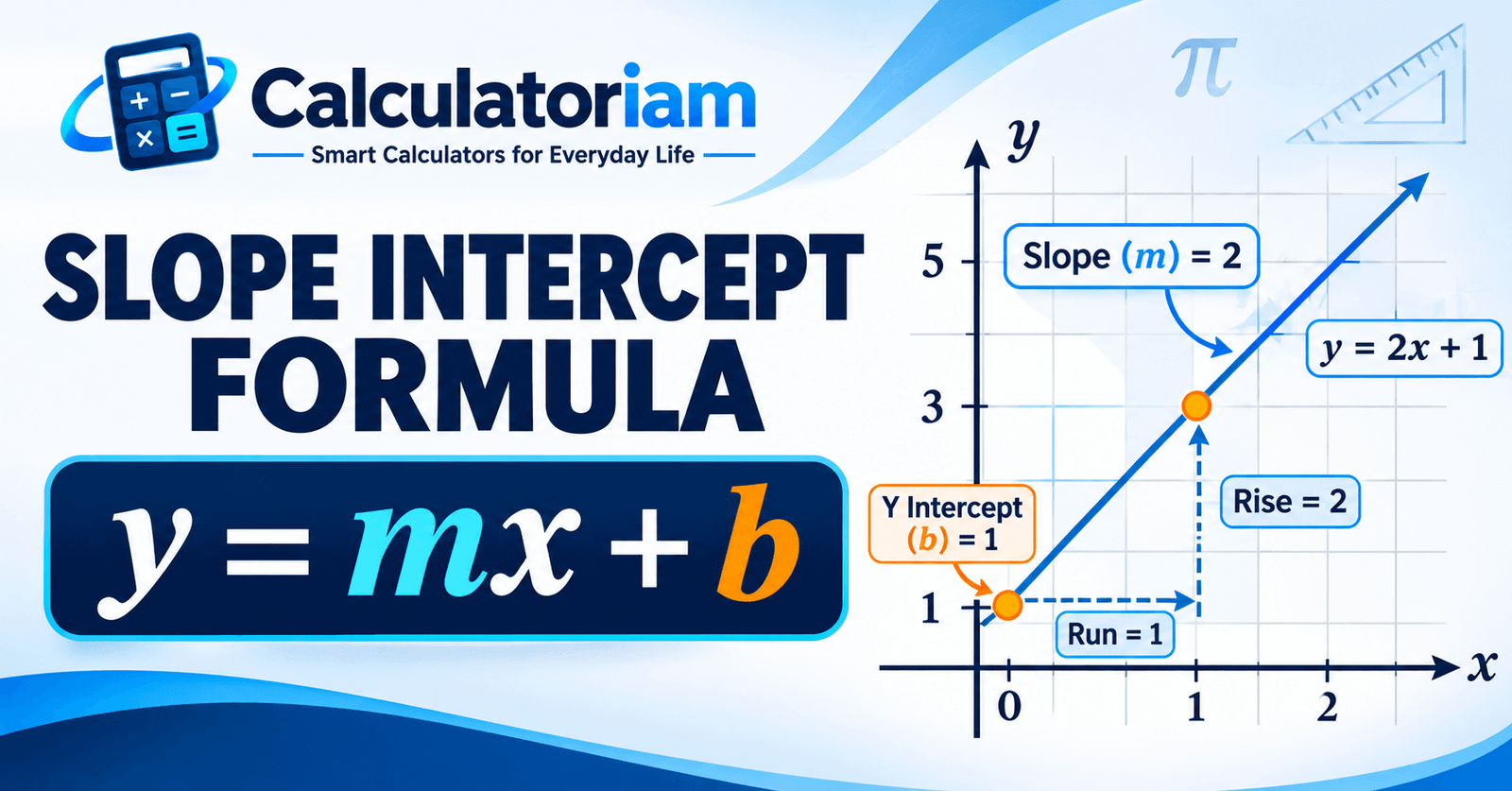
The slope intercept formula helps you write the equation of a straight line using its slope and the point where it crosses the y axis. It is one of the most useful formulas in algebra because you can identify a line’s direction and starting value directly from its equation.
The standard slope intercept formula is:
y=mx+b
In this equation, m represents the slope, while b represents the y intercept. The variables x and y describe coordinates on the straight line.
For example, consider:
y=2x+3
The slope is 2, and the y intercept is 3. This means the line rises 2 units for every 1 unit it moves to the right and crosses the y axis at (0, 3).
You can use the slope intercept formula to graph linear equations, find missing coordinates, calculate an unknown intercept, and describe relationships that change at a constant rate.
What Is the Slope Intercept Formula?
The slope intercept formula is a mathematical equation that represents any nonvertical straight line using its slope and y intercept.
The equation is:
y=mx+b
Each symbol has a specific meaning.
| Symbol | Meaning |
|---|---|
| y | Vertical coordinate or dependent variable |
| x | Horizontal coordinate or independent variable |
| m | Slope of the line |
| b | Y intercept of the line |
The slope tells you how much y changes when x increases by one unit.
The y intercept identifies where the line crosses the vertical axis.
For example:
y=4x+5
In this equation, the slope is 4, and the y intercept is 5.
The line passes through (0, 5). For every 1 unit increase in x, the y value increases by 4.
This makes the equation useful for understanding both the position and direction of a straight line.
Why Is It Called Slope Intercept Form?
The name comes from the two values shown directly in the equation.
The first value is the slope, represented by m.
The second is the y intercept, represented by b.
Because these values are already visible, you can graph or interpret the line without rearranging the equation.
This is particularly helpful when working with coordinate graphs and linear functions.
Understanding Slope and Y Intercept
Before using the slope intercept formula, it is important to understand its two main components.
What Is Slope?
Slope measures the steepness and direction of a straight line.
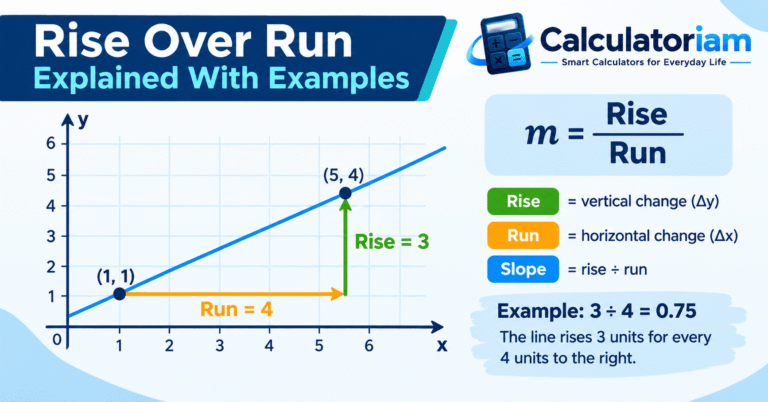
It compares the vertical change between two points with their horizontal change.
The slope formula is:
m=\frac{y_2-y_1}{x_2-x_1}
Here, the coordinate pairs represent two different points on the line.
A positive slope means the line rises from left to right.
A negative slope means the line falls from left to right.
A zero slope represents a horizontal line.
A vertical line has an undefined slope because its horizontal change is zero.
What Is the Y Intercept?
The y intercept is the location where a straight line crosses the y axis.
At this point, x equals zero.
Consider:
y=3x+7
Substitute zero for x:
y=3(0)+7
Simplify:
y=7
Answer: The y intercept is 7, located at (0, 7).
The y intercept can be positive, negative, or zero.
A positive intercept is above the origin. A negative intercept is below it.
How to Use the Slope Intercept Formula
You can write a linear equation directly when the slope and y intercept are known.
Follow these three steps.
Step 1: Identify the Slope
The slope is represented by m.
Suppose the slope is 3.
Then:
m=3
Step 2: Identify the Y Intercept
Suppose the line crosses the y axis at (0, 4).
The y intercept is 4.
Therefore:
b=4
Step 3: Substitute the Values
Start with:
y=mx+b
Substitute the known values:
y=3x+4
Final answer: y = 3x + 4.
The equation describes a line with slope 3 and y intercept 4.
You can now use it to calculate y values or graph the line.
Slope Intercept Formula Examples With Answers
The following examples demonstrate how the slope intercept formula works with different values.
Example 1: Positive Slope and Positive Intercept
Problem: Write the equation of a line with slope 2 and y intercept 5.
The known values are m = 2 and b = 5.
Use the formula:
y=mx+b
Substitute:
y=2x+5
Answer: y = 2x + 5.
The line rises 2 units for every 1 unit increase in x and crosses the y axis at (0, 5).
Example 2: Negative Slope
Problem: Find the equation of a line with slope −3 and y intercept 6.
Substitute the values:
y=-3x+6
Answer: y = −3x + 6.
The line decreases by 3 units whenever x increases by 1 unit.
It crosses the y axis at (0, 6).
Example 3: Negative Y Intercept
Problem: Write the equation of a line with slope 4 and y intercept −2.
Substitute:
y=4x+(-2)
Simplify:
y=4x-2
Answer: y = 4x − 2.
The line crosses the y axis at (0, −2).
Example 4: Fractional Slope
Problem: Find the equation of a line with slope 2/3 and y intercept 1.
Use:
y=mx+b
Substitute:
y=\frac{2}{3}x+1
Answer: y = (2/3)x + 1.
The slope means the line rises 2 units for every 3 units of horizontal movement to the right.
Example 5: Zero Slope
Problem: Find the equation of a horizontal line crossing the y axis at 8.
A horizontal line has a slope of zero.
Substitute:
y=0x+8
Simplify:
y=8
Answer: y = 8.
Every point on the line has the same y coordinate.
How to Find the Slope Intercept Formula From Two Points
Sometimes a problem provides two coordinates instead of the slope and intercept.
In that case, calculate the slope first and then determine the y intercept.
Worked Example: Find the Equation Through Two Points
Problem: Find the equation of a line passing through (2, 5) and (6, 13).
Step 1: Calculate the slope.
Use:
m=\frac{y_2-y_1}{x_2-x_1}
Substitute:
m=\frac{13-5}{6-2}
Simplify:
m=\frac{8}{4}=2
The slope is 2.
Step 2: Write the equation with the unknown intercept.
y=2x+b
Step 3: Use one point to calculate b.
Choose (2, 5).
Substitute:
5=2(2)+b
Simplify:
5=4+b
Subtract 4:
b=1
Step 4: Write the final equation.
y=2x+1
Final answer: y = 2x + 1.
To verify, substitute x = 6:
y=2(6)+1
y=13
The result matches the second point.
How to Find the Y Intercept Using a Point and Slope
If you know the slope and one point, you can calculate the y intercept without graphing the line.
Start with:
y=mx+b
Subtract mx from both sides:
b=y-mx
This equation allows you to calculate the intercept directly.
Worked Example
Problem: Find the equation of a line with slope 4 passing through (3, 10).
The known values are:
- m = 4
- x = 3
- y = 10
Substitute:
b=10-4(3)
Calculate:
b=10-12
b=-2
Write the equation:
y=4x-2
Answer: y = 4x − 2.
The slope is 4, and the line crosses the y axis at (0, −2).
How to Graph a Line Using the Slope Intercept Formula
The slope intercept formula makes graphing straightforward because it provides the slope and y intercept directly.
Consider:
y=2x+1
The slope is 2, and the y intercept is 1.
Step 1: Plot the Y Intercept
Locate (0, 1) on the coordinate plane.
Mark this point on the y axis.
Step 2: Use the Slope
The slope is 2, which can also be written as:
m=\frac{2}{1}
Starting at (0, 1), move 1 unit to the right and 2 units upward.
You reach (1, 3).
Step 3: Find Another Point
Repeat the movement.
From (1, 3), move 1 unit right and 2 units up.
You reach (2, 5).
Step 4: Draw the Line
Draw a straight line through the points (0, 1), (1, 3), and (2, 5).
Extend the line in both directions.
Step 5: Verify a Point
Substitute x = 2 into the equation:
y=2(2)+1
Calculate:
y=5
The point (2, 5) satisfies the equation.
How to Convert Standard Form to Slope Intercept Form
Linear equations can also be written in standard form:
Ax+By=C
Here, A, B, and C are constants.
To convert this equation into slope intercept form, isolate y.
Worked Example
Problem: Convert the following equation:
3x+2y=12
Step 1: Subtract 3x from both sides.
2y=-3x+12
Step 2: Divide every term by 2.
y=-\frac{3}{2}x+6
Final answer: y = −(3/2)x + 6.
The slope is −3/2, and the y intercept is 6.
This conversion works when the coefficient of y is not zero.
If the coefficient of y is zero, the equation represents a vertical line.
How to Convert Point Slope Form to Slope Intercept Form
Point slope form is another way to represent a straight line.
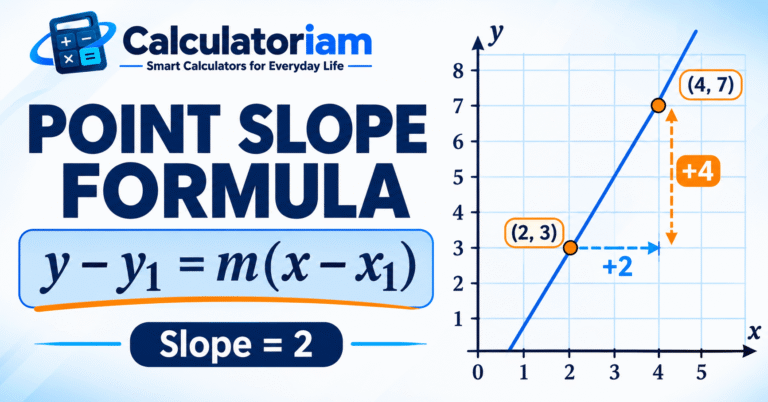
Its equation is:
y-y_1=m(x-x_1)
To convert it into slope intercept form, distribute the slope and isolate y.
Consider:
y-3=2(x-4)
Distribute 2:
y-3=2x-8
Add 3 to both sides:
y=2x-5
Answer: y = 2x − 5.
The resulting equation shows the slope and y intercept directly.
Slope Intercept Form vs. Other Linear Equation Forms
Straight lines can be represented using different equation formats.
| Equation form | Equation | Main use |
|---|---|---|
| Slope intercept | y = mx + b | Identify slope and y intercept |
| Point slope | y − y₁ = m(x − x₁) | Write a line from one point and slope |
| Standard | Ax + By = C | Express a linear relationship using coefficients |
| Horizontal line | y = c | Represent a constant y value |
| Vertical line | x = c | Represent a constant x value |
Each form has a different advantage.
Slope intercept form is especially useful for graphing because the slope and intercept are visible.
What Does the Slope Formula y = mx + b Mean?
The equation y = mx + b describes a linear relationship with a constant rate of change.
The term mx represents the change associated with x.
The constant b represents the value of y when x equals zero.
Consider:
y=5x+20
When x = 0:
y=5(0)+20
y=20
When x = 3:
y=5(3)+20
y=35
The value of y increases by 5 for every 1-unit increase in x.
Positive, Negative, and Zero Slopes
The slope determines the direction of the line.
| Slope type | Behavior | Example |
|---|---|---|
| Positive | Rises left to right | y = 3x + 2 |
| Negative | Falls left to right | y = −2x + 4 |
| Zero | Horizontal | y = 5 |
| Undefined | Vertical | x = 3 |
Vertical lines cannot be represented using y = mx + b because their slope is undefined.
Real-World Applications of the Slope Intercept Formula
The slope intercept formula is useful when one quantity changes at a constant rate relative to another.
1. Fixed Fees and Variable Costs
Suppose a service charges a $20 starting fee plus $5 per unit.
The total cost can be represented by:
C=5x+20
Here, C represents the total cost, while x represents the number of units.
For 8 units:
C=5(8)+20
C=60
Answer: The total cost is $60.
The slope represents the cost per unit, while the intercept represents the fixed starting fee.
2. Distance and Constant Speed
Suppose an object starts 10 miles from a reference point and moves away at a constant speed of 40 miles per hour.
Its distance can be modeled as:
d=40t+10
Here, t represents time in hours, while d represents distance in miles.
After 2 hours:
d=40(2)+10
d=90
Answer: The object is 90 miles from the reference point.
3. Temperature Conversion
The Fahrenheit and Celsius temperature scales have a linear relationship.
The formula is:
F=\frac{9}{5}C+32
The slope is 9/5, while the intercept is 32.
For 20°C:
F=\frac{9}{5}(20)+32
F=68
Answer: 20°C equals 68°F.
4. Linear Data Models
When data follow an approximately straight-line pattern, a linear equation can describe the relationship.
The slope represents the estimated change in the dependent variable for each unit increase in the independent variable.
The intercept represents the model’s predicted value when the input equals zero.
However, an intercept may not always have a meaningful real-world interpretation.
5. Coordinate Geometry and Engineering
Straight-line equations are useful for representing idealized relationships between coordinates and measurements.
The slope intercept formula helps describe a line when its rate of change and vertical intercept are known.
For physical slope measurements involving rise, horizontal run, and grade percentage, the Calculatoriam Slope Calculator provides a related geometric calculation tool.
It is not an algebraic equation solver for y = mx + b.
Common Mistakes When Using the Slope Intercept Formula
1. Confusing Slope With Y Intercept
Consider:
y=3x+7
The slope is 3, while the y intercept is 7.
Remember that m is the coefficient of x and b is the constant term.
2. Ignoring Negative Signs
In the equation:
y=-4x+2
The slope is −4, not positive 4.
The negative sign means the line falls from left to right.
3. Assuming Every Line Has a Y Intercept
A vertical line such as x = 3 does not cross the y axis.
It also has an undefined slope.
Therefore, it cannot be represented using standard slope intercept form.
4. Using the Wrong Coordinate Order
When calculating slope from two points, keep the subtraction order consistent.
Subtract the coordinates in the same order for both the numerator and denominator.
Reversing only one subtraction changes the sign of the slope.
5. Forgetting to Isolate Y
Consider:
2y=6x+8
This equation is not yet in standard slope intercept form.
Divide every term by 2:
y=3x+4
Now the slope and y intercept are visible.
6. Assuming the Y Intercept Must Be Positive
The intercept can be positive, negative, or zero.
For example:
y=2x-5
The y intercept is −5, located at (0, −5).
Practice Problems With Answers
Try solving these problems before checking the answers.
Practice Problem 1: Identify Slope and Intercept
Question: Find the slope and y intercept.
y=5x-3
Answer: The slope is 5, and the y intercept is −3.
Practice Problem 2: Write a Linear Equation
Question: Write the equation of a line with slope −2 and y intercept 7.
Substitute:
y=-2x+7
Answer: y = −2x + 7.
Practice Problem 3: Find the Equation From a Point and Slope
Question: Find the equation of a line with slope 3 passing through (2, 9).
Start with:
y=3x+b
Substitute the point:
9=3(2)+b
Simplify:
9=6+b
b=3
Write the final equation:
y=3x+3
Answer: y = 3x + 3.
Practice Problem 4: Convert Standard Form
Question: Convert the following equation into slope intercept form.
4x+2y=10
Subtract 4x:
2y=-4x+10
Divide by 2:
y=-2x+5
Answer: y = −2x + 5.
Practice Problem 5: Calculate a Missing Value
Question: Find y when x = 4.
y=3x-2
Substitute:
y=3(4)-2
Calculate:
y=10
Answer: y = 10.
Frequently Asked Questions
What is the slope intercept formula?
The slope intercept formula is y = mx + b, where m represents the slope and b represents the y intercept. It describes a nonvertical straight line on a coordinate plane.
How do you find the slope in y = mx + b?
Identify the coefficient of x after the equation is written in slope intercept form. For example, in y = 4x + 7, the slope is 4.
How do you calculate the y intercept?
If you know the slope and one point, use b = y − mx. Substitute the known values to calculate the intercept.
Can the slope intercept formula have a negative slope?
Yes. A negative slope means the line falls from left to right. For example, y = −3x + 5 has a slope of −3.
Is y = mx + b the same as the slope formula?
No. The equation y = mx + b is the slope intercept equation of a straight line. The two-point slope formula calculates slope from the coordinates of two points. Both are related but serve different purposes.
Conclusion
The slope intercept formula is a practical method for writing, graphing, and understanding linear equations.
Its standard equation is:
y=mx+b
The slope, m, determines how quickly the line rises or falls. The y intercept, b, identifies where the line crosses the vertical axis.
When both values are known, you can write the equation directly. If two points are given, calculate the slope first and then determine the intercept.
Understanding the slope intercept formula provides a foundation for algebra, coordinate geometry, linear functions, and real-world mathematical models.




I never realised how simple graphing could be until I read your explanation of the intercept. It has really cleared up my confusion, cheers!