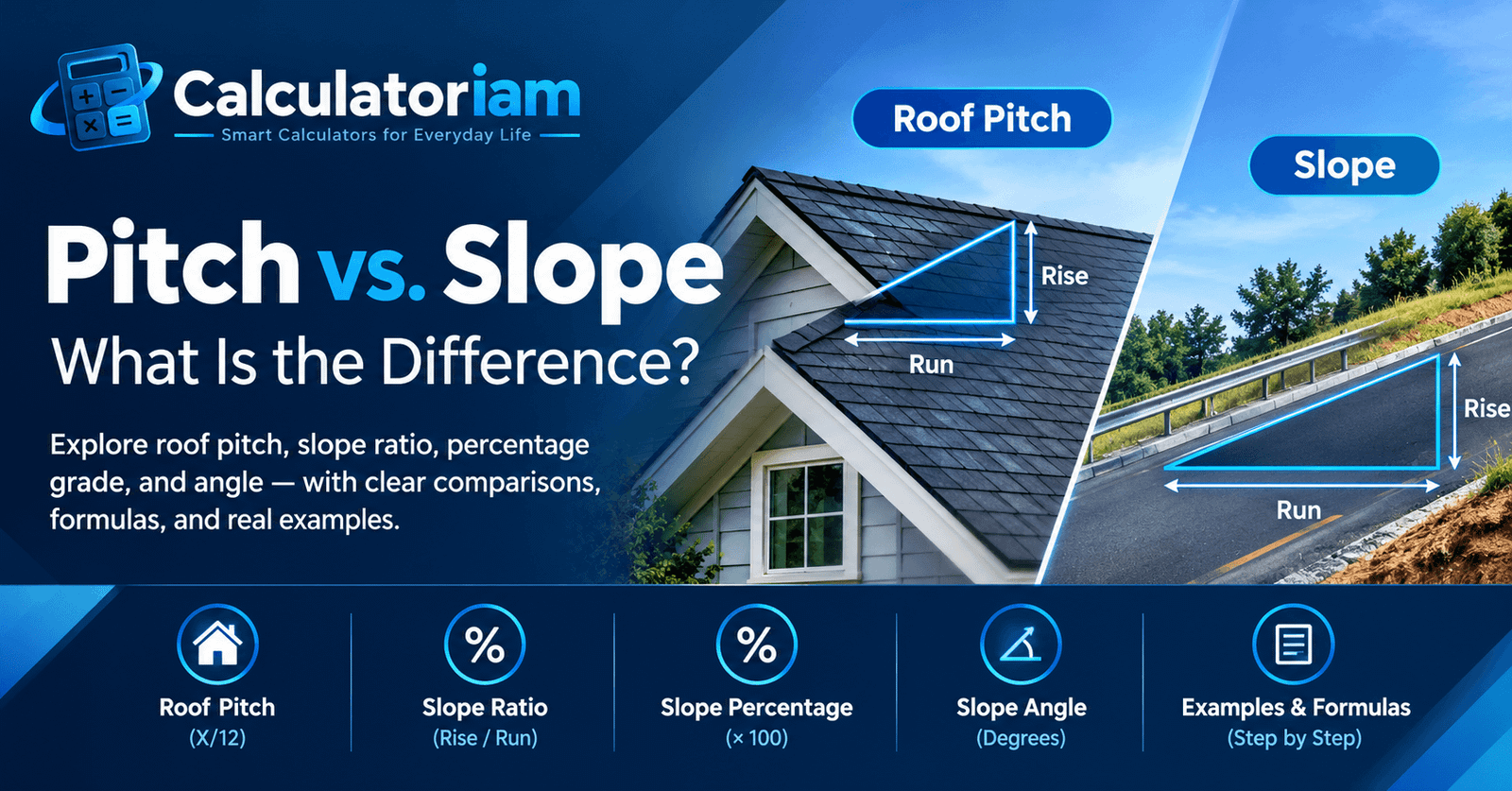
Pitch vs. Slope: What Is the Difference?
Pitch and slope both describe how steep an inclined surface is, but the terms are not always used in the same way. They commonly appear in roofing, construction, engineering, road grading, drainage, and geometry. Although people sometimes use them interchangeably, their meanings can differ depending on the measurement convention.
In modern roofing practice, pitch is frequently expressed as the amount of vertical rise for every 12 inches of horizontal run. Slope describes the relationship between vertical rise and horizontal run and can be expressed as a ratio, percentage, or angle.
For example, a roof that rises 6 inches for every 12 inches of horizontal distance has a slope ratio of 6:12. This represents a 50% grade and an angle of approximately 26.57 degrees. In modern roofing terminology, it is commonly described as a 6-in-12 roof pitch.
Understanding pitch vs. slope helps you interpret construction drawings, compare roof designs, calculate inclines, and communicate measurements accurately.
What Is the Difference Between Pitch and Slope?
The main difference between pitch and slope is how the inclination of a surface is expressed.
Slope describes the vertical change relative to horizontal distance. Pitch, particularly in roofing, is commonly expressed using a standardized rise-to-run measurement. However, some traditional technical definitions calculate roof pitch using the total span rather than the horizontal run.
Here is a comparison of the common measurements:
| Measurement | What It Describes | Common Format |
| Slope | Vertical rise compared with horizontal run | Ratio |
| Roof pitch | Roof inclination, commonly rise per 12 inches of run | 6:12 |
| Slope percentage | Rise divided by run, multiplied by 100 | 50% |
| Slope angle | Inclination measured from the horizontal | 26.57° |
| Traditional pitch fraction | Rise divided by the full roof span | 1/4 |
These measurements describe related geometric properties, but their numerical values are not interchangeable.
For accurate comparisons, identify the convention being used before interpreting a pitch or slope measurement.
What Is Slope?
Slope is a measurement of how much a surface rises or falls over a given horizontal distance. It describes the steepness and direction of an inclined surface.
You can use slope to describe:
- Roofs and inclined building surfaces.
- Driveways and access roads.
- Hillsides and land elevations.
- Drainage systems and pipelines.
- Ramps and walkways.
- Inclined surfaces in geometry.
The vertical rise compared with the horizontal run determines a line’s slope.
Slope Formula
To find the slope, divide the rise by the run:
Slope = Rise ÷ Run
Where:
- Rise = Vertical elevation change between two points.
- Run = Horizontal distance between the same points.
- Slope = Ratio of vertical change to horizontal distance.
For example, suppose a driveway rises 4 feet over a horizontal distance of 20 feet.
Slope = 4 / 20
Slope = 0.20
This result means the driveway rises 0.20 feet for every foot of horizontal distance.
The same relationship can be expressed as a ratio:
Slope ratio = 4:20
Simplified slope ratio = 1:5
A larger rise relative to the run indicates a steeper surface. Conversely, a smaller rise relative to the run indicates a flatter surface.
What Is Roof Pitch?
Roof pitch describes the inclination of a roof. It is commonly expressed as the vertical rise over a standardized horizontal run of 12 inches in modern residential roofing.
For example, a 6:12 roof pitch means the roof rises 6 inches for every 12 inches of horizontal run.
Roof pitch is important in construction because it helps describe roof geometry, compare roof designs, and determine appropriate roofing materials and installation methods.
Roof Pitch Formula
For the common rise-per-12-inch-run convention:
Roof Pitch (X/12) = (Rise / Run) × 12
Where:
- Rise = Vertical distance.
- Run = Horizontal distance.
- 12 = Standardized horizontal run in inches.
For example, suppose a roof rises 8 inches over a horizontal run of 12 inches.
Roof Pitch = (8 / 12) × 12
Roof Pitch = 8/12
Therefore, the roof has an 8-in-12 pitch.
If the measurements are taken over a different horizontal distance, calculate the equivalent rise over 12 inches rather than treating the original rise as the pitch number.
Traditional Roof Pitch Definition
There is an important terminology difference when reading older construction references.
In some traditional technical definitions, roof pitch is calculated by dividing the vertical rise by the entire roof span rather than the horizontal run of one roof side.
For a symmetrical gable roof:
Pitch = Rise / Span
Because the horizontal run is half the total span, traditional pitch fractions differ from modern rise-per-12-run roof designations.
For example, a roof with a 6-inch rise over a 12-inch horizontal run has a total span of 24 inches in the corresponding symmetrical roof geometry.
Traditional Pitch = 6 / 24
Traditional Pitch = 1/4
The same roof can therefore be described as:
- Modern roofing designation: 6:12
- Slope ratio: 6:12 or 1:2
- Traditional pitch fraction: 1/4
This distinction is important when interpreting older architectural drawings, carpentry references, or technical documents.
Pitch vs. Slope Ratio
Pitch and slope ratio are closely related because both describe the relationship between vertical rise and horizontal run.
A slope ratio is normally written as two numbers separated by a colon. The first number represents vertical rise, while the second represents horizontal run.
For example:
Slope Ratio = Rise : Run
Suppose a surface rises 3 feet over a horizontal distance of 12 feet.
Slope Ratio = 3:12
Divide both numbers by 3:
Simplified Ratio = 1:4
This means the surface rises 1 unit vertically for every 4 units horizontally.
In roofing, the same rise-to-run relationship is often standardized to a 12-inch run. Consequently, a roof with a 1:2 slope ratio is commonly described as having a 6:12 pitch.
Remember that a ratio does not automatically represent an angle or percentage. Additional calculations are needed to express the same inclination in those formats.
Pitch vs. Slope Percentage
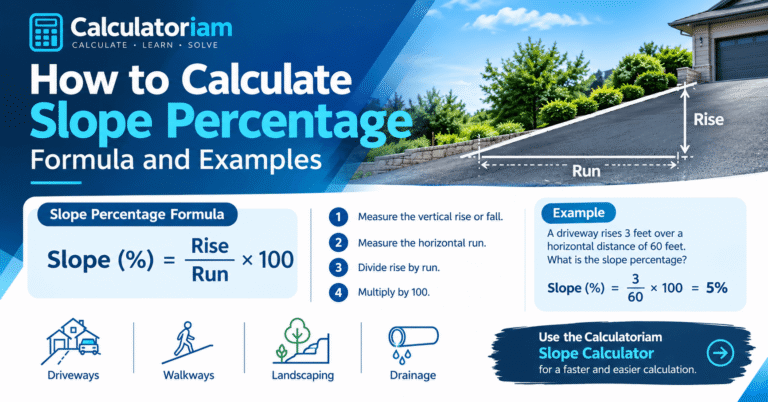
Slope percentage, also called percent grade, expresses the vertical rise or fall as a percentage of horizontal distance.
It is commonly used in road construction, land grading, drainage, ramps, and site planning.
The percentage is calculated by dividing the rise by the run and multiplying the result by 100.
Slope Percentage Formula
Slope (%) = (Rise / Run) × 100
For example, consider a surface that rises 6 feet over a horizontal distance of 12 feet.
Calculation:
Divide the rise by the run to find the decimal value, then multiply it by 100:
Slope (%) = (6 ÷ 12) × 100
Slope (%) = 50%
Therefore, the surface has a 50% grade.
A 50% grade means that the surface rises 50 units vertically for every 100 units of horizontal distance.
It does not mean the surface forms a 50-degree angle. Percentage grade and angular measurement use different mathematical scales.
Pitch vs. Slope Angle in Degrees
Slope angle measures the inclination of a surface relative to the horizontal direction. Unlike ratios and percentages, it is expressed in degrees.
A flat surface has an angle of 0 degrees, while a vertical surface has an angle of 90 degrees.
The angle is calculated using the inverse tangent function, also called arctangent.
Slope Angle Formula
Angle (degrees) = arctan(Rise / Run) × 180 / π
Where:
- Angle = Inclination measured in degrees.
- Rise = Vertical elevation change.
- Run = Horizontal distance.
- arctan = Inverse tangent function.
- π = Mathematical constant approximately equal to 3.14159.
For example, suppose a roof rises 6 inches over a horizontal run of 12 inches.
Calculation:
First, divide the rise by the run to get 0.5. Then, apply the inverse tangent function and convert the result from radians to degrees:
Angle = arctan(6 ÷ 12) × 180 ÷ π
Angle ≈ 26.57°
Therefore, a 6:12 roof pitch corresponds to an angle of approximately 26.57 degrees.
The angle describes the same inclination as the rise-to-run ratio, but it uses a different unit of measurement.
Worked Examples: Comparing Pitch and Slope
The following examples demonstrate how the same inclined surface can be expressed as roof pitch, slope ratio, percentage grade, and angle in degrees.
Example 1: Convert a 4:12 Roof Pitch Into Slope and Degrees
Suppose a roof rises 4 inches over every 12 inches of horizontal run. Calculate its slope ratio, percentage grade, and angle.
Given:
- Rise = 4 inches
- Run = 12 inches
Step 1: Determine the slope ratio.
Slope Ratio = Rise : Run
Slope Ratio = 4:12
Simplified Ratio = 1:3
Step 2: Calculate the slope percentage.
Calculation:
Divide the rise by the run, then multiply the result by 100:
Slope (%) = (4 ÷ 12) × 100 = 33.33%
The resulting slope is 33.33%.
Step 3: Calculate the slope angle.
Angle = arctan(4 / 12) × 180 / π
Angle ≈ 18.43°
Final Results:
- Roof pitch = 4:12
- Slope ratio = 1:3
- Slope percentage = 33.33%
- Slope angle = 18.43°
All four values describe the same roof inclination.
Example 2: Convert a 6:12 Roof Pitch Into Percentage and Degrees
Suppose a roof rises 6 inches over a horizontal run of 12 inches.
Given:
- Rise = 6 inches
- Run = 12 inches
Step 1: Identify the roof pitch.
Roof Pitch = 6:12
Step 2: Simplify the slope ratio.
6:12 = 1:2
Step 3: Calculate the percentage grade.
Slope (%) = (6 / 12) × 100
Slope (%) = 50%
Step 4: Calculate the angle.
Angle = arctan(6 / 12) × 180 / π
Angle ≈ 26.57°
Final Results:
- Roof pitch = 6:12
- Slope ratio = 1:2
- Slope percentage = 50%
- Slope angle = 26.57°
This example shows why a 6:12 roof pitch should not be interpreted as a 6-degree angle or a 6% slope.
Example 3: Convert an 8:12 Roof Pitch Into Traditional Pitch
Suppose a symmetrical roof has an 8-inch rise over a 12-inch horizontal run.
Find its traditional pitch fraction.
Given:
- Rise = 8 inches
- Horizontal run = 12 inches
- Full span = 24 inches
Step 1: Apply the traditional pitch formula.
Traditional Pitch = Rise / Span
Step 2: Substitute the measurements.
Traditional Pitch = 8 / 24
Step 3: Simplify the fraction.
Traditional Pitch = 1/3
Final Answer: The traditional pitch fraction is 1/3, while its modern roofing designation is 8:12.
This example illustrates why the definition of pitch matters when comparing different construction references.
Example 4: Compare Two Roofs With Different Pitches
Suppose two roofs have the following measurements:
- Roof A: 4 inches of rise over 12 inches of run.
- Roof B: 8 inches of rise over 12 inches of run.
Compare their steepness.
Roof A:
Slope (%) = (4 / 12) × 100
Slope (%) = 33.33%
Angle = arctan(4 / 12) × 180 / π
Angle ≈ 18.43°
Roof B:
Slope (%) = (8 / 12) × 100
Slope (%) = 66.67%
Angle = arctan(8 / 12) × 180 / π
Angle ≈ 33.69°
Comparison:
Roof A: With a 4:12 pitch, this roof has a 33.33% grade and an angle of approximately 18.43 degrees.
Roof B: An 8:12 pitch produces a 66.67% grade and an angle of approximately 33.69 degrees.
Since both roofs have the same horizontal run, the second roof is steeper because its vertical rise is twice as high.
Roof Pitch and Slope Conversion Table
The following table compares common roof rise-to-run measurements with their corresponding simplified slope ratios, percentage grades, and angles.
| Roof Pitch | Simplified Ratio | Slope Percentage | Angle |
| 1:12 | 1:12 | 8.33% | 4.76° |
| 2:12 | 1:6 | 16.67% | 9.46° |
| 3:12 | 1:4 | 25.00% | 14.04° |
| 4:12 | 1:3 | 33.33% | 18.43° |
| 5:12 | 5:12 | 41.67% | 22.62° |
| 6:12 | 1:2 | 50.00% | 26.57° |
| 7:12 | 7:12 | 58.33% | 30.26° |
| 8:12 | 2:3 | 66.67% | 33.69° |
| 9:12 | 3:4 | 75.00% | 36.87° |
| 10:12 | 5:6 | 83.33% | 39.81° |
| 11:12 | 11:12 | 91.67% | 42.51° |
| 12:12 | 1:1 | 100.00% | 45.00° |
The table assumes the common modern roofing convention of rise per 12 inches of horizontal run.
Notice that the slope percentage increases linearly with the rise-to-run ratio, while the angle increases according to the inverse tangent relationship.
A 12:12 roof pitch represents equal vertical rise and horizontal run, producing a 45-degree angle and a 100% grade.
How to Choose Between Pitch, Slope Ratio, Percentage, and Degrees
The appropriate measurement depends on the type of project and the information you need to communicate.
Roof Construction
Roof pitch is commonly expressed as rise per 12 inches of horizontal run. This notation helps builders, roofers, architects, and contractors communicate roof steepness.
For example, a 6:12 roof designation communicates that the roof rises 6 inches for every 12 inches of horizontal distance.
Road and Driveway Construction
Slope percentage is frequently used for roads, driveways, and site grading because it expresses elevation change as a percentage of horizontal distance.
For example, a 5% grade represents a 5-unit elevation change for every 100 units of horizontal distance.
Drainage and Land Grading
Slope ratios and percentages help describe the elevation difference across a surface.
For instance, a 1:50 ratio represents one unit of vertical change for every 50 units of horizontal distance, equivalent to a 2% grade.
Actual drainage requirements depend on the surface, materials, site conditions, and applicable specifications.
Geometry and Engineering
Slope angles in degrees are useful when the inclination itself is required.
Engineers and designers may use angular measurements to describe inclined components, geometric relationships, and other technical dimensions.
The best format is the one that matches the relevant design specification or measurement convention.
Common Mistakes When Comparing Pitch and Slope
Although pitch and slope are related, confusing their different formats can lead to incorrect measurements and interpretations.
Treating Pitch as an Angle
A 6:12 roof pitch does not mean the roof forms a 6-degree angle.
It means the roof rises 6 units for every 12 units of horizontal distance. The corresponding angle is approximately 26.57 degrees.
Confusing Percentage With Degrees
Percentage grade and angular degrees are different measurements.
For example, a 50% grade corresponds to approximately 26.57 degrees, not 50 degrees.
Use the inverse tangent function when converting a rise-to-run ratio into an angle.
Confusing Traditional Pitch With Modern Roofing Pitch
Older construction references may define pitch as rise divided by the entire roof span. Modern roofing practice commonly expresses roof inclination as rise per 12 inches of horizontal run.
A 6:12 roof designation and a traditional 1/4 pitch fraction can describe the same symmetrical roof geometry.
Always check which convention a drawing or document uses.
Using Diagonal Distance Instead of Horizontal Run
Slope calculations use horizontal run, not the diagonal distance measured along the inclined surface.
The diagonal distance is the hypotenuse of the right triangle. Substituting it for horizontal run produces an incorrect ratio.
Mixing Measurement Units
Rise and run must use consistent units when calculating a slope ratio.
For example, convert feet into inches if the rise is measured in inches and the run is measured in feet.
Once both measurements use the same unit, the ratio, percentage, and angle can be calculated correctly.
Frequently Asked Questions
Is pitch the same as slope?
Pitch and slope are related measurements, but their definitions can differ. In modern roofing terminology, pitch commonly describes rise per 12 inches of horizontal run. Slope describes the vertical rise relative to horizontal run and can be expressed as a ratio, percentage, or angle.
What is the difference between roof pitch and roof slope?
Roof pitch and roof slope are often used interchangeably in modern construction. Both can describe roof steepness using a rise-to-run measurement. However, traditional technical references sometimes define pitch as rise divided by the full roof span, which produces a different numerical expression.
Is a 6:12 pitch the same as a 50% slope?
Yes. A 6:12 roof pitch means 6 inches of rise over 12 inches of horizontal run.
Slope (%) = (6 / 12) × 100 = 50%
Therefore, a 6:12 pitch represents a 50% grade.
What angle is a 4:12 roof pitch?
A 4:12 roof pitch corresponds to an angle of approximately 18.43 degrees.
Angle = arctan(4 / 12) × 180 / π
What does a 1:12 slope mean?
A 1:12 slope means the surface rises or falls 1 unit vertically for every 12 units horizontally.
It corresponds to an 8.33% grade and an angle of approximately 4.76 degrees.
Is a 12:12 roof pitch equal to 45 degrees?
Yes. A 12:12 roof pitch means the vertical rise equals the horizontal run.
When rise and run are equal, their ratio is 1, and the inverse tangent of 1 is 45 degrees.
Can slope percentage be greater than 100%?
Yes. A slope percentage can exceed 100% when the vertical rise is greater than the horizontal run.
For example, a 150-unit rise over a 100-unit horizontal run produces a 150% grade. This is mathematically valid, although it represents a very steep incline.
Which is steeper: a 4:12 or an 8:12 roof pitch?
An 8:12 roof pitch is steeper because it rises 8 inches over the same 12-inch horizontal distance, while a 4:12 roof rises only 4 inches.
An 8:12 pitch corresponds to approximately 33.69 degrees, compared with approximately 18.43 degrees for a 4:12 pitch.
How do you convert pitch into slope percentage?
Divide the rise by the horizontal run and multiply the result by 100.
For a 5:12 pitch:
Slope (%) = (5 / 12) × 100
Slope (%) ≈ 41.67%
How do you convert slope ratio into degrees?
Divide the vertical rise by the horizontal run, then apply the inverse tangent function.
Angle (degrees) = arctan(Rise / Run) × 180 / π
For example, a 1:2 slope ratio corresponds to approximately 26.57 degrees.
Conclusion
Pitch and slope describe the steepness of an inclined surface, but they can use different measurement conventions. In modern roofing, pitch is commonly expressed as vertical rise per 12 inches of horizontal run, while slope can be represented as a ratio, percentage grade, or angle in degrees.
The key relationships are:
- Slope Ratio = Rise / Run
- Roof Pitch (X/12) = (Rise / Run) × 12
- Slope (%) = (Rise / Run) × 100
- Angle (degrees) = arctan(Rise / Run) × 180 / π
Understanding these relationships makes it easier to compare roof designs, interpret construction measurements, and avoid confusing ratios, percentages, and degrees.
For practical calculations, use the Calculatoriam Slope Calculator to calculate slope measurements, grade percentages, and angles from rise and horizontal run.