
Point-Slope Formula: How to Use Point-Slope Form With Examples
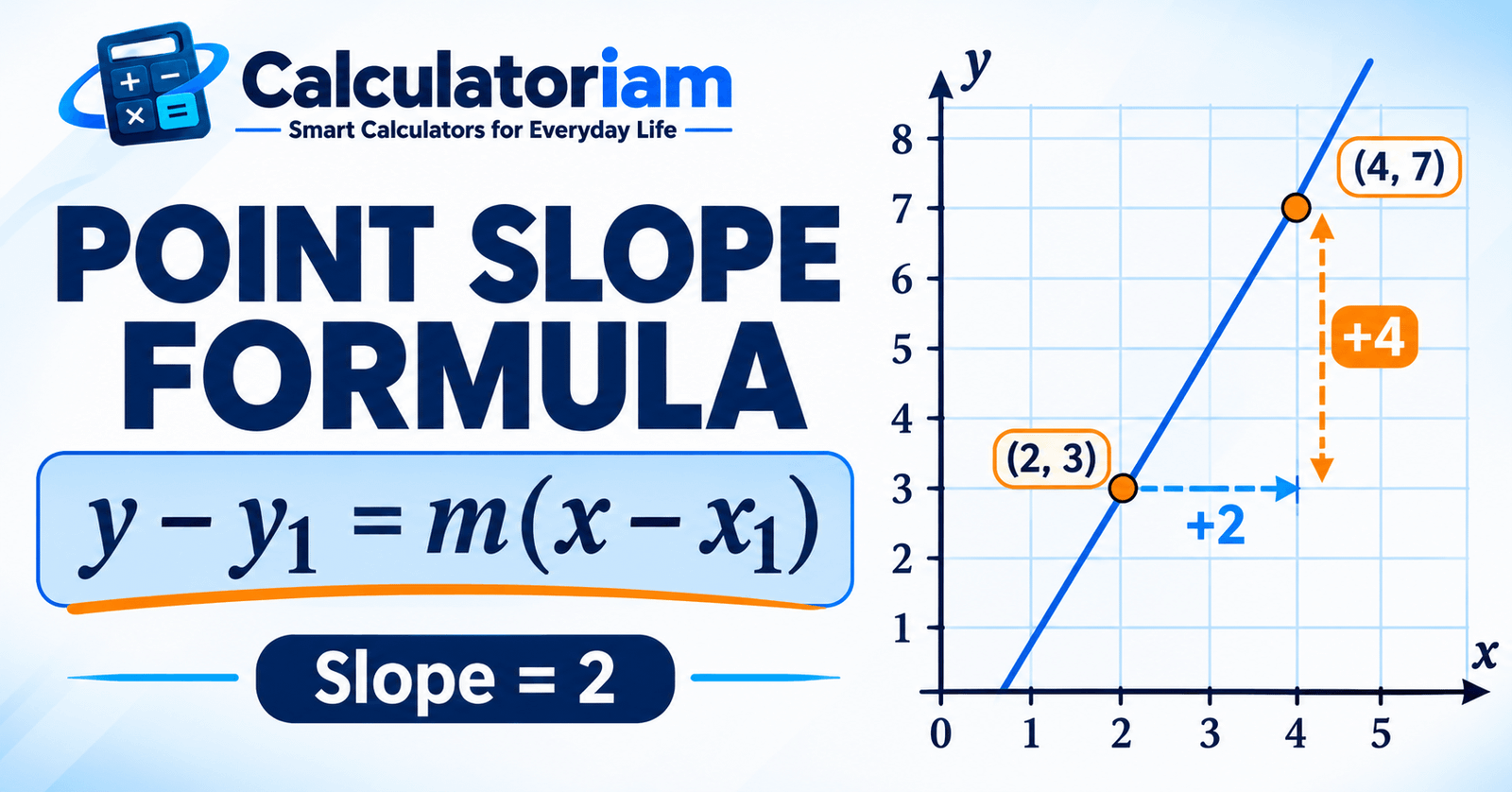
The point slope formula helps you write the equation of a straight line when you know its slope and one point on the line. Instead of finding the y-intercept first, you can substitute the known values directly into an equation.
The standard point slope formula is:
y-y_1=m(x-x_1)
Here, m represents the slope, while (x₁, y₁) represents a known point on the line. The variables x and y represent the coordinates of any point on that line.
For example, suppose a line has a slope of 3 and passes through the point (2, 5). Substitute these values into the formula:
y-5=3(x-2)
Answer: The equation is y − 5 = 3(x − 2).
This equation represents a straight line passing through (2, 5) with a slope of 3.
The method works with positive slopes, negative slopes, fractions, and horizontal lines. It is especially useful in algebra, coordinate geometry, and linear equation problems.
What Is the Point Slope Formula?
The point slope formula is an algebraic equation used to describe a nonvertical straight line from its slope and one known coordinate.
It is commonly called point-slope form because it combines two pieces of information: a point and the slope.
The formula is:
y-y_1=m(x-x_1)
Each variable has a specific meaning.
| Symbol | Meaning |
|---|---|
| m | Slope of the line |
| x₁ | x-coordinate of the known point |
| y₁ | y-coordinate of the known point |
| x | x-coordinate of another point on the line |
| y | y-coordinate of another point on the line |
The slope describes the line’s rate of change. A positive slope means the line rises from left to right, while a negative slope means it falls.
If the slope is zero, the line is horizontal. A vertical line has an undefined slope and cannot be expressed using standard point-slope form with a finite slope value.
Why Is the Point Slope Formula Useful?
The main advantage is that you do not need to know the y-intercept.
Many algebra problems provide a slope and a point rather than the coordinates where a line crosses the y-axis.
Point-slope form lets you write the equation immediately.
It is also helpful when you need to:
- Find the equation of a line through a given point.
- Write an equation from two coordinates.
- Convert a linear equation into slope-intercept form.
- Graph a line using a known point and its slope.
- Represent a constant rate of change using a reference value.
How to Use the Point Slope Formula Step by Step
Using the point slope formula is straightforward once you identify the slope and the known point.
Step 1: Identify the Slope
The slope is represented by m.
For example, if a question states that the line has a slope of 4, then m = 4.
If the question provides two points instead, you must calculate the slope first.
Step 2: Identify the Known Point
Suppose the line passes through (3, 7).
The coordinates are:
- x₁ = 3
- y₁ = 7
Always keep the x-coordinate and y-coordinate in the correct order.
Step 3: Substitute Into the Formula
Start with the standard equation:
y-y_1=m(x-x_1)
Substitute the slope of 4 and the point (3, 7).
y-7=4(x-3)
Final answer: y − 7 = 4(x − 3).
You can leave the equation in this form if the question asks for point-slope form.
If you need slope-intercept form, expand the parentheses and isolate y.
Point Slope Formula Examples With Answers
The following examples show how to apply the point slope formula to different types of linear equations.
Example 1: Positive Slope
Problem: Find the equation of a line with slope 2 passing through (4, 6).
First, identify the known values.
The slope is 2, and the point is (4, 6).
Use the formula:
y-y_1=m(x-x_1)
Substitute the values:
y-6=2(x-4)
Answer: y − 6 = 2(x − 4).
To check the equation, substitute x = 4 and y = 6.
6-6=2(4-4)
Both sides equal zero, so the given point satisfies the equation.
Example 2: Negative Slope
Problem: Write the equation of a line with slope −3 passing through (2, 8).
Identify the values:
- m = −3
- x₁ = 2
- y₁ = 8
Substitute them into point-slope form:
y-8=-3(x-2)
Answer: y − 8 = −3(x − 2).
The negative slope means that y decreases by 3 units for every 1-unit increase in x.
You can also convert the equation into slope-intercept form.
Distribute −3:
y-8=-3x+6
Add 8 to both sides:
y=-3x+14
Both equations describe the same straight line.
Example 3: Negative Coordinates
Problem: Find the equation of a line with slope 5 passing through (−2, −4).
Start with:
y-y_1=m(x-x_1)
Substitute the slope and coordinates:
y-(-4)=5(x-(-2))
Subtracting a negative value becomes addition.
Simplify:
y+4=5(x+2)
Answer: y + 4 = 5(x + 2).
This example highlights an important rule: carefully simplify double negatives when substituting negative coordinates.
Example 4: Fractional Slope
Problem: Write the equation of a line with slope 2/3 passing through (6, 1).
The known values are:
- m = 2/3
- x₁ = 6
- y₁ = 1
Substitute into the formula:
y-1=\frac{2}{3}(x-6)
Answer: y − 1 = (2/3)(x − 6).
A slope of 2/3 means the line rises 2 units for every 3 units of horizontal movement.
To convert the equation into slope-intercept form, distribute the fraction.
y-1=\frac{2}{3}x-4
Add 1:
y=\frac{2}{3}x-3
The line has a slope of 2/3 and a y-intercept of −3.
Example 5: Zero Slope
Problem: Find the equation of a horizontal line passing through (5, 9).
A horizontal line has a slope of zero.
Substitute the values:
y-9=0(x-5)
Since zero multiplied by any value is zero:
y-9=0
Therefore:
y=9
Answer: y = 9.
Every point on this horizontal line has a y-coordinate of 9.
How to Find the Point Slope Formula From Two Points
Some problems provide two points instead of a slope.
In that situation, calculate the slope using the coordinates, then substitute the result and either point into the point slope formula.
The slope formula is:
m=\frac{y_2-y_1}{x_2-x_1}
Here, (x₁, y₁) and (x₂, y₂) represent two different points.
Worked Example: Equation Through Two Points
Problem: Find the equation of the line passing through (2, 3) and (6, 11).
Step 1: Calculate the slope.
Substitute the coordinates:
m=\frac{11-3}{6-2}
Simplify:
m=\frac{8}{4}=2
The slope is 2.
Step 2: Choose a known point.
Use (2, 3).
Step 3: Apply the point slope formula.
y-3=2(x-2)
Final answer: y − 3 = 2(x − 2).
You could also use the second point, (6, 11).
y-11=2(x-6)
Although these equations look different, they represent the same line.
To verify, simplify the first equation:
y-3=2x-4
y=2x-1
Now simplify the second:
y-11=2x-12
y=2x-1
Both produce the same slope-intercept equation.
Key takeaway: You can use either known point when writing the equation of a line from two coordinates.
How to Convert Point Slope Form to Slope-Intercept Form
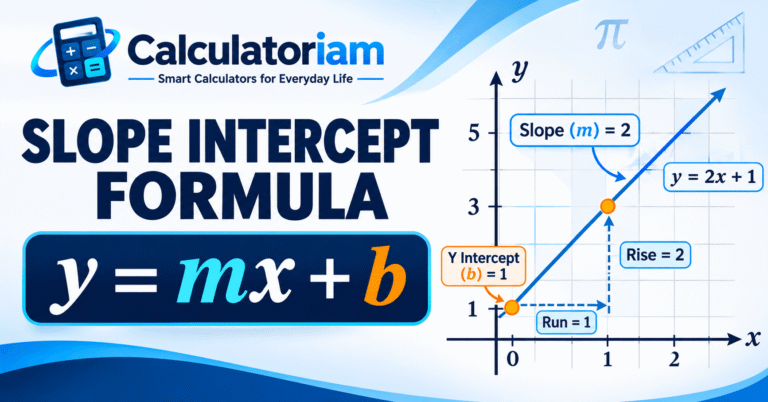
Point-slope form and slope-intercept form describe the same type of linear relationship.
The point slope formula is:
y-y_1=m(x-x_1)
The slope-intercept formula is:
y=mx+b
In slope-intercept form, m represents the slope and b represents the y-intercept.
Step-by-Step Conversion Example
Problem: Convert the following equation into slope-intercept form.
y-4=3(x-2)
Step 1: Distribute the slope.
Multiply 3 by each term inside the parentheses.
y-4=3x-6
Step 2: Isolate y.
Add 4 to both sides.
y=3x-2
Final answer: y = 3x − 2.
The slope is 3, and the y-intercept is −2.
Point Slope Form vs. Slope-Intercept Form
| Feature | Point-slope form | Slope-intercept form |
|---|---|---|
| Equation | y − y₁ = m(x − x₁) | y = mx + b |
| Required information | Slope and one point | Slope and y-intercept |
| Main advantage | Uses any known point | Shows the y-intercept directly |
| Common application | Writing equations | Graphing and interpreting lines |
| Slope symbol | m | m |
Neither form is inherently more accurate.
The best choice depends on the information provided and the required final answer.
How to Graph a Line Using the Point Slope Formula
Point-slope form makes graphing easier because it gives you a known point and the slope.
Consider the equation:
y-2=\frac{3}{2}(x-1)
This tells you that the line passes through (1, 2) and has a slope of 3/2.
Step 1: Plot the Known Point
Locate (1, 2) on the coordinate plane.
Move 1 unit to the right of the origin and 2 units upward.
Mark the point.
Step 2: Use the Slope
The slope is 3/2.
Starting at (1, 2), move 2 units to the right and 3 units upward.
You reach the point (3, 5).
Step 3: Draw the Line
Draw a straight line passing through (1, 2) and (3, 5).
Extend the line in both directions.
Step 4: Verify the Second Point
Substitute x = 3 and y = 5 into the equation.
5-2=\frac{3}{2}(3-1)
Simplify:
3=\frac{3}{2}\times2
3=3
The equality is true, confirming that (3, 5) lies on the line.
How Is the Point Slope Formula Derived?
The point slope formula comes directly from the definition of slope.
For two points on a nonvertical straight line, slope is the ratio of vertical change to horizontal change.
The slope equation can be written as:
m=\frac{y-y_1}{x-x_1}
Here, (x₁, y₁) is the known point, while (x, y) represents another point on the line.
Multiply both sides by the horizontal difference:
m(x-x_1)=y-y_1
Rearrange the terms:
y-y_1=m(x-x_1)
This produces the standard point slope formula.
The derivation begins with two points having different x-coordinates, so the denominator is not zero.
The resulting equation also includes the known point itself.
The formula works because a straight line has a constant slope between any two distinct points.
What Happens When the Line Is Vertical?
A vertical line has an undefined slope.
For example, suppose a vertical line passes through (4, 7).
Every point on the line has the same x-coordinate.
Its equation is:
x=4
You cannot use the standard point slope formula with a finite value of m because the horizontal change is zero.
Remember the distinction:
- Zero slope: Horizontal line.
- Undefined slope: Vertical line.
A horizontal line can be written using point-slope form with m = 0.
A vertical line requires an equation of the form x = a constant.
Real-World Applications of the Point Slope Formula
The point slope formula is useful whenever a linear relationship has a known rate of change and a reference point.
Algebra and Coordinate Geometry
Students use the formula to find equations of straight lines, solve coordinate problems, and interpret graphs.
It is particularly useful when the y-intercept is not given.
Linear Growth Models
Suppose a quantity increases by 4 units for every additional unit of input.
If the quantity equals 18 when the input is 5, the relationship can be written as:
y-18=4(x-5)
This equation represents a linear model with a constant rate of change.
Such a model is appropriate only when the underlying relationship can reasonably be treated as linear.
Physics and Data Analysis
In a linear model, the slope represents how quickly one variable changes relative to another.
Point-slope form can express the relationship using a reference observation and a known or estimated rate of change.
However, real-world measurements do not always follow an exact straight line.
Engineering and Technical Calculations
Linear equations are useful for describing idealized relationships between measurements.
For example, a straight-line model may connect two known coordinate positions.
The point slope formula helps represent that line mathematically.
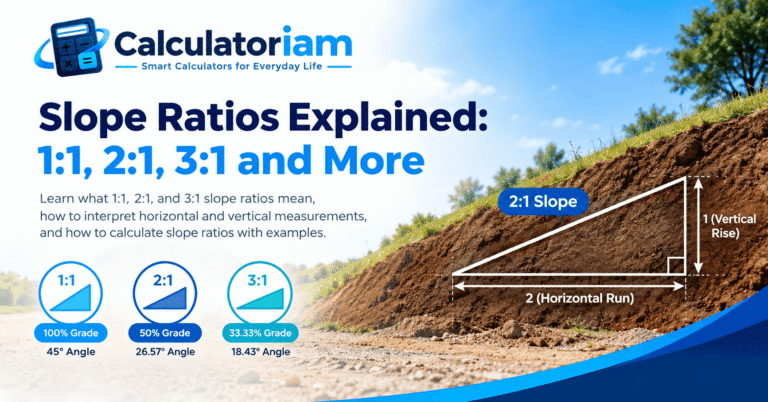
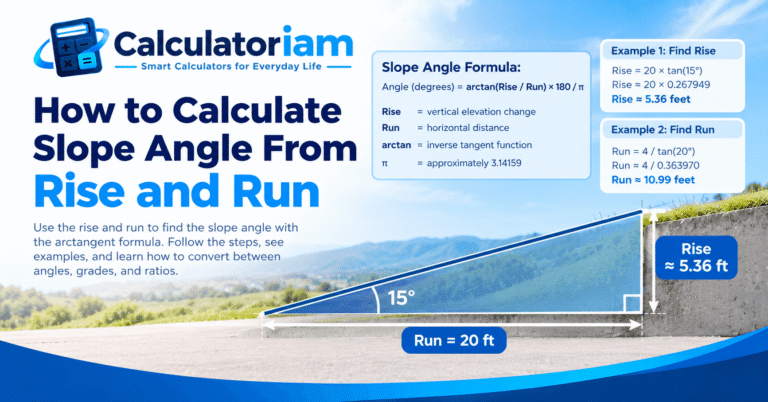
For physical slope measurements involving elevation, horizontal run, and percentage grade, you can use the Calculatoriam Slope Calculator.
That calculator addresses geometric slope measurements rather than solving algebraic point-slope equations.
Common Mistakes When Using the Point Slope Formula
1. Mixing Up the Coordinates
If the known point is (3, 8), then x₁ = 3 and y₁ = 8.
Reversing these values produces an equation for a different point.
Always identify the coordinates before substitution.
2. Forgetting the Negative Signs
Suppose the known point is (−2, −5).
The substitution becomes:
y-(-5)=m(x-(-2))
Simplify:
y+5=m(x+2)
A common mistake is keeping the minus signs unchanged after subtracting negative coordinates.
3. Calculating the Wrong Slope
When finding the slope from two points, use a consistent subtraction order.
If you subtract the first y-coordinate from the second, do the same with the x-coordinates.
Reversing only one subtraction changes the sign of the slope.
4. Confusing Point-Slope Form With Slope-Intercept Form
Point-slope form uses a known point and slope.
Slope-intercept form uses the slope and y-intercept.
Both can represent the same nonvertical line, but their equations have different structures.
5. Expanding the Equation Unnecessarily
If a question asks for point-slope form, you can leave the equation in its original structure.
For example:
y-3=2(x-4)
This is already a complete point-slope equation.
Expanding is optional unless the question requests another form.
6. Using Point-Slope Form for a Vertical Line
A vertical line does not have a defined numerical slope.
Instead of forcing it into point-slope form, write its equation as x = a constant.
Practice Problems With Answers
Use the following questions to check your understanding.
Practice Problem 1
Question: Find the equation of a line with slope 5 passing through (2, 9).
Substitute the values:
y-9=5(x-2)
Answer: y − 9 = 5(x − 2).
Practice Problem 2
Question: Write the equation of a line with slope −2 passing through (−3, 4).
Substitute the values:
y-4=-2(x+3)
Answer: y − 4 = −2(x + 3).
Practice Problem 3
Question: Find the equation of the line through (1, 3) and (5, 11).
First, calculate the slope:
m=\frac{11-3}{5-1}
Simplify:
m=\frac{8}{4}=2
Use the point (1, 3):
y-3=2(x-1)
Answer: y − 3 = 2(x − 1).
Practice Problem 4
Question: Convert the following equation into slope-intercept form.
y-6=4(x-2)
Distribute 4:
y-6=4x-8
Add 6:
y=4x-2
Answer: y = 4x − 2.
Frequently Asked Questions
What is the point slope formula?
The point slope formula is y − y₁ = m(x − x₁). It is used to write the equation of a nonvertical straight line when you know its slope and one point.
How do you use the point slope formula with two points?
First, calculate the slope by dividing the change in y by the change in x. Then substitute the slope and either known point into the point slope formula. If both points have the same x-coordinate, the line is vertical and must be written as x = a constant.
What is the difference between point slope and slope-intercept form?
Point-slope form uses a known point and slope. Slope-intercept form uses the slope and y-intercept. Both describe the same nonvertical straight-line relationship.
Can you use the point slope formula with negative numbers?
Yes. The formula works with negative slopes and coordinates. Carefully simplify expressions involving subtraction of negative values.
Does the point slope formula work for vertical lines?
No. Vertical lines have undefined slopes. Their equations are written as x = a constant rather than using standard point-slope form.
Conclusion
The point slope formula provides a direct way to write the equation of a straight line when you know its slope and one point.
The formula is:
y-y_1=m(x-x_1)
To use it, identify the slope, select the known point, and substitute the values into the equation.
When two points are given, calculate the slope first. If the question asks for slope-intercept form, distribute the slope and isolate y.
With practice, the point slope formula becomes a reliable method for solving linear equations, graphing straight lines, and understanding constant rates of change.


One Comment