
What Is the Slope of x = 5? Horizontal vs. Vertical Lines
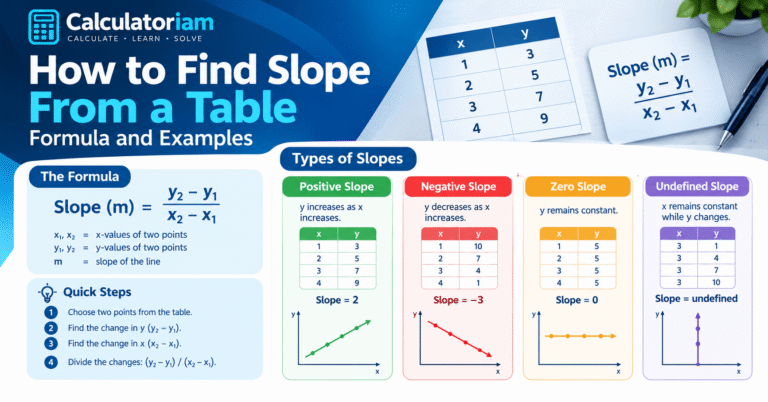
The slope of x = 5 is undefined because x = 5 represents a vertical line. Every point on this line has an x-coordinate of 5, so the horizontal change between any two distinct points is zero. Calculating slope would require division by zero, which is undefined.
In contrast, the equation y = 5 represents a horizontal line with a slope of zero.
This distinction is one of the most important concepts when identifying slope from a line equation, graph, or coordinate pair.
| Equation | Line Type | Slope |
|---|---|---|
| x = 5 | Vertical | Undefined |
| y = 5 | Horizontal | 0 |
| x = -3 | Vertical | Undefined |
| y = -3 | Horizontal | 0 |
| x = 0 (y-axis) | Vertical | Undefined |
| y = 0 (x-axis) | Horizontal | 0 |
The key rule is simple: A vertical line has undefined slope, while a horizontal line has zero slope.
Why Is the Slope of x = 5 Undefined?
The equation x = 5 describes every point whose x-coordinate is 5, regardless of its y-coordinate.
For example, the points (5, -6), (5, 0), and (5, 4) all lie on the line x = 5.
When plotted on a coordinate plane, these points form a straight vertical line passing through the x-axis at 5.
To understand why its slope is undefined, consider the standard two-point slope formula:
m=\frac{y_2-y_1}{x_2-x_1}
Where:
- m represents the slope.
- x1 and y1 are the coordinates of the first point.
- x2 and y2 are the coordinates of the second point.
- The numerator measures vertical change.
- The denominator measures horizontal change.
Step-by-Step Example: Find the Slope of x = 5
Choose two distinct points on the vertical line:
Point A: (5, -6)
Point B: (5, 4)
Substitute these coordinates into the slope formula:
m=\frac{4-(-6)}{5-5}
Simplify the numerator and denominator:
m=\frac{10}{0}
The denominator equals zero because the x-coordinate does not change.
Division by zero is undefined, so the calculation cannot produce a numerical slope.
Final answer: The slope of x = 5 is undefined.
This result applies to every vertical line, regardless of where the line crosses the x-axis.
What Is the Slope of a Horizontal Line?
A horizontal line has a slope of zero because its y-coordinate remains constant as its x-coordinate changes.
For example, the equation y = 5 represents a line that passes through every point with a y-coordinate of 5.
Two points on this line are (-3, 5) and (4, 5).
Apply the slope formula:
m=\frac{5-5}{4-(-3)}
Simplify the expression:
m=\frac{0}{7}=0
Final answer: The slope of y = 5 is 0.
The numerator equals zero because there is no vertical change. Unlike a vertical line, the horizontal distance between the two selected points is not zero.
This makes the slope calculation valid.
General Equation of a Horizontal Line
A horizontal line follows the equation:
y=b
Here, b represents any constant number.
Examples include y = 2, y = -7, and y = 0. Each equation describes a horizontal line with zero slope.
Changing the value of b moves the line up or down on the coordinate plane without changing its slope.
How to Identify Horizontal and Vertical Lines From Equations
You do not always need to calculate slope using two coordinates. When an equation contains only x or only y, you can often identify the line type immediately.
Vertical Line: x = a
A vertical line has the general equation:
x=a
The constant a determines the line’s horizontal position.
For example:
- x = 5 is a vertical line passing through (5, 0).
- x = -2 is a vertical line passing through (-2, 0).
- x = 0 is the y-axis.
Every vertical line has undefined slope.
Horizontal Line: y = b
A horizontal line has the general equation:
y=b
The constant b determines the line’s vertical position.
For example:
- y = 5 is a horizontal line passing through (0, 5).
- y = -2 is a horizontal line passing through (0, -2).
- y = 0 is the x-axis.
Every horizontal line has zero slope.
Quick Comparison
| Property | Horizontal Line | Vertical Line |
|---|---|---|
| General equation | y = b | x = a |
| Constant coordinate | y | x |
| Changes along the line | x | y |
| Vertical change between points | 0 | Can be nonzero |
| Horizontal change between distinct points | Nonzero | 0 |
| Slope | 0 | Undefined |
| Parallel to | x-axis | y-axis |
This comparison also provides a useful shortcut: look for the variable that remains constant.
If x stays constant, the line is vertical. When y stays constant, the line is horizontal.
How to Graph x = 5 and y = 5
Graphing both equations on the same coordinate plane helps show why their slopes are different.
Graphing x = 5
Follow these steps:
- Draw a coordinate plane with a horizontal x-axis and a vertical y-axis.
- Locate 5 on the x-axis.
- Plot the points (5, -2), (5, 0), and (5, 3).
- Connect the points using a straight vertical line.
- Extend the line upward and downward.
Every point on the resulting line has an x-coordinate of 5.
The line does not move horizontally as its y-coordinate changes, so its slope is undefined.
Graphing y = 5
To graph the horizontal equation:
- Locate 5 on the y-axis.
- Plot the points (-2, 5), (0, 5), and (3, 5).
- Connect the points using a straight horizontal line.
- Extend the line left and right.
All the plotted points have the same y-coordinate.
The resulting line has a slope of zero because its vertical position never changes.
Remember: In x = 5, the line crosses the x-axis at 5. In y = 5, it crosses the y-axis at 5. These intercepts are different from the slopes of the lines.
Zero Slope vs. Undefined Slope: What Is the Difference?
Although zero slope and undefined slope are frequently confused, they describe two different mathematical situations.
A zero slope is a valid numerical result. An undefined slope means the rise-over-run calculation does not produce a real number.
Zero Slope Means No Vertical Change
Consider a line passing through (-2, 3) and (6, 3).
Its slope is:
m=\frac{3-3}{6-(-2)}=\frac{0}{8}=0
The line moves horizontally without changing its y-coordinate.
The slope is exactly zero.
Undefined Slope Means No Horizontal Change
Now consider a line passing through (-2, 3) and (-2, 9).
Substitute the coordinates:
m=\frac{9-3}{-2-(-2)}=\frac{6}{0}
The x-coordinate remains constant, so the denominator is zero.
The slope is undefined, not zero.
Is an Undefined Slope the Same as an Infinite Slope?
No. Although a vertical line may sometimes be informally described as having an infinitely steep slope, its slope is not a numerical value of infinity.
The ordinary slope formula requires division by horizontal change. For a vertical line, that change is zero, so the ratio is undefined.
When answering algebra questions, write undefined rather than infinity.
For a more detailed explanation of numerical slope calculations, see Calculatoriam’s slope formula guide.
How to Recognize Zero and Undefined Slopes in Different Equation Forms
Some line equations do not initially appear as x = a or y = b. Simplifying them can reveal whether the line is horizontal or vertical.
Consider these examples:
| Original Equation | Simplified Equation | Slope |
|---|---|---|
| 2x = 10 | x = 5 | Undefined |
| -3x = 12 | x = -4 | Undefined |
| 4y = 20 | y = 5 | 0 |
| -2y = 14 | y = -7 | 0 |
| x + 0y = 8 | x = 8 | Undefined |
| 0x + y = 6 | y = 6 | 0 |
To classify a line, simplify the equation and determine which coordinate is constant.
For instance, dividing both sides of 2x = 10 by 2 gives x = 5. This is a vertical line, so its slope is undefined.
Similarly, dividing 4y = 20 by 4 gives y = 5, which represents a horizontal line with zero slope.
Why Can’t a Vertical Line Use y = mx + b?
The familiar slope-intercept equation is:
y=mx+b
In this form, m represents the slope and b represents the y-intercept.
A horizontal line such as y = 5 can be written as:
y=0x+5
Therefore, its slope is zero.
However, the vertical line x = 5 cannot be written in this form using a finite numerical value of m. A vertical line allows multiple y-values for the same x-value, so it is not a function of x.
This is why the vertical line retains its equation x = 5.
To learn more about equations with defined numerical slopes, read the slope-intercept formula guide.
Common Mistakes When Finding the Slope of x = 5
Understanding a few common errors can help you identify zero and undefined slopes correctly.
Mistake 1: Saying x = 5 Has a Slope of 5
The number 5 indicates where the vertical line crosses the x-axis. It is not the slope.
Correct answer: Undefined.
Mistake 2: Saying a Vertical Line Has Zero Slope
A vertical line has zero horizontal change, not zero vertical change.
Since the denominator in the slope formula is zero, the slope is undefined.
Mistake 3: Confusing x = 5 With y = 5
These equations represent different lines.
- x = 5: Vertical line, undefined slope.
- y = 5: Horizontal line, zero slope.
Pay attention to which variable is constant.
Mistake 4: Treating Two Identical Points as a Defined Line
Suppose you are given the same point twice: (5, 2) and (5, 2).
The slope formula produces:
m=\frac{2-2}{5-5}=\frac{0}{0}
This expression is undefined. More importantly, one distinct point alone is insufficient to identify a unique straight line.
Do not conclude that the line must be vertical simply because the repeated point has the same x-coordinate. Two distinct points are needed to establish the line using this method.
Practice Questions: Find the Slope
Try identifying each slope before checking the answers.
| Question | Equation or Points | Your Task |
|---|---|---|
| 1 | x = -8 | Find the slope |
| 2 | y = 0 | Find the slope |
| 3 | (4, -3) and (4, 9) | Find the slope |
| 4 | (2, 7) and (6, 7) | Find the slope |
| 5 | 3x = 21 | Find the slope |
Answers and Explanations
1. Undefined. The equation x = -8 represents a vertical line.
2. Zero. The equation y = 0 represents the x-axis, which is horizontal.
3. Undefined. Both points have an x-coordinate of 4, so the horizontal change is zero.
4. Zero. Both points have a y-coordinate of 7, so there is no vertical change.
5. Undefined. Dividing both sides by 3 gives x = 7, a vertical line.
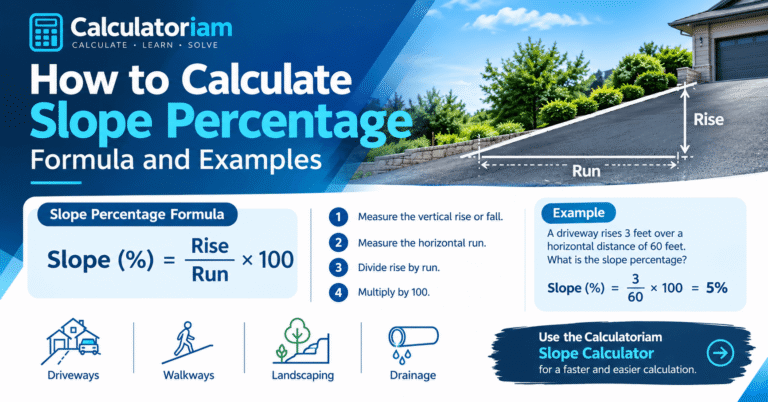
For lines with a nonzero horizontal change, use the Calculatoriam Slope Calculator to calculate rise-over-run slope, percentage grade, and angle from measurements. A vertical line does not have a finite numerical grade.
Frequently Asked Questions
What is the slope of the line x = 5?
The slope of x = 5 is undefined. It is a vertical line, meaning all its points have the same x-coordinate. The horizontal change is zero, making division by zero necessary in the slope formula.
Is the slope of x = 5 zero or undefined?
It is undefined. Zero slope belongs to horizontal lines such as y = 5. Vertical lines such as x = 5 have undefined slopes.
What is the slope of y = 5?
The slope of y = 5 is zero because the line is horizontal. Its y-coordinate remains constant while its x-coordinate changes.
Does x = 0 have an undefined slope?
Yes. The equation x = 0 describes the y-axis, which is vertical. Like every other vertical line, its slope is undefined.
Can a vertical line have a negative slope?
No. A vertical line does not have a positive, negative, or zero numerical slope. Its slope is undefined because horizontal change is zero.
How do you know whether a slope is zero or undefined from two points?
Check the coordinates of two distinct points. If their y-coordinates are equal, the line is horizontal and its slope is zero. If their x-coordinates are equal, the line is vertical and its slope is undefined.
Final Answer
The slope of x = 5 is undefined because the equation represents a vertical line with zero horizontal change. Dividing vertical change by zero does not produce a defined numerical slope.
A horizontal line such as y = 5 has a slope of zero because its vertical change is zero.
Whenever you need to identify slope from an equation, remember the distinction: x = constant means a vertical line with undefined slope, while y = constant means a horizontal line with zero slope.
For further practice with other types of straight lines, explore the Calculatoriam Slope Calculator and learn how slope changes with rise and horizontal run.